Aurangzeb and the impact of his religious piety (OCR GCSE History B (Schools History Project)): Revision Notes
📚Revision Notes
Aurangzeb and the impact of his religious piety
Note
The third son of Shah Jahan, Aurangzeb was the sixth and last of the great Mughal Emperors. Historians suggest that after him, successors were weak until they lost power altogether. Aurangzeb gained the throne after the war of succession against his three brothers.
Note
Unlike his great grandfather Akbar, Aurangzeb imposed religious intolerance throughout the Mughal Empire. In 1658, a year after he ascended the throne, Aurangzeb appointed muhtasib from the ranks of the clergy or ulema to enforce the imposition of sharia in every large city. Moreover, he prohibited practices against the Muslim faith, including gambling and drinking alcohol.
Cultural and Religious Policies During Aurangzeb's Reign
Unlike his predecessors who built extravagant mosques and mausoleums, Aurangzeb's reign was characterised by austerity. He dismissed court musicians that were previously loved during the reign of Shah Jahan. Only the royal band or naubat continued to play music. Ironically, many Persian works on classical Indian music were written during Aurangzeb's reign.
Note
Muhtasib or censors of public morals were appointed by Aurangzeb to ensure the imposition of Islamic law, or sharia.
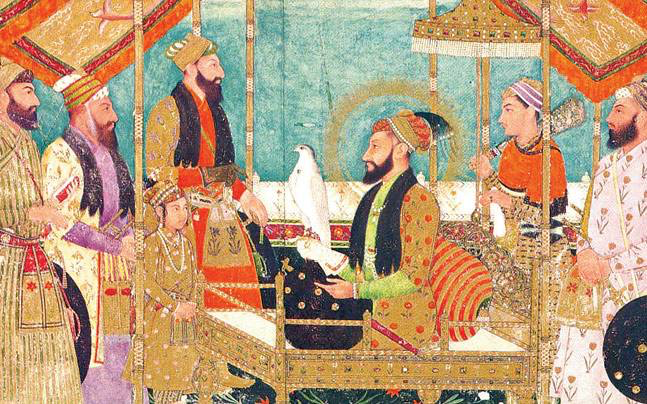
Image of Aurangzeb at his court
Note
Aurangzeb ordered the compilation of Islamic laws in a book so people could practice the religion correctly. Such laws were organised by hundreds of Muslim scholars from all over the world. They came up with the Fatawa-e-Almgiri, which means 'The Religious Decrees of Alamgir'.
All taxes not aligned to Islamic laws were abolished. In order to compensate for the loss in tax revenue, Aurangzeb adopted a simple lifestyle, which was very different to his predecessors. Lavish festivities and royal traditions, including birthdays and weighing of his children, were either abolished or made simpler.
Like the Hindus, Sikh temples that were also used as political offices were destroyed.
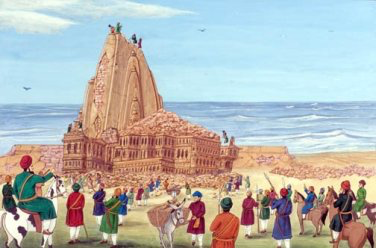
Image showing the demolition of the Somnath Temple
"Even to look at a temple is a sin for a Musalman"- as stated by Aurangzeb
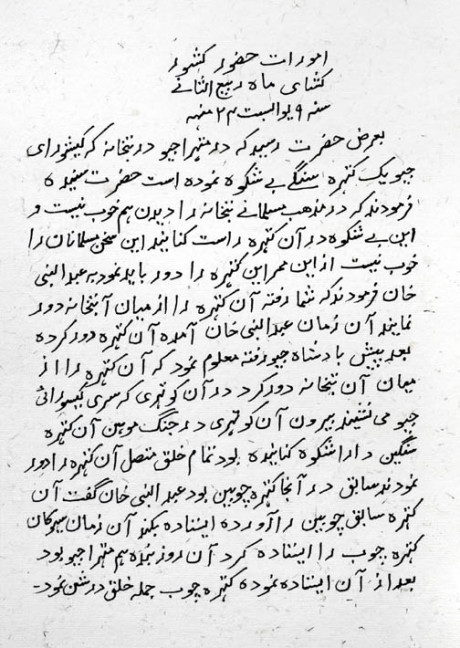
Stone railing in the Temple of Keshava Rai
Note
Aurangzeb was a Sunni Musalman who wanted to convert the country of kafirs or infidels (India) to a country of Islam. In addition to the Hindus, he also imposed intolerance on Shia Muslims. His policies revolved around the promotion of the tenets of the Muslim faith and the adoption of anti-Hindu measures.
Aurangzeb's anti-Hindu policies:
- In the first year of his reign, he ordered the demolition of Hindu temples in every province and replaced them with mosques.
- In his 12th year, all famous non-Muslim temples were demolished. In Mewar, about 240 temples were destroyed and replaced with mosques.
- In contrast to Akbar, who abolished tax on Hindus, Aurangzeb imposed them two-fold. This policy financed Aurangzeb's military campaigns and forced a number of Hindus to convert to Islam. In response, thousands of Hindus protested and Aurangzeb directed his officers to release the elephants against the people.
- Initially, Hindu traders were levied with a 5% toll tax, while Muslim traders paid half. Later on, Muslim traders were exempted from such tax.
- Unlike Akbar, who appointed Hindus as government officials, Aurangzeb removed them from these jobs. In 1670, the revenue department banned employment of Hindus in government office.
Note
Jizya was the tax levied to Hindus.
- Hindu educational institutions at Varanasi, Multan and Thatta were destroyed. Moreover, Hindu children were prohibited from studying the basics of Hinduism.
- In addition to the imposition of several types of taxes, Hindus who converted to Islam were given jobs. Hindu prisoners who changed their faith were promised freedom.
- Despite allowing the celebrations of Holi and Diwali festivals, Hindus were restricted from wearing fine clothes. No Hindu, except Rajputs, were allowed to ride an elephant or a horse. Cremation of their dead on the banks of the rivers Sabarmati and Yamuna was also banned.
Note
The impact of Aurangzeb's policies:
- Conflict with the Jats, Satnamos, Sikhs, Marathas, and the Rajputs emerged. Such rebellions interrupted the peace of the empire.
- The empire's administrative, economic, and military structure weakened.
- Aurangzeb's fanaticism clouded his virtues.
- Extravagant royal ceremonies were lessened, thus diminishing imperial spending.
Note
"the lawfulness of a solid construction over a grave is doubtful, and there can be no doubt about the extravagance involved."
- Aurangzeb on the construction of Taj Mahal by his father Shah Jahan
Another motive into Aurangzeb's rigid religious intolerance was due to political plots against him. Some historians suggest that Aurangzeb's religious policies were more political than that of intolerance of faith.
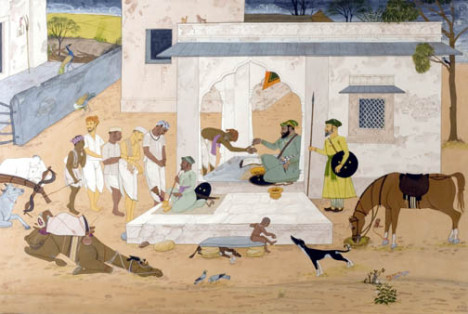
Painting showing the Hindus paying the Jizya tax
<img src="https://simplestudy-assets-prod.s3.eu-west-1.amazonaws.com/assets/backend/uploads/manually-styled-note-images/646daf09-1fad-4e9c-9683-100c9b6128f1.png" width="460" height="306" alt="Illustration showing the restrictions on Hindus to travel in palkis or ride on elephants and horses*
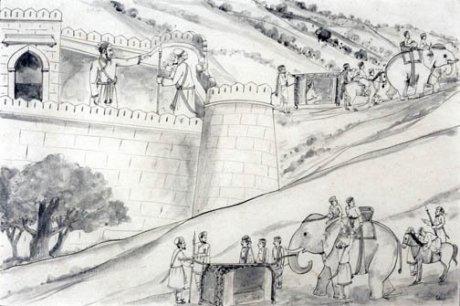
Illustration showing the restrictions on Hindus to travel in palkis or ride on elephants and horses