Jahangir, the influence of his wife Nur Jahan, and the impact of their rule (OCR GCSE History B (Schools History Project)): Revision Notes
📚Revision Notes
Jahangir, the influence of his wife Nur Jahan, and the impact of their rule
Note
In 1605, Prince Salim, who adopted the title Jahangir which means 'conqueror of the world', succeeded his father, Akbar. In his youth, Salim tried to revolt against his father. At the time of Akbar's death, Salim forcefully claimed the throne. His own son, Khusrau Mirza, revolted against him too, and claimed that he was the rightful heir to the throne as per his grandfather's wishes.
At the Battle of Bhairowal, Jahangir defeated his son's forces. Mirza was executed in 1622 by his brother Prince Khurram, who was said to be their father's favourite.
Jahangir had 20 wives, but among these, he had a favourite consort, Nur Jahan, his last and 20th wife.
In 1611, widowed Mehr-un-Nissa, commonly known as Nur Jahan married Jahangir.
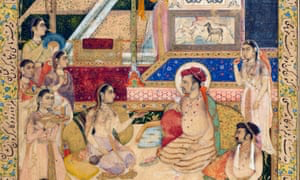
Image depicting Jahangir and Nur Jahan
The title 'Nur Mahal' means Light of the World, a title granted to Mehr-un-Nissa five years after her marriage to Jahangir.
Historians suggest that Jahangir fell deeply in love with Nur Jahan. Aside from being the favourite wife, Nur Jahan gained wide influence over the administration of the court and the Mughal Empire as a whole. In times of Jahangir's absence, Nur Jahan took over military and political affairs.
Note
In 1620, the Mughals broke the treaty when they besieged the Ahmednagar fort.
Among Jahangir's goals was the conquest of Mewar, that his father failed to subdue. In 1615, a peace treaty was signed between Rana and Jahangir after a successful military attack on Mewar.
In contrast to his success in gaining control of Mewar, Jahangir failed to gain immediate full control of Ahmednagar, a region in south India.
Despite its resistance, Ahmednagar accepted a treaty with the Mughal Empire. As a result, a number of forts and the area of Balaghat were given to the Mughals.
Note
At the age of thirty-four, Mihr-un-nissa married Jahangir, and gained the title Nur Jahan. Nur Jahan was described as a beautiful, educated, and cultured woman. She loved music, poetry, and painting.
As a result of Nur Jahan's influence over Jahangir, the following events happened:
- the empress' father attained a high position in the Mughal government.
- Nur Jahan's brother, Abu Hasan Hasaf Khan gained power in the emperor's entourage.
- Their daughter, Mumtaz Mahal, married Jahangir's son and successor, Shah Jahan. Zanana housed Jahangir's wives, concubines, servants, slaves, entertainers, relatives, and craftspeople.
Nur Jahan
Born from a noble family, Nur Jahan was a daughter of Mirza Ghiyas Beg, who served as the governor of Yazd. While travelling to India, Mirza with the help of Mali Masud was presented before Akbar who took him under service. He later served as a Diwan at the emperor's household.
In 1594, Mihr-un-nisa married Ali Quli Beg who was later given the title Sher Afghan by Prince Salim.
After the death of his husband, Mihr-un-nisa became prisoner of Agra. Later she was appointed in the service of Salima Begum, Akbar's widow.
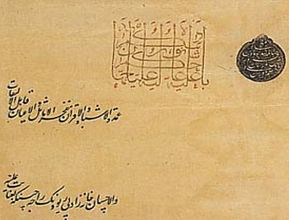
Nur Jahan's farman
A farman is an adjoining legal document of order.
In addition to remarkable promotion of her relatives, Nur Jahan's influence was seen in the following:
-
Appearance with the emperor in Jharokha Darshan
-
Her name was engraved in a number of coins
-
She became a co-signatory of the emperor
-
Orphan girls were given land and dowries
-
She directly ruled Jahangir's zanana
Note
Due to ill health and age, Jahangir gave Nur Jahan more liberty and authority on the administration of the empire. In contrast to the status of women at that time, Nur Jahan ruled over trusted males of the court.