The Mughal economy and European traders (OCR GCSE History B (Schools History Project)): Revision Notes
📚Revision Notes
The Mughal economy and European traders
Note
By the early 17th century, the Mughal Empire that covered northern and central India likely held the centre of power of the world's civilizations. A hundred years prior to the establishment of the English East India Company, the Portuguese had direct trade with India.
Note
In 1611, Sir Thomas Roe, under the order of King James I, first visited Jahangir to establish a company to oversee trading between Indian and England.
Note
By 1615, a company was finally set up in India that was bound to send Indian textiles from Surat to Bantam.
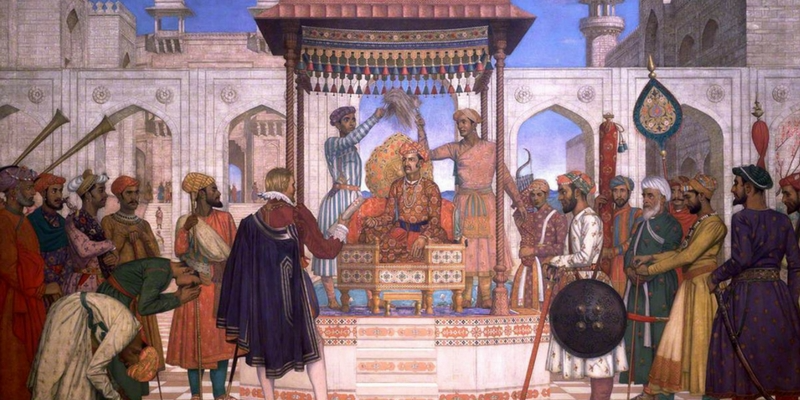
Image depicting the visit of English emissary Sir Thomas Roe to the court of Mughal emperor Jahangir
With initial trading conflicts against other European countries, including, Portudal, France, the Netherlands, and Spain, England failed to establish a trade monopoly in India. After gaining Mughal patronage, the English finally ousted Portuguese traders.
Agriculture
Note
Prior to foreign trade, the Mughal Empire was highly-dependent on agriculture. Among their major crops included millets, oil seeds, cereals, sugar cane, indigo and cotton. It was Babur who initiated the first cultivation of Asian fruits in India. At the time of Akbar, textile industries gained a market.


During Jahangir's reign, cultivation of tobacco and potato were introduced by the Portuguese. In his 8th year as emperor, Jahangir issued a silver Nazaran Rupee minted in Agra.
Lahore, Delhi, Agra and Ahmedabad became leading cities of trade in the world.
In return, the Mughal Empire imported gold, silver, horses, metals, precious stones, and African slaves.
It was Queen Elizabeth I who granted hundreds of English merchants the right to trade in the East Indies, in 1600.
Note
The East India Company, incorporated by royal charter in 1600, was originally forced to share the East Indian spice trade. Following their defeat of the Portuguese, the EIC gained a trading partnership with the Mughal Empire under Jahangir in 1612. By the 1620s, slave labour became the backbone of the EIC. Enslaved people were traded from Southeast Asia and West Africa.