Shah Jahan, the luxury of his court and the nature of his rule (OCR GCSE History B (Schools History Project)): Revision Notes
📚Revision Notes
Shah Jahan, the luxury of his court and the nature of his rule

Note
During the latter years of Jahangir's reign, Prince Khurram, who would later be named Shah Jahan revolted against his father. Amidst Nur Jahan's attempts to subdue and marginalised Prince Khurram, the prince ascended the throne.
Born in 1592, Prince Khurram was the son of Jahangir and his second wife Jagat Gosaini, a Rajput princess. Young Khurram grew up under the care of his grandfather Akbar and Empress Ruqaiya Sultan Begum. As expected, he was trained in martial arts and cultural arts. At the age of 13, he returned to his biological parents. In 1607, 15-year-old Prince Khurram got engaged to Arjumand Banu Begum, later known as Mumtaz Mahal. Following Mughal astrology, the couple married in 1612.
In the history of Mughal succession, they did not believe in rule through primogeniture, in which the eldest son inherits his father's title and estate. Instead, they used the Timurid custom of copernary inheritance, or division of the inheritance amongst all the sons. As a result, rebellion amongst Mughal princes was common.
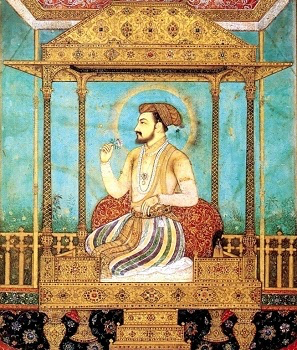
Miniature painting of Shah Jahan
Threats to the throne
Note
In 1617, while still a prince, Khurram succeeded in conquering the Deccan Plateau. As a reward, his father Jahangir bestowed on him the title 'Shah Jahan' which literally meant 'King of the World' in Persian. Amidst proving his military skills, his step-mother Nur Jahan influenced Jahangir that Shahzada Shahryar, his son-in-law, was better than Shah Jahan. In response, Prince Khurram led a revolt against his father that failed in 1623. After being forgiven by Jahangir, Shah Jahan claimed the throne after his father's demise in 1627. As emperor, Shah Jahan immediately eliminated possible contenders to the throne.
Note
Threats to his throne included his brother, cousins, nephews and stepmother, Nur Jahan. Generally, Shah Jahan ruled the Mughal Empire towards expansion. Constant battles and a number of alliances materialised his vision of expanding the empire. It is said that Shah Jahan's army was composed of over 900,000 warriors and 185,000 horsemen.
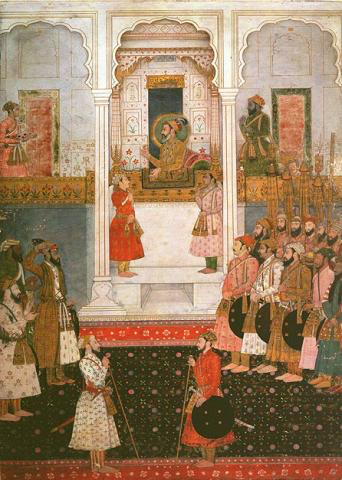
Image depicting Shah Jahan's court
Shah Jahan and the luxury of his court
Note
In 1628, Shah Jahan issued an order for the construction of halls for his public audiences, especially in the capital of Agra. During his reign, court life imposed strict ceremonies focusing on the emperor. Each architectural design used in ceremonial functions was approved by him. Moreover, jewellers from Asia and Europe visited Shah Jahan's court to sell their precious goods.
Shah Jahan's court was characterised by extravagance and splendour due to his personal collection of jewels.
In contrast to his grandfather's religious tolerance, Shah Jahan ordered the demolition of Hindu temples and Christian churches in 1632. Moreover, Portuguese settlements near Calcutta were also destroyed.
At the time that Shah Jahan moved the capital from Agra to Delhi, his own household comprised of:
- 7,000 Family members, servants, clerks and officials
- 57,000 Soldiers, servants and dependents
- 70 Amir/noble households
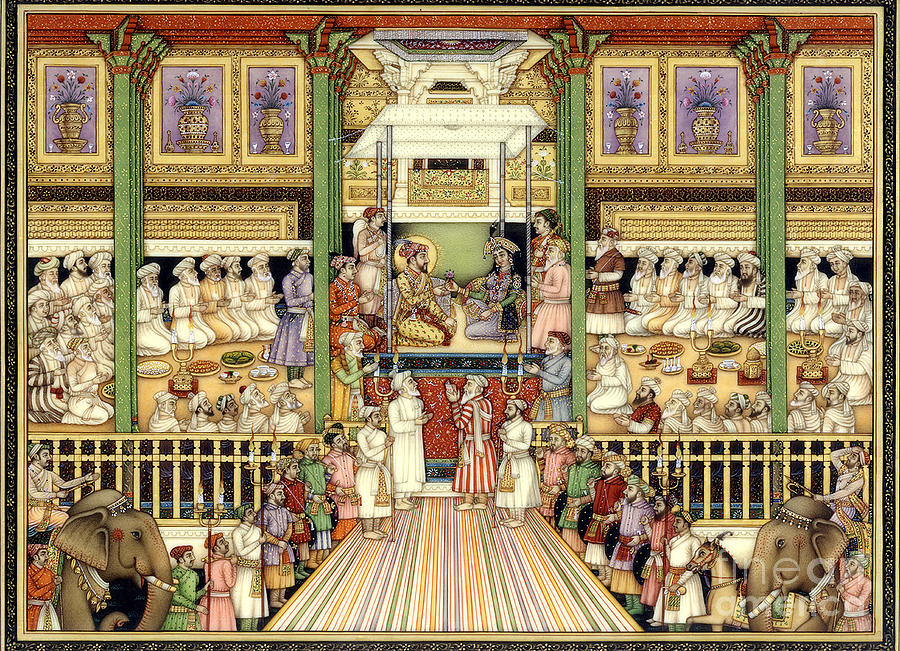
Painting depicting the wedding of Shah Jahan and Mumtaz Mahal