Shah Jahan’s patronage of building including the Taj Mahal and his new capital in Delhi (OCR GCSE History B (Schools History Project)): Revision Notes
📚Revision Notes
Shah Jahan's patronage of buildings including the Taj Mahal and his new capital in Delhi
Note
Mumtaz Mahal, Shah Jahan's second wife and mother of 14 of his 16 children died in 1631 while giving birth to their last child. In addition to the two great mosques built in Agra (the Pearl Mosque and the Great Mosque), Shah Jahan ordered the construction of the Taj Mahal, a magnificent mausoleum, to commemorate his favourite queen.
Taj Mahal
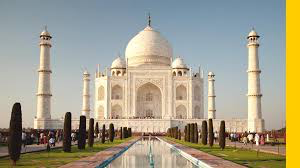
Image of Taj Mahal, a colossal tomb as a symbol of Shah Jahan's enduring love to Mumtaz Mahal
The tall doorways of the Taj Mahal was inscribed with texts from the Quran. Precious stones such as onyx, jasper, carbuncle, cornelian, malachite, and lapis lazuli studded the mosaic, which is how it gained its name "A Dream in Marble".
A central dome is surrounded by four smaller domes, while four slimmer towers called minarets are situated at the corners. Inside the mausoleum is a cenotaph or false tomb for Mumtaz Mahal, while the real sarcophagus of her remains is in the lower chamber.
Note
Directly across the mosque is an identical building called a jawab, which means mirror. The construction began in 1632 and was completed in 1648. By 1653, additions of the outer courtyard and its cloisters were built. Ustad-Ahmad Lahori was the main architect of the Taj Mahal.
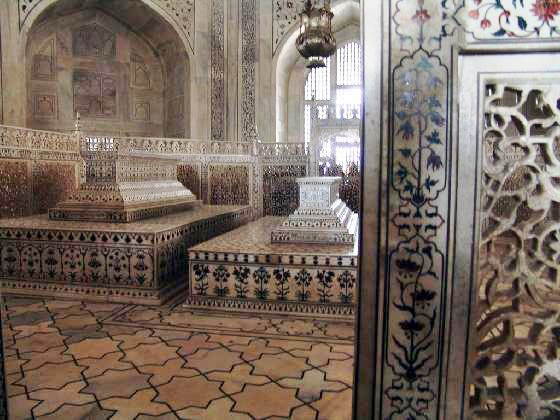
Image of the cenotaphs inside the Taj Mahal
The two exquisite cenotaphs inside the Taj Mahal represent the tombs of Shah Jahan and Mumtaz Mahal.
In addition to the Taj Mahal, Shah Jahan ordered the construction of the following:
- Red Fort or Lal Quila (Delhi)
- Sections of the Agra Fort
- Great Mosque or Jama Masjid (Delhi)
- Pearl Mosque or Moti Masjid (Lahore)
- Shalimar Gardens (Lahore)
- Sections of the Lahore Fort (Lahore)
- Jahangir Mausoleum
- Takht-e-Taus
- Shahjahan Mosque (Thatta)
Shah Jahan's patronage of building the Taj Mahal and his new capital in Delhi
Note
In 1638, a year before the reconquest of Kandahar, Shah Jahan transferred the capital city of the Mughal Empire from Agra to Delhi, thus creating the new city of Shahjahanabad. A Jami Masjid or a great mosque was built in Delhi, which became one of the finest mosques in India. Moreover, a fortress palace called the Red Fort was also erected.
In order to finance Shah Jahan's architectural buildings, he increased existing taxes and created new ones.

Inside the fort was the Hall of Public Audience were members of the general public were accepted and heard.

Shah Jahan sat on the Peacock throne inside the hall. The throne was made of jewels, precious metals and stones, such as diamond, emerald, ruby, and pearl.
Note
At that time, Agra was inhabited by over 660,000 people, including foreigners. Shah Jahan decided to move the capital to the larger Delhi in order to accommodate his own household, which was roughly 65,000-strong.