The First Mughal Emperors, 1526–1556 (OCR GCSE History B (Schools History Project)): Revision Notes
📚Revision Notes
Humayun, his struggle to retain control, and the condition of the Mughal
Empire by 1556

Note
When Babur fell ill in 1530, Babur's brother-in-law planned a conspiracy with a number of Mughal court nobles to grab the throne, bypassing Humayun. According to legend, Babur begged God to spare his son's life (who became ill as he defended his throne), offering his own in return.
Upon his succession in India, Humayun lost control of Kabul and Western Punjab to his rival brother, Kamran. As a result, Humayun struggled with supplies that were coming from Kabul.
After 10 years of rule, Humayun was driven out of northern India by the Governor of Bengal. In his thirteenth year, he returned to India with his son, Akbar, and fought with the Indo-Afghan army at the Second Battle of Panipat. As a result, the Mughals regained control of northern India.
In 1539, Sher Shah from Bengal defeated the Mughals at Chausa. The battle cost the lives of over 8,000 Mughal warriors, which weakened Humayun's defence. Sher Shah continued with his attacks, which eventually drove Humayun west.
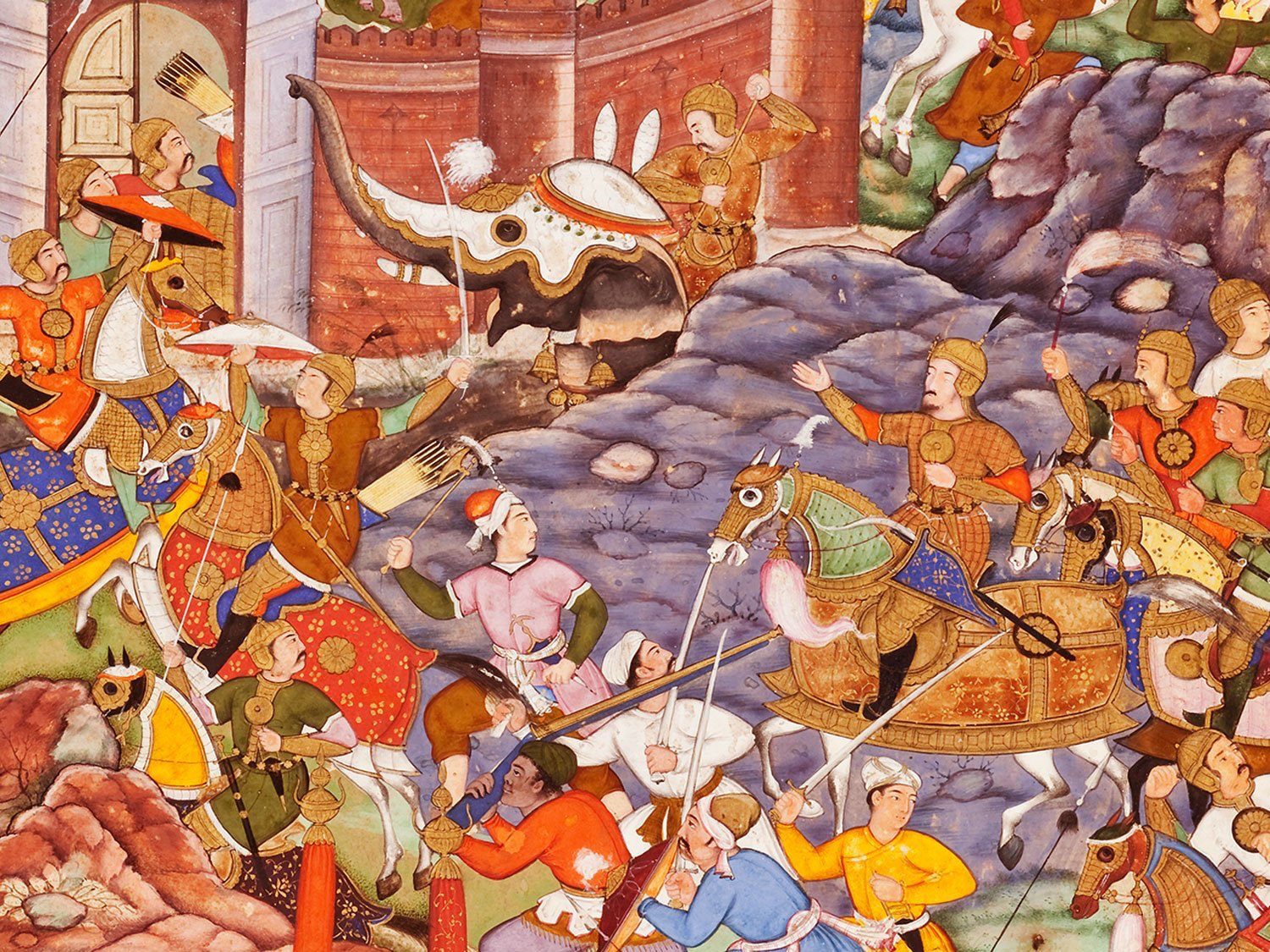
Image showing Humayun battles Bahadur Shah of Gujarat
Note
In 1540, at the Battle of Kanauj, Sher Shah won again against the Mughals until Humayun quit the battlefield and fled from India. Sher Shah was able to capture Agra, the Mughal capital city.
Note
In 1545, Sher Shah Suri died. His son and successor followed in 1554, which resulted in political chaos and the opportunity for Humayun's return. Under the leadership of Bairam Khan, Humayun's greatest military commander, the second Mughal emperor reclaimed the throne in 1555.
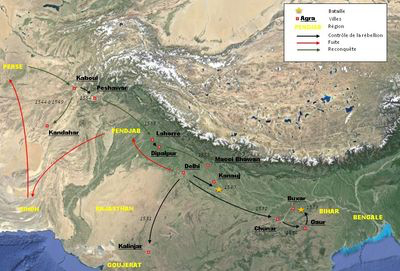
Map detailing Humayun's conquest to 1530 and 1555

Glossary of Terms
Babur
Descendant of Timur and Genghis Khan, he was the founder and first ruler of the Mughal Empire.
Humayun
Son of Babur, he was the second Mughal emperor and father of Akbar, one of the greatest rulers of the empire.
Conspiracy
An act of secretly planning or plotting unlawful events.
Timurid
A member of the Timur dynasty, descendants of Timur the Lame, conqueror of Central Asia.
Mughal Empire
The empire built by Babur by conquering northern India.
Sher Shah Suri
An Afghan ruler and Sultan of Bihar who defeated Humayun and conquered the Mughal Empire.

Source Analysis
"The shrill blast of the clarion of destruction, and a scene like that of the day of judgement, full of awful and tremendous strife, now operating together, the meaning of the text, 'When the heavens shall be rent,' became manifest; and the heads of the leaders of the armies of the time, like shooting-stars falling from the sky, fell like balls in the arena, and the meaning of the words, 'The stars shall be scattered,' became apparent"
- Description of Babur's conquest
SOURCE A
Note
Read the source carefully and answer the questions which follow: How can you describe Babur's conquest?
What are the terms used that describes the outcome of his battle?