Cnut’s Anglo-Scandinavian Empire, 1016–1035 (OCR GCSE History B (Schools History Project)): Revision Notes
📚Revision Notes
Cnut's Anglo-Scandinavian Empire, 1016–1035

Note
Cnut, son of Sweyn, was the first Danish King of all England. His rule lasted between 1016 and 1035. From 1018 until 1935, Cnut was King of Denmark and Norway from 1028 until 1035. After his successful campaign with his father, Cnut assumed the throne at the age of 23.
With about 200 longships and a thousand-strong army, Cnut sailed to England in 1015. He fought against the King of the Wessex. According to the Peterborough Chronicle, the Vikings arrived in Sandwich going to Kent and to Wessex.
By late-1015, Wessex that was ruled by Ethelred surrendered to Cnut. The following year, with Ethelred's army, Cnut crossed the Thames to subdue Edmund Ironside. In this campaign, he was able to gain control of Northumbria and later on London, where Edmund faced his death.
The Battle of Assandun
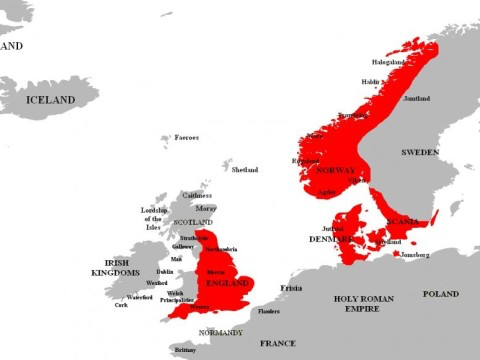
Map showing Cnut the Great empire in 1016
On October 18, 1016, the Battle of Assandun took place, which resulted in a decisive English defeat. Upon the death of Edmund on November 30th, West Saxons recognised Cnut as the new King of England. In 1017, he was crowned by Lyfing, Archbishop of Canterbury in London.
Note
For nearly two decades, Cnut ruled England. With almost all the Vikings under his command, he was able to halt raids and restore prosperity to English lands. Moreover, with the help of the English, Cnut established total control over Scandinavia.
Eliminating the challenges to the throne:
- In order to eliminate challenges to the throne, especially from the Wessex dynasty, Cnut executed a number of noblemen. Etheling, son of Ethelred, fled from England but was later killed, while his half-brother to Emma of Normandy, Edward, was sent into exile.
- In July 1017, he married Emma, widow of Ethelred and daughter of Richard I of Normandy. Their son, Harthacnut was later named as his heir.
- Upon collecting enormous Danegeld, Cnut paid off his army and sent the majority home. In addition, heregeld, an annual tax to pay the army, was also collected.
England under King Cnut
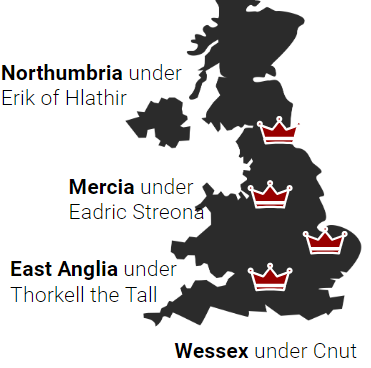
- He divided England into four large administrative units or kingdoms by grouping multiple shires under a single ealdorman. However, the initial distribution of earldoms was short-lived. By 1033, Wessex came under the control of Godwin, an influential Anglo-Saxon family from Sussex. Later on, Cnut allowed Anglo-Saxon nobility whom he trusted to dominate the lands.
- Cnut was known for his fair treatment of the Church.
- The Danelaw constitution was reinstated. Moreover, he strengthened the system of coinage.
Note
In 1018, upon the death of his brother Harald II, Cnut assumed kingship of Denmark. Amidst resistance, he was able to gain control and achieve stability in 1020. When he went back to England, he appointed his brother-in-law Ulf Jarl as regent of Denmark, while his son with Emma, Harthacnut, was made crown prince. In 1027, upon returning from Rome to witness the ascension of the Holy Roman Emperor Conrad II, Cnut proclaimed himself the king of all England, Denmark, Norway, and part of Sweden.

Glossary of Terms
Svein Forkbeard
Son of Harald, he ruled England for five weeks and is often regarded as the 'forgotten king'
Cnut
Cnut, son of Sweyn was the first Danish King of all England. His rule lasted between 1016 and 1035. From 1018 until 1035, Cnut was king of Denmark and Norway in 1028 until 1035.
Christianity
A religion based on the teachings of Jesus of Nazareth. The Vikings who settled in England converted to this religion.
Harald Bluetooth
Son of King Gorm the Old, he unified North Jutland and promoted the conversion of the Danes and Norwegians to Christianity
Kingdom
Under Cnut, England was unified into 4 kingdoms; East Anglia, Mercia, Northumbria, and Wessex. A kingdom is ruled by a king or queen.
Jelling stone
A massive carved rune stone made in the 10th century, which showed the establishment of Denmark as a Christian land.

Source Analysis:
Note
Amongst the legacy of Harald Bluetooth was the runestones. Given the sources, discuss the nature and significance of the runestones. Highlight the meaning of the underlined phrase.
Source A:
"King Haraldr ordered this monument made in memory of Gormr, his father, and in memory of Thyrvé, his mother; that Haraldr who won for himself all of Denmark and Norway and made the Danes Christian"
- Runestone inscription
Source B:
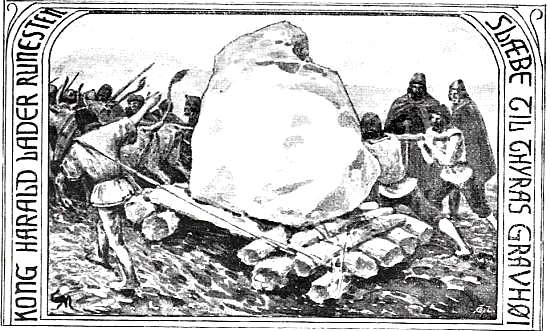
Illustration of runestone being dragged

Exam Practise:
Note
Given your knowledge about kings Svein Forkbeard and Cnut, what were the factors which led to their invasion of England? Discuss why England attracted raiders, traders, and invaders during the Viking Age. Support your answer with historical facts.

Source interpretation:
Note
Critically read the source and make an inference on the message implied. What was Cnut trying to say?
... I spoke with the Emperor himself and the Lord Pope and the princes there about the needs of all people of my entire realm, both English and Danes, that a juster law and securer peace might be granted to them on the road to Rome and that they should not be straitened by so many barriers along the road, and harassed by unjust tolls; and the Emperor agreed and likewise King Robert who governs most of these same toll gates. And all the magnates confirmed by edict that my people, both merchants, and the others who travel to make their devotions, might go to Rome and return without being afflicted by barriers and toll collectors, in firm peace and secure in a just law.
— Cnut's letter of 1027