The ‘great heathen army’ in England and the establishment of Danelaw, 865–879 (OCR GCSE History B (Schools History Project)): Revision Notes
📚Revision Notes
The 'great heathen army' in England and the establishment of Danelaw, 865–879

Note
Since the landing in Norfolk in 787 AD, the Norse raiders plundered British territories from time to time. Among the weakest and most frequent targets were monasteries and abbeys, which later labelled the raiders as 'heathens'.
The Vikings were known for launching a voyage in small warbands, but in 865, a large number of Vikings arrived on the coast of East Anglia. Upon arrival, King Edmund of East Anglia offered horses to the Vikings as a sign of peace. Moreover, he let the invaders from Scandinavia stay over for the winter on the Isle of Thanet.
The large party of the Vikings led, by the three sons of Ragnar Lothbrok, became known as the Great Heathen Army who began the invasion of England.
Note
After spending the winter in East Anglia, the Vikings, led by Ivar the Boneless, moved northwards to Northumbria. Faced with little resistance, the Vikings invaded York in November 866. Northumbrians offered payment for the Vikings to leave. In response, Ivan and his men accepted the payment and left, but installed a puppet government to lead. In 867, the Vikings headed south to Mercia and captured the town of Nottingham after defeating the joint forces of Mercia and Wessex. The following year, the Vikings left Nottingham after again receiving payment from the Anglo-Saxon.
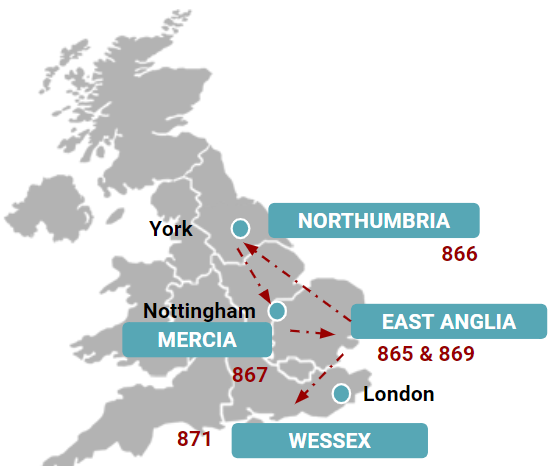
By 869, the Viking army travelled again to East Anglia to spend the winter, however, they were met with great resistance. According to the Anglo-Saxon Chronicle, King Edmund fought against the Vikings and was defeated and killed.
After several battles, King Alfred of Wessex offered the Vikings payment. The Vikings accepted and went to London for the winter.

At the Battle of Edington, the Anglo-Saxons were victorious against the Vikings. As a result, Wessex became the only kingdom free from the Vikings. After his defeat, Guthrum agreed to be baptised.
In the following years, the Vikings drifted between Northumbria and Mercia, while its leaders negotiated peace.
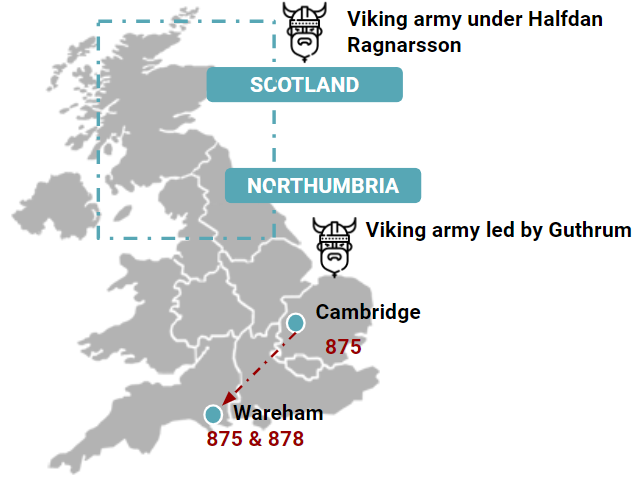
By 873, the kingdom of Mercia completely fell to the Vikings. After eight years of raiding England, the Heathen Army split in half. Halfdan Ragnarsson conquered the north, while the other half moved south. As Halfdan conquered the north, his army began to plough land and established farms.
In the south, his brother Guthrum faced a series of battles against King Alfred.
Note
Given the success of Viking expansion in the 9th century, Danelaw, which refers to the lands to the north and east of England, were conquered by the invaders.
The five boroughs:
Under the Danelaw, five fortified towns, which became known as the Five Boroughs, were established: Leicester, Nottingham, Derby, Stamford, and Lincoln. These five towns under the control of the Vikings followed Danish law and customs.
A total of fifteen shires were included in the Danelaw: Leicester, Nottingham, Derby, Lincoln, York, Essex, Cambridge, Suffolk, Northampton, Norfolk, Huntington, Bedford, Middlesex, Hertford and Buckinghamshire. A Danish Jarldom ruled each borough controlling the lands and answering to a Jorvik or overlord in the Viking Kingdom of York.
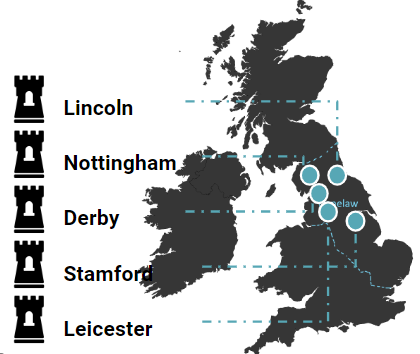
The term 'Borough' came from the Old English word burg, which means walled or fortified.
Note
In 868, brothers Ivan the Boneless and Halfdan Ragnarsson occupied the borough of Nottingham over the winter. Danish settlement officially began in 877 and lasted until 918, after the assault of Edward of Wessex.
Note
In 877, the Danes settled and established Derby, the second borough, which was ruled until 913.
Note
The borough at Lincoln served as a strategic area on the route going to Wessex and York. The Danes maintained control over the burh until 918.
Note
In 877, the Danes settled and established Stamford remained under the Danish control until the successful assault of King Edward in 918.
By 942, King Edmund recovered the Five Boroughs from the Vikings.
For some time, the Danelaw established civilian peace between the neighbouring Anglo-Saxon and Viking communities.
As a result of this co-existence, many Norse words were mixed into the English language.
Today, four out of the Five Boroughs became county towns, including Leicestershire, Lincolnshire, Nottinghamshire, and Derbyshire.

Glossary of Terms
RAID
A form of assault or attack to seize territories and possessions.
BERSERKS
A group of Viking warriors that wore bearskins and no armour, as they believed that the god Odin gave them superhuman powers.
DANELAW
It refers to the lands to the north and east of England conquered by the Viking invaders.
GREAT HEATHEN ARMY
The large group of Scandinavian Vikings who raided England.
FIVE BOROUGHS
Five important walled towns under the Danelaw.
SHIELD-WALL
A defence tactic of drawing up in line with overlapping shields for better protection.

Source Analysis
Source A:
What may I say about avarice, robbery, violent judgments? – when it is clearer than day how much these crimes have increased everywhere and a despoiled people testifies to it. Whoever reads the Holy Scriptures and ponders ancient histories and considers the fortune of the world will find that for sins of this kind kings lost kingdoms and peoples their country; and while the strong unjustly seized the goods of others, they justly lost their own.
- Letter by scribe Alcuin to Aethelred, King of Northumbria, 793 CE
Source B:
In this year, terrifying omens appeared over Northumbria and the people were wretchedly afraid. There were huge flashes of lightning and terrifying dragons were seen flying in the air. A great famine followed these signs and shortly after that, on the sixth day before the Ides of January, the miserable raiding of heathens destroyed God's church on the Isle of Lindisfarne through plundering and murder.
- Anglo-Saxon Chronicle, 793 CE
Note
Read the sources and critically analyse the projected reasons behind the Viking raids in Western Europe.
Note
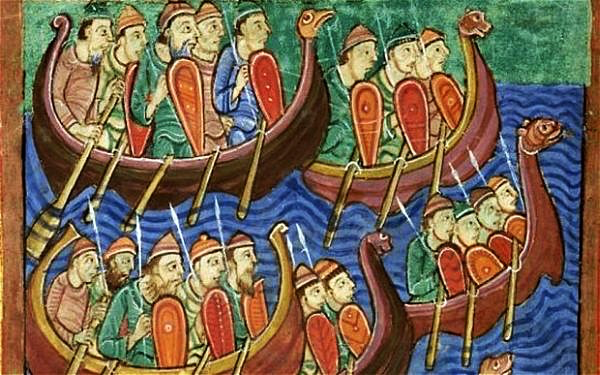
SOURCE C
Note
Make an inference on the source provided. Substantially describe the nature of Viking warfare.

Note
Given your historical knowledge about the Danelaw, answer the questions which follow:
- Discuss the concept of Danelaw and the Five Boroughs.
- How different were the Five Boroughs from other towns in East Anglia, Mercia, and Northumbria invaded by the Vikings?
- What was the impact of the Danelaw?