The nature of Viking warfare: warships, warriors and tactics (OCR GCSE History B (Schools History Project)): Revision Notes
📚Revision Notes
The nature of Viking warfare: warships, warriors and tactics
Note
With their longships equipped with oars and sails, the Vikings travelled to distant seas and raided coastal monasteries in the British Isles and other parts of Western Europe. Designed with a shallow draught, the raider's ships were able to reach inland streams and rivers for attacking settlements.

The Vikings rarely faced actual sea battles. In rare times, enemy fleets were showered with arrows. In close encounters, they attempted to board opponents' ships to capture them rather than destroy them. By the late 11th century, Viking warriors fought on foot and had no cavalry. Horses were occasionally used by Viking leaders. Most Vikings dispersed after a campaign. Some returned to their homes as farmers and merchants, while others continued and joined other war-bands.
Weapons used by the Vikings:
The Vikings typically owned weapons, such as spears, swords, and battle-axes. In addition, bows and arrows and other forms of missiles were also utilised. Aside from use in battles, weapons also served as symbols of the owner's wealth and status. Weapons were decorated with silver, copper and bronze.
The Vikings used shields probably covered with leather to protect them. In popular culture, the Vikings are often depicted wearing horned helmets. In reality, the leading men wore helmets made of metal.
At a young age, Viking boys were trained in hunting, sports and raiding. During battle, young warriors formed the shield-wall by drawing up a line of overlapping shields for better protection. The veterans would then be positioned behind them. A shower of spears usually marked the beginning of a battle. Afterwards, Viking warriors aimed to capture or kill leaders.
A group of Vikings called the Berserks only wore bearskins and no armour, as they believed that the god Odin gave them superhuman powers.
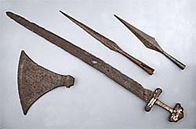
Image of typical Viking sword, spearheads and battle-axe, excavated in London
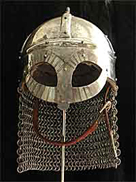
A replica of a Viking helmet found in Norway
A large Viking army was believed to have been composed of several warbands. Local kings, earls, and chieftains could lead and order raids. Based on archaeological finds and accounts, Viking warriors and raiders were generally men.
Note
Initially, the Vikings limited their attacks to hit-and-run tactics, however, between the years 814 and 820, they continued to sack monasteries in Northwestern France and eventually establish settlements. By the 870s, the Vikings conquered territories of the English, Franks, and European Russian.
Almost similar to merchant ships, Viking warships made their journeys and raids successful. A longship could carry 50 to 60 seamen and was mainly built from oak or pine with hewn planks. While naval battles were less common, the Vikings usually fought against themselves, e.g. Danes vs. Norwegians, Swedes vs. Norwegians, and Swedes vs. Danes.
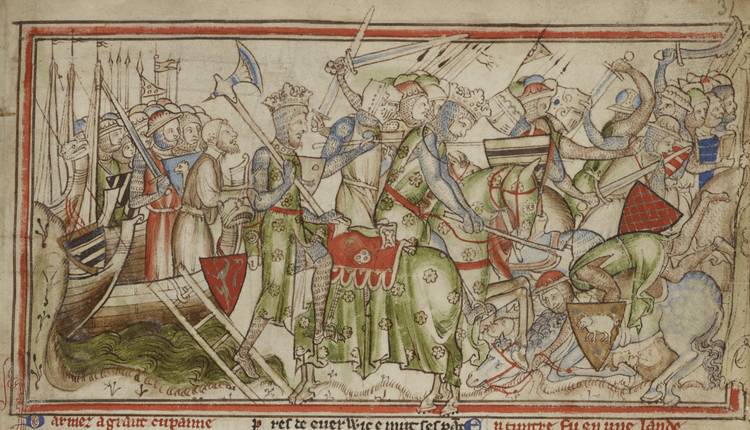
Depiction of King Harald III of Norway at the Battle of Fulford Gate in 1066