Solving quadratic equations (OCR GCSE Maths): Revision Notes
📚Revision Notes
Solving Quadratic Equations
Quadratic equations are equations where the highest power of the unknown is a square (e.g., ). There are three main methods to solve quadratic equations:
- Factorising
- Using the Quadratic Formula
- Completing the Square
No matter which method you are asked to use in the exam, it is crucial to remember the Golden Rule for solving quadratic equations:
You should always get two answers!
This is because quadratics often involve squared terms, which means there are two possible solutions to satisfy the equation.
Why do we get two answers?
Consider the simple equation:
You might think is the answer, but don't forget:
So, the solutions are and . Quadratics give two solutions because squaring both positive and negative numbers results in the same value.
1. Solving by Factorising
This method is often the easiest and quickest way to solve a quadratic equation, provided that the quadratic can be factorised.
The steps are as follows:
- Rearrange the equation so that it equals zero.
- Factorise the quadratic expression.
- Solve for the unknown by setting each factor equal to zero.
Note
Worked Example: Solve the quadratic equation:
- The equation is already factorised, so set each bracket equal to zero:
- Solve for :
Thus, the solutions to the quadratic equation are:
Worked Examples
Note
Example 1: Solve the equation .
Step-by-Step Solution:
- The equation is already set to zero, so proceed to factorising.
- Factorise into .
- Set each factor equal to zero:
- Solve for :
The solutions are or .
Note
Example 2: Solve the equation .
Step-by-Step Solution:
- First, rearrange the equation to equal zero:
- Factorise into .
- Set each factor equal to zero:
- Solve for :
The solutions are or .
2. Solving by Using the Quadratic Formula
The quadratic formula is:
This formula provides the solution(s) for any quadratic equation of the form:
Worked Example:
Note
📑Example: Solve using the quadratic formula. 12. Identify and =
- Substitute into the formula:
Simplifying:
- The discriminant is negative , indicating no real solutions.
Worked Example:
Note
📑Example: Solve using the quadratic formula.
Step 1: Identify the Coefficients
First, you need to identify the coefficients and from the quadratic equation .
For the equation:
- (the coefficient of )
- (the coefficient of )
- (the constant term)
Step 2: Substitute into the Quadratic Formula
Now substitute these values into the quadratic formula:
Substituting the values:
Simplify it step by step:
Step 3: Simplify and Calculate
Now, simplify the expression under the square root and calculate the two possible values of .
This gives two possible values for :
And:
So, the solutions are:
Step 4: Using Your Calculator Effectively
To ensure accuracy, follow these tips when using your calculator:
- Always use brackets around negative numbers to avoid errors.
- After calculating the square root, remember to compute both the plus and minus scenarios to get both possible solutions.
- Carefully enter the formula into your calculator to avoid mistakes.
🤔Top Tip: Always double-check your results by substituting them back into the original equation to make sure they satisfy it.
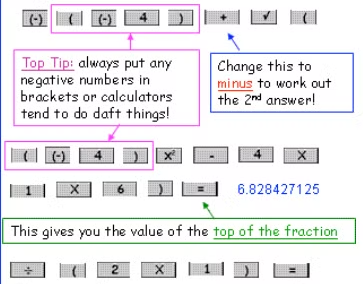
Final Answers:
For , the roots are approximately:
:::
Worked Example 2:
Note
📑Example: Solve using the quadratic formula.
Step 1: Rearrange the Equation
The first step is to rearrange the equation so that it equals zero. This is necessary before you can apply the quadratic formula.
Given:
Rearrange by subtracting and adding to both sides:
Step 2: Identify the Coefficients
Identify the coefficients , , and from the quadratic equation .
For the equation:
- (the coefficient of )
- (the coefficient of )
- (the constant term)
Step 3: Substitute into the Quadratic Formula
Now substitute these values into the quadratic formula:
Substituting the values:
Simplify step by step:
Step 4: Calculate the Roots
Now, you will calculate the two possible values for using a calculator.
First Root:
Second Root:
Step 5: Using Your Calculator Effectively
To ensure accuracy, here are some tips for using your calculator:
- Always use brackets around negative numbers.
- Compute both the positive and negative roots to find the two possible solutions. Pressing the buttons on the calculator:
- Start with the square root:
- Use brackets for the negative sign:
- Divide the result by to get one root.
- Repeat the process with instead of to find the other root.
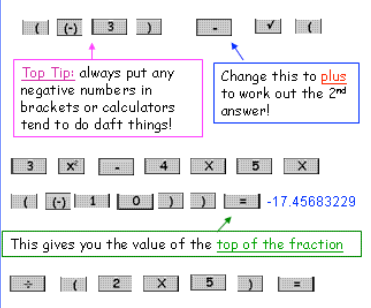
Final Answers:
For the solutions are approximately:
Worked Example:
Note
📑Example: Solve by completing the square.
Step 1: Recognise the Form
First, let's rewrite the quadratic expression in a form that can be factorised by completing the square.
The expression can be rewritten as:
Step 2: Understand the Expansion
To confirm that is indeed the same as , we expand the square:
This shows that can be expressed as .
Step 3: Complete the Square
To complete the square, you must add and subtract the same value, ensuring that the equation balances. Here's how it's done:
Given:
We rewrite it as:
Now, is the "square", and the "completes" it.
Step 4: Method for Completing the Square
- If the coefficient of is NOT 1, factor it out first. For example, if you had , you'd factor out the first.
- Complete the square using the formula:
In our case, , so:
- Solving the equation: If you need to solve for , you would now isolate by moving the constant to the other side and taking the square root. Remember to consider both the positive and negative square roots!
3. Completing the Square
Worked Example 1:
Note
📑Example Problem: Solve by completing the square.
Step 1: Identify the coefficient of
- In this case, the coefficient of is , which is ideal for completing the square without needing to factor out any terms.
Step 2: Apply the Completing the Square Formula
- Rewrite the quadratic expression using the formula for completing the square:
- Here, , so:
Step 3: Solve the Equation
- Substitute back into the equation:
- Add to both sides to isolate the square:
- Take the square root of both sides:
- Solve for :
- Solution: The solutions are or .
Worked Example 2:
Note
📑Example Problem: Solve by completing the square.
Step 1: Factor out the Coefficient of
- The coefficient of is , so we factor it out:
Step 2: Apply the Completing the Square Formula
- Use the completing the square formula on the expression inside the brackets:
- Substitute back:
Step 3: Solve the Equation
- Expand and solve:
- Add to both sides:
- Divide both sides by :
- Take the square root of both sides:
- Solve for :
- Solution: The solutions are or .