Current, Potential Difference & Resistance (OCR GCSE Physics A, Combined (Gateway Science Suite)): Revision Notes
📚Revision Notes
2.1.8 Required Practical: Investigating I–V Characteristics
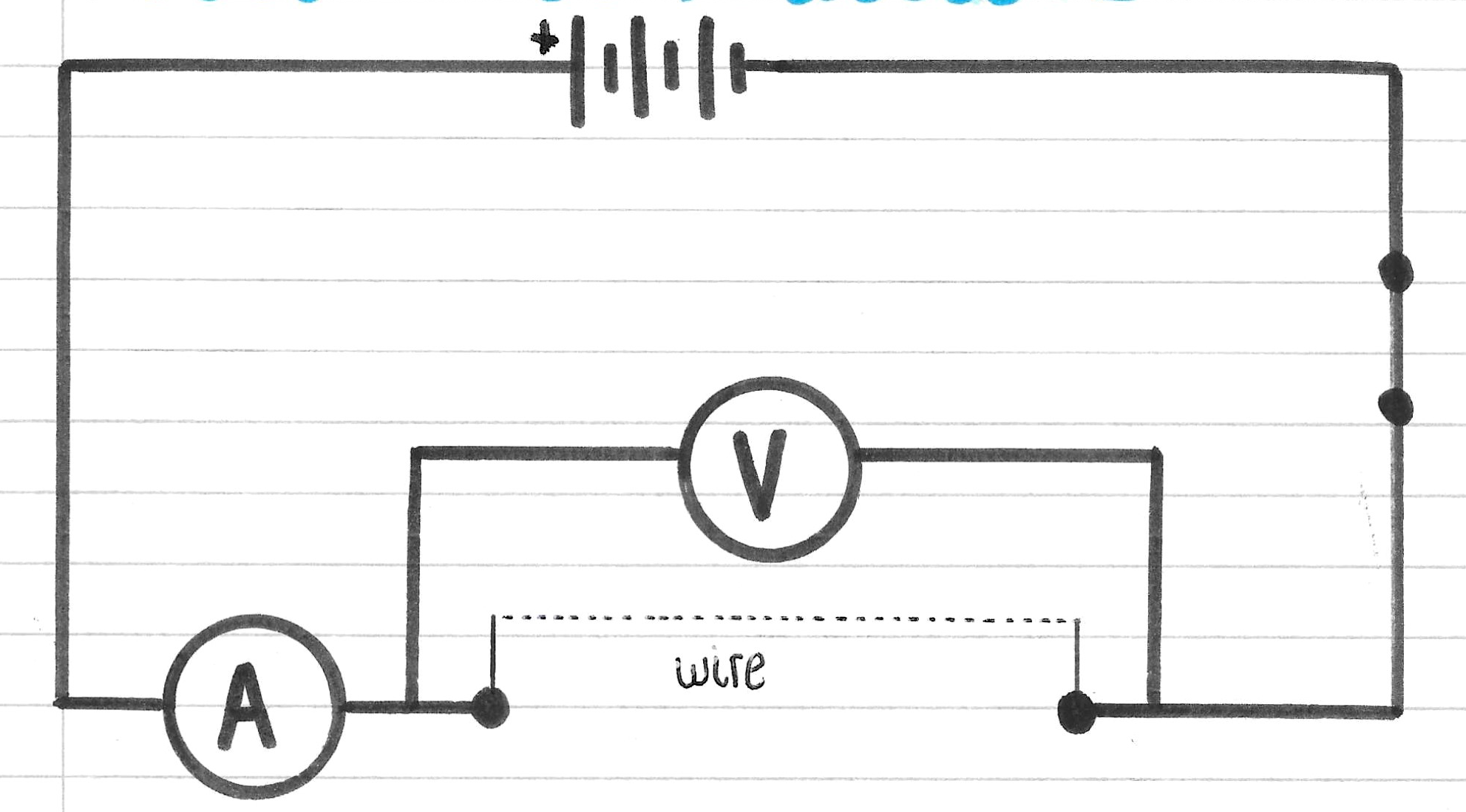
Circuit Setup
-
Components:
- Battery
- Ammeter (A)
- Voltmeter (V)
- Wire
-
Procedure:
- Change the length of the wire, and each time measure the resistance.
Note
Formula for Resistance
Variables:
- : Resistance (Ω)
- : Potential difference (V)
- : Current (A)
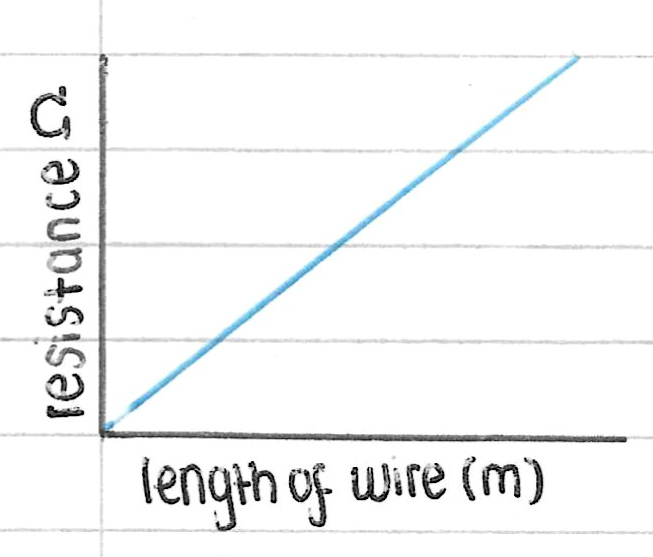
- Graph:
- The resistance of the wire is directly proportional to the length.
Zero Error
Note
Definition:
- A zero error reading is a systematic error. It is a reading on a measuring instrument when the value should be zero.
- In the case of resistance, we need to subtract the zero error from all of our readings.
Heating Effects
- Impact on Results:
- If the temperature of the wire increases, then the resistance will also increase.
- Mitigation:
- Use a low P.D. to keep the current low, reducing any heating in the wire.
- Only turn on the current when taking a reading. Turn it off between readings.
I-V Characteristics
Note
An I-V characteristic curve illustrates the relationship between the current through and the voltage across a component. For a resistor, this relationship is linear, meaning the graph will be a straight line, indicating Ohm's law is obeyed.
Comparing Different Components
- This practical can be extended to compare the I-V characteristics of different components:
- Resistor: Shows a straight line, indicating constant resistance.
- Diode: Only allows current to flow in one direction, resulting in a curve.
- Filament Bulb: Shows a curve where resistance increases as temperature rises.
Safety Considerations
- Ensure the circuit is switched off before making any changes to avoid electric shocks or short circuits. Handle the equipment carefully, especially when adjusting the wire length, to prevent accidents.
Expected Results
- For a resistor, you should expect a straight-line graph indicating that resistance remains constant as current and voltage change proportionally.