Resistors (OCR GCSE Physics A, Combined (Gateway Science Suite)): Revision Notes
📚Revision Notes
2.1.5 Resistors
Resistors
Note
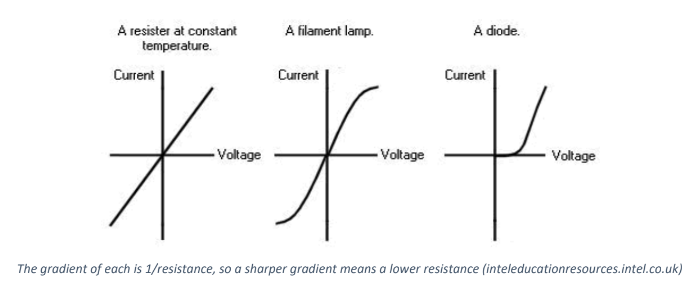
If the resistance is constant, an ohmic conductor, the current is directly proportional to the potential difference, in this case, the graph is linear.
Note
If the resistance of components such as lamps, diodes, thermistors and LDRs is not constant it changes with the current through the component, so the graph is nonlinear, for example, the resistance of a filament lamp increases as the temperature of the filament increases and the current through a diode flows in one direction only, so it has a higher resistance in the reverse direction.
Resistors
Overview
- Resistance and Energy:
- The higher the resistance, the more energy is transferred as the current moves.
- Ohm's Law:
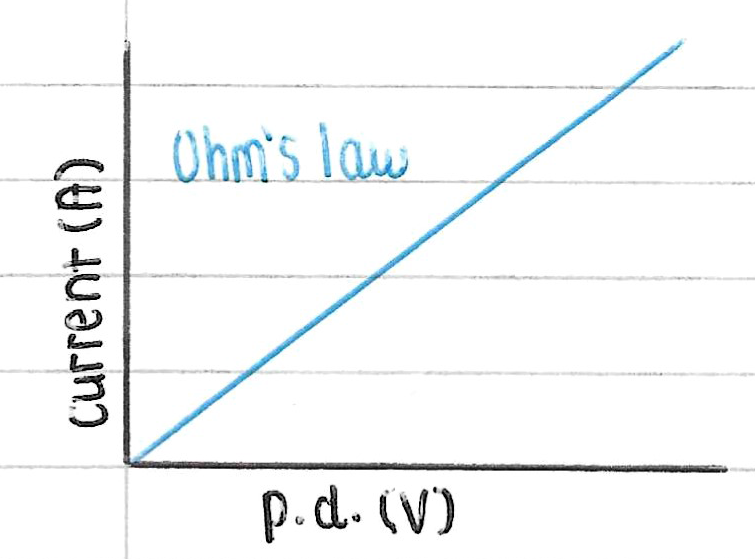
- Current through a resistor is directly proportional to the potential difference (P.D.).
- The resistance is constant and does not change if we increase the current.
- This kind of resistor is an ohmic conductor.
- The resistance will only stay constant if the temperature is constant.
How does the resistance change?
- With current
- As current increases, electrons (charge) have more energy
- When electrons flow through a resistor, they collide with the atoms in the resistor
- This transfers energy to the atoms, causing them to vibrate more
- This makes it more difficult for electrons to flow through the resistor
- So resistance increases, and current decreases
- With temperature
- Normal wires - See above, the same process occurs as atoms vibrate when hot
- Thermistor
- In hotter temperatures, the resistance is lower
- These are often used in temperature detectors/thermostats
- With length
- The greater the length, the more resistance and the lower the current
- Electrons have to make their way through more resistor atoms, so it is harder than using a shorter wire
- With light
- LDR (Light Dependent Resistor)
- The greater the intensity of light, the lower the resistance
- So the resistance is greatest when it is dark
- These are used in automatic night lights.
- With Voltage
- Diodes
- The diode allows current to flow freely in one direction
- In the opposite direction, it has a very high resistance so no current can flow
Resistance of a Filament Lamp
Overview
- Filament Lamp:
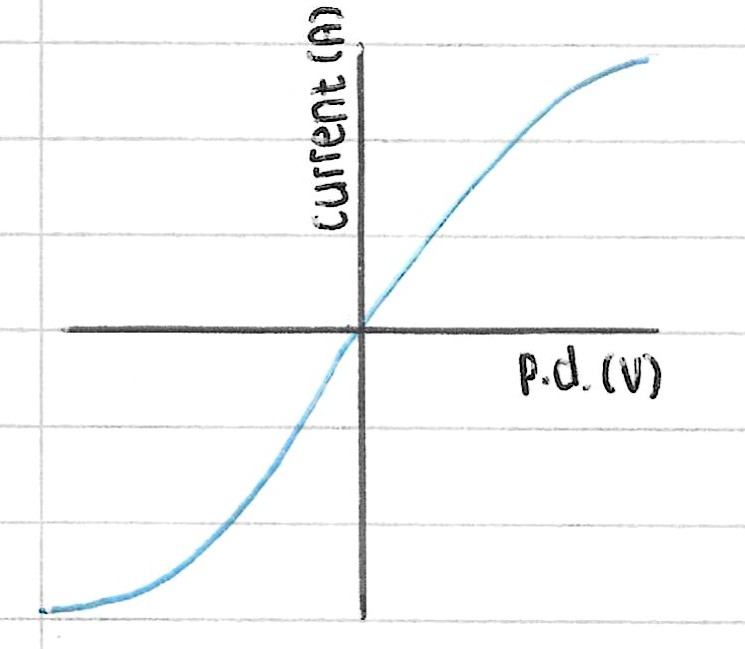
- The current through a filament lamp is not directly proportional to the P.D.
- As the filament gets hot, its resistance increases.
- At high temperatures, the atoms in the filament vibrate more.
- Current and Electrons:
- Electrons in the current collide more with the atoms.
- More energy is needed to push the current through the filament.
- As the P.D. increases, the current no longer increases as much.
Graphs
- Ohm's Law (Resistors):
- The linear relationship between current (A) and P.D. (V).
- Filament Lamp:
- Non-linear relationship between current (A) and P.D. (V).
Diodes and LEDs
Diode
-
Current Flow:
-
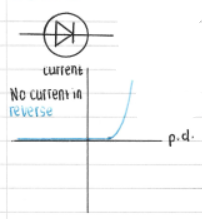
The current through the diode flows in one direction only.
-
The diode has a very high resistance in the reverse direction.
-
Forward and Reverse Direction:
-
No current in reverse.
-
Current flows in a forwards direction with the potential difference (P.D.).
-
Usage:
- Diodes are extremely useful for controlling the flow of current in circuits.
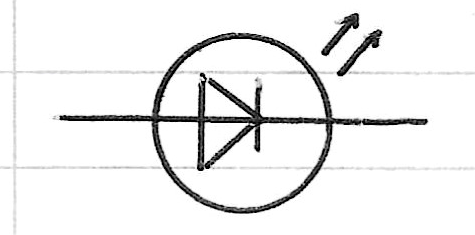
Light-emitting diode (LED)
-
Function:
-
Like a normal diode, it only allows current to flow in the forwards direction.
-
An LED gives off light when a current flows through.
-
Efficiency:
- LEDs are an extremely energy-efficient source of light.