The Life Cycle of Solar Mass Stars (OCR GCSE Physics A (Gateway Science Suite)): Revision Notes
📚Revision Notes
8.1.4 The Life Cycle of Solar Mass Stars
Stars go through several stages in their lifecycle, starting from clouds of dust and gas in a galaxy. Here are the main stages of a star's life:
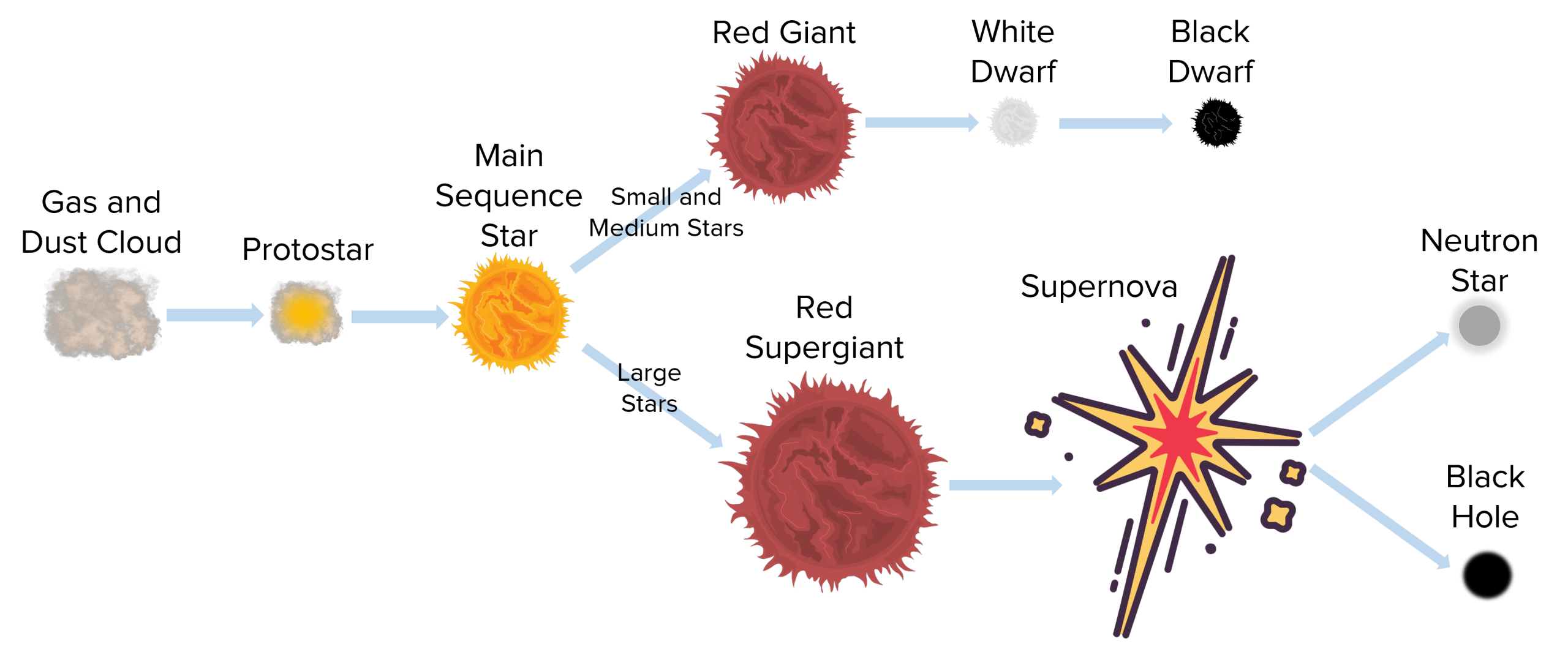
- Formation from Dust and Gas Clouds
- Stars begin as large clouds of dust and gas, often called nebulae, found within galaxies.
- The gravitational attraction between the dust and gas particles causes them to draw closer together, making the cloud more concentrated.
- As the particles get closer, the temperature and pressure within the cloud increase due to compression.
- Birth of a Star
- Eventually, the pressure and temperature become so high that the hydrogen gas within the cloud begins to undergo nuclear fusion, where light hydrogen nuclei fuse to form helium nuclei.
- This fusion process releases a tremendous amount of energy, which counteracts the gravitational collapse of the cloud.
- An equilibrium is reached when the outward pressure from the energy produced by fusion balances the inward pull of gravity.
- At this point, a protostar forms, which then matures into a main sequence star. The star can remain in this stable state, fusing hydrogen into helium, for billions of years.
- Evolution After Hydrogen Depletion
-
Eventually, the star exhausts its hydrogen fuel. Without fusion to produce outward pressure, the star becomes unstable and begins to collapse under its own gravity.
-
The next stages of the star's life depend on its initial mass: For Massive Stars:
-
The core collapse increases the temperature and pressure to levels where heavier elements can fuse.
-
After the fusion of heavier elements, the star becomes too massive to maintain stability and undergoes a dramatic collapse.
-
This collapse causes the star to explode in a supernova, a massive explosion that expels the outer layers of the star into space.
-
The core that remains after the supernova may form a neutron star (extremely dense core) or, if massive enough, collapse further into a black hole. For Medium-sized Stars (like the Sun):
-
As the hydrogen runs out, the star begins to fuse helium and other elements in its core, but less vigorously compared to massive stars.
-
The outer layers are expelled gently, forming a planetary nebula—a shell of gas that surrounds the remaining core.
-
The remaining core cools and contracts into a white dwarf, a small, dense, and slowly cooling remnant.