Chapter 7 - Chapter 10 (Scottish Highers English): Revision Notes
📚Revision Notes
Chapter 7 - Chapter 10
Chapter 7: Incident at the window
The narrative shifts to focus on a brief but disturbing encounter between Utterson, Enfield, and Jekyll.
The Sunday walk
Utterson and Enfield take their regular Sunday stroll through London. As they pass the door where Enfield once witnessed Hyde's violent trampling of a child, Enfield comments on the murder case. He observes that the story that began with the trampling has reached an end, as London will never again see Mr. Hyde. During their conversation, Enfield reveals that he has discovered the run-down laboratory is physically connected to Jekyll's house.
The window encounter
The two men stop to peer into Jekyll's windows. Utterson expresses concern for his friend's health. To their surprise, they find Jekyll sitting at an open window, enjoying fresh air. Jekyll appears depressed, complaining that he feels very low. Utterson suggests a walk to improve Jekyll's circulation, but Jekyll refuses, saying he cannot go out.
The transformation
As the three men engage in polite conversation, something terrible happens. A look of terror suddenly seizes Jekyll's face. He quickly shuts the window and vanishes from sight. The abruptness and horror of this moment leave both Utterson and Enfield shocked. They depart in silence, unable to speak about what they have witnessed.
Important
This brief chapter marks a turning point. Jekyll's uncontrolled transformation at the window shows that his condition has deteriorated. He can no longer maintain his respectable appearance even for brief social interactions. The horror on his face suggests he is aware of what is happening but powerless to stop it.
Chapter 8: The last night
This chapter represents the climax of the mystery, as Utterson and Poole break into Jekyll's laboratory.
Poole's visit
Jekyll's butler, Poole, arrives at Utterson's home one night after dinner. He appears deeply agitated and can only say that he believes there has been foul play regarding Dr. Jekyll. He quickly brings Utterson to Jekyll's residence. The night is dark and windy, the streets deserted. Utterson feels a premonition of disaster.
When they arrive at Jekyll's house, they find all the servants gathered fearfully in the main hall. Poole leads Utterson to the door of Jekyll's laboratory and calls inside, announcing that Utterson has come to visit. A strange voice responds from within. The voice sounds nothing like Jekyll's. It tells Poole that no visitors can be received.
The voice in the laboratory
Poole and Utterson retreat to the kitchen to discuss the situation. Poole insists that the voice they heard does not belong to his master. Utterson wonders why, if Hyde has murdered Jekyll, he would remain in the laboratory rather than flee. Poole then describes how the mystery voice has sent him on constant errands to chemists throughout London. The person inside the laboratory seems desperate for some ingredient that no drugstore in the city can provide.
Note
Utterson asks whether the notes Poole has received are written in Jekyll's handwriting. Poole confirms they are. However, he then reveals something more disturbing. He has seen the person inside the laboratory when the figure came out briefly to search for something. The man looked nothing like Jekyll. He was much smaller than Jekyll and, in fact, looked exactly like Mr. Hyde.
Utterson tries to offer a rational explanation. He suggests that Jekyll may have contracted some disease that changes his voice and deforms his features. Poole rejects this theory, maintaining with certainty that he saw Hyde.
Breaking into the laboratory
Hearing Poole's account, Utterson resolves that they must break into the laboratory. He sends two servants to guard the laboratory's other door, the one that opens onto the side street where Enfield first witnessed Hyde. Then, armed with a fireplace poker and an axe, Utterson and Poole return to the inner door.
Utterson calls inside, demanding admittance. The voice begs for mercy, pleading to be left alone. However, Utterson recognizes the voice as Hyde's. He orders Poole to smash down the door.
Discovery
Once inside, the men find Hyde's body lying on the floor. A crushed vial lies in his hand. He appears to have poisoned himself. Utterson observes that Hyde is wearing a suit that belongs to Jekyll, though the clothing is much too large for him.
The men search the entire laboratory, the surgeon's theatre below, and all other rooms in the building. They find no trace of Jekyll, living or dead. They notice a large mirror in the laboratory and consider it strange to find such an item in a scientific space.
Note
On Jekyll's business table, they discover a large envelope addressed to Utterson. Inside are three items:
- A will, similar to the previous one, but replacing Hyde's name with Utterson's
- A note to Utterson, dated with the current day's date
- A sealed packet
The note's date proves that Jekyll was alive that very day. This evidence makes Utterson wonder whether Hyde really committed suicide or whether Jekyll killed him. The note instructs Utterson to go home immediately and read the letter that Lanyon gave him earlier. It adds that if Utterson wishes to learn more, he can read the confession signed Your worthy and unhappy friend, Henry Jekyll.
Utterson takes the sealed packet and promises Poole that he will return that night with the police. He then heads back to his office to read Lanyon's letter and the contents of the sealed packet.
Chapter 9: Dr. Lanyon's narrative
This chapter consists entirely of the letter Lanyon left for Utterson to open after both Lanyon's and Jekyll's deaths. It provides the first eyewitness account of the transformation.
Jekyll's strange request
Lanyon writes that after Jekyll's last dinner party, he received an unusual letter from Jekyll. The letter asked Lanyon to go to Jekyll's home and, with Poole's help, break into the upper room of Jekyll's laboratory. Jekyll referred to this room as his cabinet. The letter instructed Lanyon to remove a specific drawer and all its contents from the laboratory, return with this drawer to his own home, and wait for a man who would arrive precisely at midnight to claim it.
The letter seemed to Lanyon to have been written in desperation. It offered no explanation for these strange orders. However, it promised that if Lanyon followed the instructions, he would soon understand everything.
The mysterious drawer
Lanyon followed Jekyll's instructions. He went to Jekyll's home, where Poole and a locksmith met him. The locksmith broke into the laboratory, and Lanyon returned home with the drawer.
Note
Inside the drawer, Lanyon found several vials. One contained what appeared to be salt. Another held a peculiar red liquid. The drawer also contained a notebook recording what seemed to be years of experiments. The notebook included brief notations such as double or total failure!!! scattered throughout a long list of dates. However, the notebook offered no explanation of what the experiments involved.
Lanyon waited for his visitor, increasingly convinced that Jekyll must be insane.
The midnight visitor
As promised, at the stroke of midnight, a visitor arrived. He was a small, evil-looking man dressed in clothes much too large for him. It was Mr. Hyde, though Lanyon, having never seen Hyde before, did not recognize him.
Hyde appeared nervous and excited. He avoided polite conversation, interested only in the contents of the drawer. Lanyon directed him to it. Hyde then asked for a graduated glass. In it, he mixed the ingredients from the drawer. The mixture formed a purple liquid, which then turned green.
Hyde paused and offered Lanyon a choice. He could leave and take the glass with him, or he could stay and drink it in front of Lanyon. Hyde claimed that if he drank it in Lanyon's presence, the doctor would witness something that would stagger the unbelief of Satan. Lanyon, irritated and curious, declared that having become so involved in the matter, he wanted to see it through to the end.
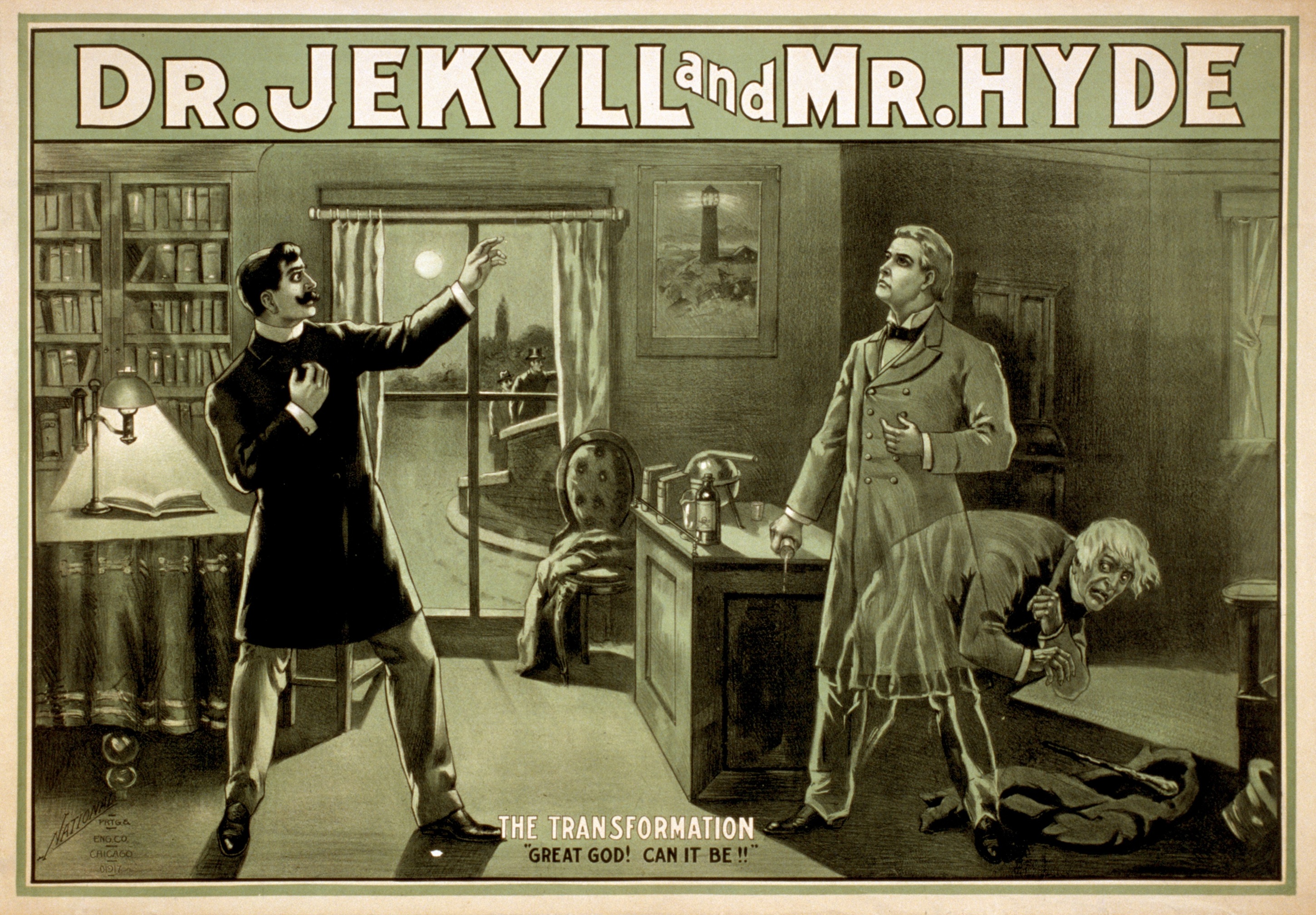
The transformation
Hyde took up the glass and told Lanyon that his skepticism of transcendental medicine would now be disproved. Before Lanyon's eyes, Hyde drank the contents in one gulp.
Important
Then the transformation began. Hyde's body seemed to swell and expand. His face melted and shifted. Shockingly, Hyde disappeared, and Dr. Jekyll stood in his place.
Lanyon ends his letter by stating that what Jekyll told him afterwards is too shocking to repeat. He writes that the horror of witnessing the transformation has destroyed his health. He knows he will soon die.
Chapter 10: Henry Jekyll's full statement of the case
This final chapter is Jekyll's own confession, written as a letter to Utterson. It provides the complete explanation of his experiments and their consequences.
Jekyll's early life and dual nature
Jekyll begins by describing his background. At birth, he possessed a large inheritance, a healthy body, and a hardworking, decent nature. His idealism allowed him to maintain a respectable public image while hiding his more frivolous and indecent impulses.
As he matured, he found himself leading a dual life. His better side constantly felt guilt for the transgressions of his darker side. When his scientific interests led him to study the divided nature of human beings, he hoped to find some solution to his own internal conflict.
Important
Jekyll writes that man is not truly one, but truly two. He records how he dreamed of separating his good and evil natures into distinct entities.
The discovery
After extensive research, Jekyll found a chemical solution that might achieve this separation. He purchased a large quantity of salt as his last ingredient. He took the potion knowing he was risking his life, but he remained driven by the hope of making a great discovery.
At first, he experienced incredible pain and nausea. But as these symptoms faded, he felt vigorous, filled with recklessness and sensuality. He had become the shrunken, deformed Mr. Hyde.
Note
Jekyll hypothesizes that Hyde's small stature resulted from the fact that this persona represented only his evil side, which until that point had been repressed. His good side, having been allowed to develop throughout his life, remained larger and stronger.
Embracing Hyde
When Jekyll first looked into a mirror after the transformation, he was not repulsed by his new form. Instead, he experienced a leap of welcome. He came to delight in living as Hyde.
Jekyll reasoned that he was becoming too old to act upon his more embarrassing impulses. Hyde, however, was a younger man, the physical manifestation of the evil side that had emerged several years after Jekyll's own birth. Transforming into Hyde became a welcome outlet for Jekyll's suppressed passions.
Jekyll furnished a home and established a bank account for his alter ego. As Hyde, he sank into utter degradation, committing acts Jekyll would never have dared as himself. Yet each time he transformed back into Jekyll, he felt no guilt for Hyde's exploits, though he did attempt to repair whatever damage had been done.
Loss of control
The first sign of danger appeared two months before the Carew murder. One night, while asleep, Jekyll involuntarily transformed into Hyde without taking the potion. He awoke in the body of his darker self. This incident convinced him that he must stop the transformations or risk being trapped as Hyde forever.
However, after two months of abstaining, Jekyll weakened and took the potion again. Hyde, so long repressed, emerged wild and vengefully savage. It was in this uncontrolled state that he murdered Carew, delighting in the violence.
Important
Hyde showed no remorse for the murder. But Jekyll, even before his transformation back was complete, knelt and prayed to God for forgiveness. The horrifying nature of the murder convinced Jekyll never to transform again.
During the following months, Utterson and others observed that Jekyll seemed relieved, as if a weight had been lifted from his shoulders. Everything appeared well with him.
The final descent
Eventually, Jekyll grew weary of constant virtue. He indulged some of his darker desires, but crucially, he did so as himself, not as Hyde. This lapse proved sufficient to trigger another spontaneous transformation. One day, while sitting in a park far from home, Jekyll suddenly became Hyde.
As Hyde, he immediately felt brave and powerful. But he also knew the police were searching for him because of Carew's murder. He could not return to his rooms to retrieve his potions without great risk of capture.
In desperation, he sent word to Lanyon to break into his laboratory and obtain the potions for him. This led to the scene Lanyon described, in which he witnessed the transformation.
Note
After that night, Jekyll had to take a double dose of the potion every six hours to prevent spontaneous transformation into Hyde. As soon as the drug began to wear off, the transformation would begin. It was one of these episodes that struck him while he spoke to Enfield and Utterson at the window, forcing him to retreat suddenly.
The end
In his final, desperate hours, Hyde grew stronger as Jekyll grew weaker. Even worse, the salt necessary for the potion began to run out. Jekyll ordered more from various suppliers, only to discover that the new batches did not have the same effect. He realized that the original salt must have contained some impurity that made the potion work. Without this unknown impurity, the formula was useless.
Important
Jekyll understood that he would soon become Hyde permanently. He used the last of his potion to buy himself enough time to compose his final letter.
He writes that he does not know whether Hyde, when faced with discovery, will take his own life or be arrested and hanged. But he knows with certainty that by the time Utterson reads this letter, Henry Jekyll will no longer exist.
Remember!
Summary
Key Points to Remember:
-
Chapter 7 shows Jekyll losing control in public when he transforms at the window, terrifying Utterson and Enfield with his sudden withdrawal.
-
Chapter 8 builds to the discovery of Hyde's body in the laboratory, wearing Jekyll's oversized clothes, with crucial letters left for Utterson to read.
-
Chapter 9 provides Lanyon's eyewitness account of the transformation, revealing how the experience destroyed his health and led to his death.
-
Chapter 10 is Jekyll's full confession, explaining his philosophy that man is not truly one, but truly two, his creation of the potion, his initial delight in becoming Hyde, and his eventual loss of control leading to spontaneous transformations.
-
The progression shows how Jekyll's experiment moves from controlled exploration to complete loss of agency, ending with his permanent transformation into Hyde and his recognition that Henry Jekyll will cease to exist.