Types of Questions: Analysing Punctuation (Scottish Highers English): Revision Notes
📚Revision Notes
Types of Questions: Analysing Punctuation
Understanding punctuation in analysis
Punctuation marks are tools that writers use to signal meaning to readers. When analysing texts, understanding how punctuation works helps you decode the writer's intentions and identify key information. While you may not always be asked directly about punctuation, recognising its function can help you answer questions about meaning, structure and tone.
Note
Punctuation acts as a signposting system in texts. Even when exam questions don't explicitly ask about punctuation, recognising these marks helps you locate key information and understand the writer's intended emphasis.
Comma (,)
Functions of the comma
The comma clarifies text and prevents confusion. Without commas, sentences can become ambiguous or difficult to read.
Example
Understanding Comma Placement
Consider the sentence: "This number is being played live, in response to many requests, by Simple Minds."
The commas here make clear that Simple Minds are playing the song, not making the request. Without them, the reader might misunderstand who requested the performance.
Uses of commas
Commas serve several purposes:
- Separating items in simple lists where each item is straightforward
- Separating two main clauses when a second subject is introduced (but not needed if the second verb shares the same subject)
- After an adjunct that has been moved to the beginning of a sentence for emphasis or variety
How commas affect meaning
When you see commas, they guide you through the sentence structure. They create pauses that help separate different parts of the sentence, making the writer's meaning clearer. In analysis questions, commas often separate the main point from additional information.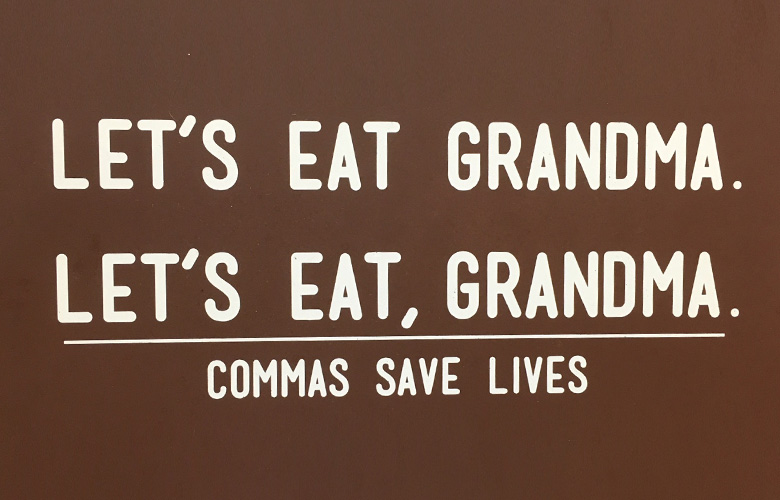
Semi-colon (;)
Linking independent clauses
The semi-colon connects two parts of a sentence that could stand alone as separate sentences. This connection shows that the ideas are closely related.
Example
Semi-colon Linking Independent Ideas
"I have a boyfriend; his name is Sam"
Both halves work as independent sentences, but the semi-colon signals that these facts are interconnected. The second clause provides specific information about the first.
Semi-colons in complex lists
Semi-colons separate items in lists where commas alone would be insufficient or confusing. This happens when:
- The list items are complex
- Commas already appear within individual items
Example
Semi-colons in Complex Lists
"'We recognised them instantly: the foreign place names such as the Somme and Ypres; the lines of men at the recruiting office; the rows of crosses in war cemeteries; the scarlet poppies blowing in the fields.'"
Here, the semi-colons separate major items in the list, while commas separate minor elements within those items. This creates clear divisions between each distinct image.
Effect on reading
Semi-colons create a stronger pause than a comma but less separation than a full stop. They tell the reader to notice the relationship between connected ideas.
Colon (:)
Three main functions
The colon introduces what follows. It signals to the reader that something specific is coming.
Example
Colon Introducing Description
"The house felt utterly abandoned: its doors hanging loose, lights extinguished, paint peeling from the walls."
The colon acts as a signal that the description of desolation is about to be provided.
Uses of the colon
- Introducing a list of items or ideas
- Signalling an explanation that follows a statement
- Introducing a quotation that supports or illustrates a point
How colons guide understanding
When you see a colon in an exam passage, the material after it often provides the answer to questions about explanation or meaning. The colon acts as a signpost, directing you to the writer's clarification or development of the preceding statement.
Important
In exam passages, colons are powerful signposts. Look after the colon for answers to "what" or "why" questions. The colon literally points you to the explanation or list you need.
The phrase "There is a predictable reaction to my preference for solitude: that I am avoiding people." uses a colon to introduce the actual response. Everything after the colon answers the implied question "What is this reaction?"
Parenthesis
What parenthesis does
Parenthesis isolates additional information that is grammatically separate from the main sentence. The sentence would still make sense if you removed the parenthetical material.
Parenthesis can be marked by:
- Paired dashes (—)
- Paired brackets ( )
- Paired commas (,)
Examples of parenthesis
Example
Paired Dashes for Parenthesis
"I often go to the cinema — the one off Union Street — on Friday evenings"
The information between the dashes adds a detail about which cinema, but removing it still leaves a complete sentence: "I often go to the cinema on Friday evenings."
Another example: "I met Kevin at the cinema last night — he often goes there on Fridays — and he told me about the strangest happening."
Why writers use parenthesis
Parenthesis allows writers to insert extra information without disrupting the main flow of the sentence. The material in parenthesis is syntactically independent – it stands apart from the grammar of the main sentence while providing useful context or detail.
Paired comma: interpolation
Understanding interpolation
Interpolation occurs when a phrase is inserted into a sentence and, unlike parenthesis, the phrase is part of the sentence's grammar.
Note
The phrase "unlike parenthesis" in the previous sentence is an example of interpolation. It cannot be removed without affecting the grammatical structure.
Effect of interpolation
Writers use interpolation to add qualifying information or conditions without starting a new sentence. This technique keeps related ideas together while delaying the main point to create emphasis or build anticipation.
Paired comma: apposition
Defining apposition
Apposition happens when a phrase explains a term while performing the same grammatical function as the word or phrase it explains.
Example
Apposition in Action
"Nicola Sturgeon, Scotland's First Minister, said in the Chamber yesterday..."
The phrase "Scotland's First Minister" is in apposition to "Nicola Sturgeon". It explains who she is, and both phrases function as the subject of the verb "said".
Formal versus informal usage
In formal English, the explanatory phrase comes after the main term, as shown above. In informal English, such as tabloid newspapers, the explanatory phrase often comes first:
Example: "Scotland's First minister, Nicola Sturgeon, said in the Chamber yesterday..."
Why apposition matters
While you are unlikely to be asked specifically about apposition, recognising it can help you identify the formality level of a text. It also shows how writers provide information efficiently by combining identification and explanation in one grammatical structure.
Note
Both interpolation and apposition can be regarded as forms of parenthesis for practical purposes.
Single dash (-)
Functions of the single dash
The single dash indicates an afterthought or adds information at the end of a sentence. In more recent usage, it can replace a colon when introducing an explanation.
Example
Single Dash Adding an Afterthought
"You know I have always regarded maths as difficult — less so as I get older."
Effect on meaning and tone
The single dash creates a pause before the final point, which often contains the most important or surprising information. This delays the main point, building anticipation or emphasis. The information after the dash feels more casual or spontaneous than information introduced by a colon.
Inverted commas
Multiple functions
Inverted commas (also called quotation marks) can be written as "double" or 'single' marks. They serve several purposes.
Uses of inverted commas
Indicating direct speech: Words actually spoken by someone
Marking quotations: Words taken from another source
Signalling titles: Books, plays, films, and other works – e.g. "Macbeth" makes clear you are discussing the play, not the character
Showing unusual usage: A word being used in an unexpected way or with a meaning different from usual
Example
Inverted Commas Showing Unusual Usage
"it's nasty if you are 'thumped' on the head by an asteroid"
The word "thumped" appears in inverted commas because it is being used in an unusual context – asteroids do not literally "thump" in the way the word normally suggests.
Indicating irony
Important
Inverted commas most frequently indicate irony – the writer is using words to mean the opposite of their literal meaning or to suggest criticism. When you see inverted commas around a word or phrase in a passage, consider whether the writer is being ironic.
Sometimes italics replace inverted commas for the same purposes.
Apostrophe
Two main uses
The apostrophe serves two distinct functions that should not be confused.
Showing contraction
An apostrophe indicates that letters have been omitted from a word:
- "don't" = do not
- "can't" = cannot
The apostrophe marks where the missing letters would be.
Indicating possession
An apostrophe shows that something belongs to someone or something:
Example: "John's book"
The book belongs to John. The apostrophe followed by 's' indicates this possession.
Note
These two functions are completely different. Contractions show missing letters, while possession shows ownership. Don't confuse them in your analysis.
Aposiopesis
Definition and purpose
Aposiopesis refers to three dots at the end of a sentence (...). This device indicates:
- The sudden ending of speech or thought
- A trailing off
- A change in subject
- An unwillingness to continue speaking or writing
Effect on the reader
Aposiopesis creates a sense of incompleteness. It suggests that something is being left to the reader's imagination or that the speaker cannot or will not continue. This can create tension, suggest hesitation, or imply that the unsaid words are too obvious or too difficult to express.
Ellipsis
How ellipsis works
Ellipsis consists of three dots in the middle of a sentence. This device shows that words have been deliberately missed out.
Example
Ellipsis Showing Omission
"To be, or not to be
That is the question
Whether 'tis ... end them"
The ellipsis indicates that words from the original passage have been omitted. This is commonly used when quoting to keep only the most relevant parts.
Difference from aposiopesis
Note
While both use three dots, ellipsis occurs within or between quoted material to show omission, whereas aposiopesis appears at the end of a sentence to show trailing off.
Remember!
Summary
Key Points to Remember:
- Punctuation marks signal meaning and guide readers through text structure
- Commas clarify relationships between sentence parts and prevent ambiguity
- Semi-colons link related independent clauses and separate complex list items
- Colons introduce lists, explanations, or quotations – look after the colon for answers to "what" or "why" questions
- Parenthesis (marked by paired dashes, brackets, or commas) adds grammatically separate information
- Inverted commas most frequently indicate irony, though they also mark speech, quotations, titles, and unusual word usage
- In exam questions, use punctuation marks as signposts to locate key information and decode the writer's intended meaning