Investigating Mechanisms & Machines (Junior Cert Engineering): Revision Notes
📚Revision Notes
Investigating Mechanisms & Machines
Why investigate mechanisms?
Studying different mechanisms helps us find solutions to our own design challenges. When we examine mechanisms, we can learn from their design features and evaluate how well they work. This investigation process makes us better at comparing products and understanding how things are maintained and repaired.

Understanding how mechanisms are built and how they operate is essential knowledge for any engineer. When buying products, this knowledge helps us make better choices by comparing different options more effectively.
Note
Investigating existing mechanisms is one of the most effective ways to improve your own design skills. By understanding what works well and what doesn't in existing products, you can apply these insights to create better solutions for new design challenges.
Assessment criteria for mechanisms
When investigating any mechanism or machine, we should evaluate it against seven key criteria:
Note
The Seven Assessment Criteria for Mechanisms:
- Appearance: How does it look? Is it visually appealing?
- Function: Does it work well? Does it do its job properly?
- Safety: Are there any risks when using it?
- Cost: Is it affordable to make and buy?
- Ease of use: Is it simple to operate?
- Reliability: Will it work consistently over time?
- Maintenance: How easy is it to keep in good condition?
These criteria provide a systematic approach to evaluating any mechanism or machine you encounter.
Practical examples of mechanisms
Can opener investigation
The can opener demonstrates how a simple mechanism can be very effective. Here's how it performs against our assessment criteria:
Example
Practical Assessment: Kitchen Can Opener
Appearance: The shape works well with kitchen cutlery and looks attractive, mainly made from stainless steel.
Function: It cuts through can lids quite successfully using a combination of cutting edge and toothed wheel.
Safety: Made from stainless steel so it won't contaminate food. The twisted handle design spreads pressure over a flat surface, making it safer to use.
Cost: Although the manufacturing tooling costs are high initially, each unit costs relatively little to produce. The materials are not expensive.
Ease of use: Requires reasonable pressure to force the cutting edge through the lid. The holes in the turning lever provide a good grip for operation.
Reliability: Over time, the toothed wheel and plastic bushings will wear out.
Maintenance: Stainless steel cleans easily, but the cutting edge and toothed wheel areas are harder to reach and need extra attention.

Surface gauge investigation
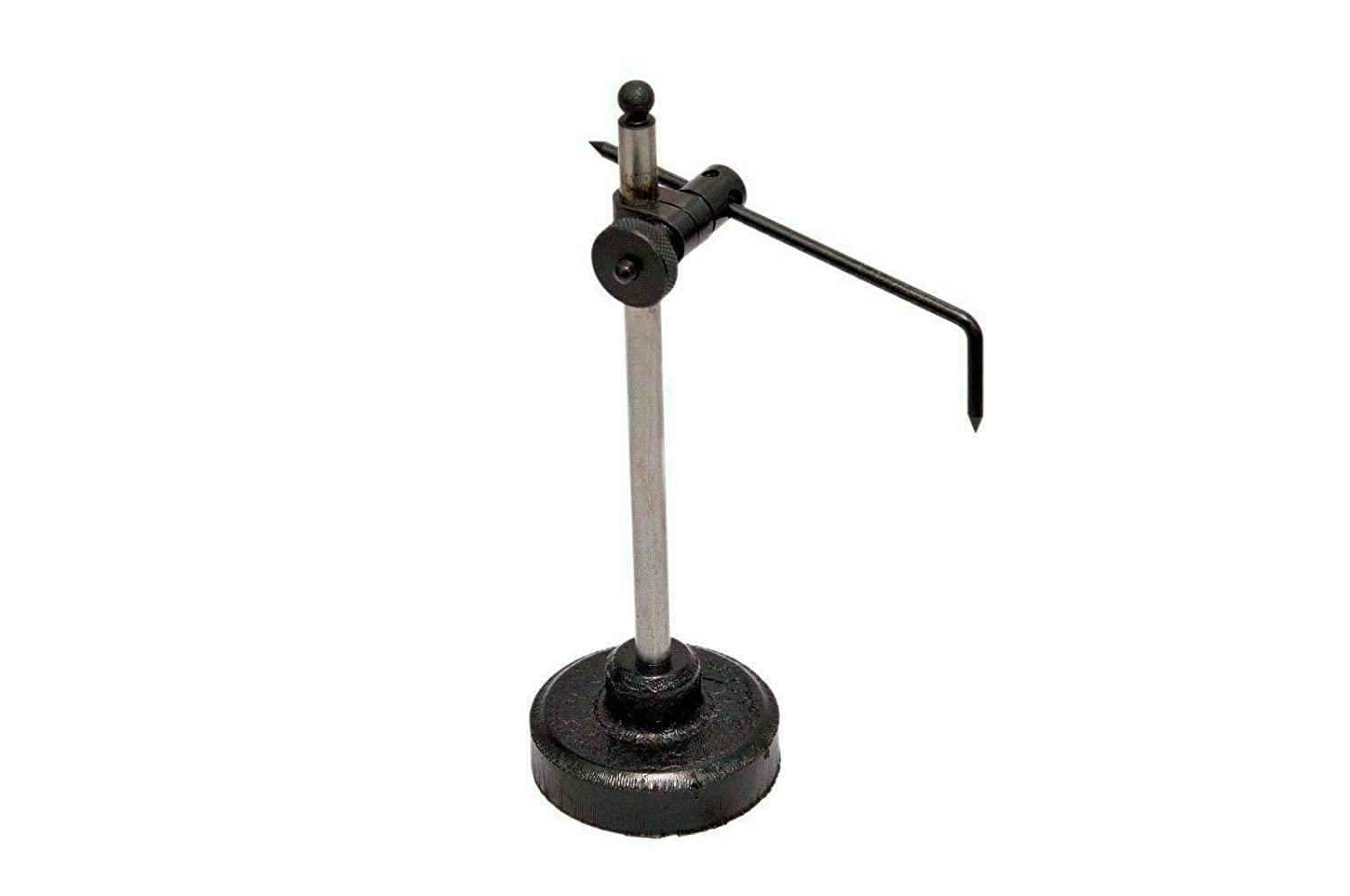
A surface gauge is a precision measuring tool used in engineering workshops.
Example
Practical Assessment: Engineering Surface Gauge
Appearance: Has a functional design with all parts the same colour, giving it an attractive professional look.
Function: Works very effectively. The clamp nut locks both the clamp block on the spindle and keeps the scriber in the correct position.
Safety: The sharp scriber point must be handled carefully to avoid injury.
Cost: Relatively inexpensive to manufacture. Most parts are made from mild steel, except the base (cast iron), scriber (high carbon steel), and spring components.
Ease of use: The scriber height must be set manually. A screw mechanism would make this faster and more accurate.
Reliability: Very reliable and durable construction.
Maintenance: The scriber point must be kept sharp for accurate measurements.
Mortise lock and latch mechanism
A mortise lock fits into a slot cut into a door and prevents the door opening except with a key. It also has a latch mechanism to keep the door closed without locking it.
The latch has one curved side that gets pushed into the lock by the receiver in the door frame when the door closes. The spring then pushes the latch forwards through the receiver into a groove in the door frame. The other side of the latch is flat, so pressure from the opposite direction won't open the door.
The latch holder connects to a follower, and a square spindle fits through this follower into the door handles. This allows either handle to turn the follower and pull back the latch. When released, the spring returns the latch to its original position.
Example
Practical Assessment: Mortise Lock System
- Appearance: Visible parts (latch, front plate, handles) look good. Brass latch is decorative and stainless steel front plate is attractive
- Function: Successfully controls door opening, closing and locking
- Safety: Poses no safety risks
- Cost: Relatively inexpensive way to control door access
- Ease of use: Simple to operate
- Reliability: Reliable and long-lasting
- Maintenance: Requires very little maintenance

Electric bell mechanism
An electric bell converts electrical energy into sound through electromagnetic principles.
The electromagnet, brass pillar and spring attach to the base but stay insulated from it. A hammer strikes the gong and attaches to a soft iron bar called an armature. When the bell switch is pressed, current flows through the electromagnet, creating magnetism that attracts the armature. This makes the hammer strike the gong.
At the same time, the spring pulls away from the contact screw, breaking the electrical circuit. Current stops flowing and the electromagnet loses its magnetism, allowing the armature and spring to return and close the circuit again. This process repeats continuously while the switch button stays pressed.
Example
Practical Assessment: Electric Bell System
- Appearance: Can look attractive if housed in a decorative case
- Function: Alerts people when someone needs attention at a door or counter
- Safety: Operates at low voltage with minimal risk
- Cost: Inexpensive to manufacture
- Ease of use: Very simple to operate
- Reliability: Contact points can corrode from electrical arcing or long periods without use
- Maintenance: Switch contacts may need attention over time

Engine mechanisms
Four-stroke spark-ignition engine
This engine type powers most motor cars and uses a crank-slider mechanism to convert the up-and-down motion of pistons into rotary motion at the crankshaft.
The main engine components work together precisely:
- Piston: The slider that travels up and down with reciprocating motion
- Piston rings: Provide gas sealing and prevent oil entering the combustion chamber
- Connecting rod: Links the piston to the crankshaft
- Crankshaft: Converts reciprocating motion into rotary motion
- Combustion chamber: Space where fuel mixture gets compressed and combustion provides the power stroke
- Cylinder: Guides piston movement and provides space for fuel mixture intake
- Valves: Control gas flow in and out of the cylinder
- Spark plug: Ignites the compressed fuel mixture
- Camshaft: Opens and closes the valves at precise times
Important
Understanding the relationship between reciprocating and rotary motion is fundamental to engine operation. The crankshaft is the key component that makes this motion conversion possible, similar to how bicycle pedals convert your leg motion into wheel rotation.
The four-stroke cycle
A stroke means the movement of the piston from its highest point to its lowest point (or vice versa). A cycle is the complete series of operations that happen in a definite order.

The four-stroke engine needs four piston strokes (two crankshaft revolutions) for each complete cycle:
Example
The Four-Stroke Engine Cycle Process
1. Induction stroke: The inlet valve opens and exhaust valve closes. The piston moves down, creating a partial vacuum that draws the fuel mixture (air and petrol) into the cylinder.
2. Compression stroke: Both valves close. The piston moves up, compressing the fuel mixture into the combustion chamber.
3. Power stroke: At the end of compression, the spark plug ignites the fuel mixture. Rapid combustion creates a huge temperature and pressure increase, forcing the piston downwards. Both valves stay closed.
4. Exhaust stroke: The exhaust valve opens and inlet valve closes. The piston moves up, pushing the burnt gases out through the exhaust valve.
Memory aid: Remember "In-Com-Pow-Ex" for Induction, Compression, Power, Exhaust!
Two-stroke engine
This simpler engine design is commonly used in motorcycles and small boat engines. It completes a full cycle in just two strokes (one crankshaft revolution).
Instead of valves, the two-stroke engine uses three ports that get covered and uncovered as the piston moves up and down:
Upward stroke: As the piston moves up, it covers the transfer and exhaust ports while uncovering the inlet port. The partial vacuum below the piston draws fuel mixture into the crankcase. Meanwhile, the mixture above the piston gets compressed.
Downward stroke: At the end of the upward stroke, the spark plug ignites the compressed fuel mixture. The combustion forces the piston down the cylinder. As it travels down, it compresses the mixture in the crankcase and uncovers the transfer and exhaust ports. This allows the compressed mixture to transfer to the top of the cylinder while burnt gases escape.

Note
The key advantage of two-stroke engines is their simplicity - they produce power on every downstroke rather than every other downstroke like four-stroke engines. However, they are generally less fuel-efficient and produce more emissions.
Summary
Key Points to Remember:
- Investigation criteria: Always assess mechanisms using the seven key criteria - appearance, function, safety, cost, ease of use, reliability, and maintenance
- Learning from examples: Studying existing mechanisms helps us solve our own design problems and make better purchasing decisions
- Engine cycles: Four-stroke engines need four piston movements (two crankshaft turns) per cycle, while two-stroke engines need only two movements (one crankshaft turn)
- Motion conversion: Many mechanisms convert one type of motion into another - engines convert reciprocating piston motion into rotary crankshaft motion
- Safety first: Always consider safety when investigating mechanisms, especially with sharp tools like scribers or moving parts in engines