Lennie Small (Junior Cert English): Revision Notes
📚Revision Notes
Lennie Small
Introduction to Lennie Small
Lennie Small is one of the two main characters in John Steinbeck's "Of Mice and Men." Despite his surname suggesting otherwise, Lennie is physically enormous and represents one half of the central friendship that drives the novel's plot. He travels with George Milton as a migrant worker during the Great Depression, but his intellectual disability makes him completely dependent on George for survival in their harsh world.
Physical appearance and the irony of his name
Steinbeck creates immediate contrast through Lennie's physical description. While his surname is "Small," Lennie is actually a giant of a man whose imposing presence dominates every scene he enters. This irony extends beyond just his name - his massive physical strength contrasts sharply with his limited mental capacity, creating the central tension of his character.
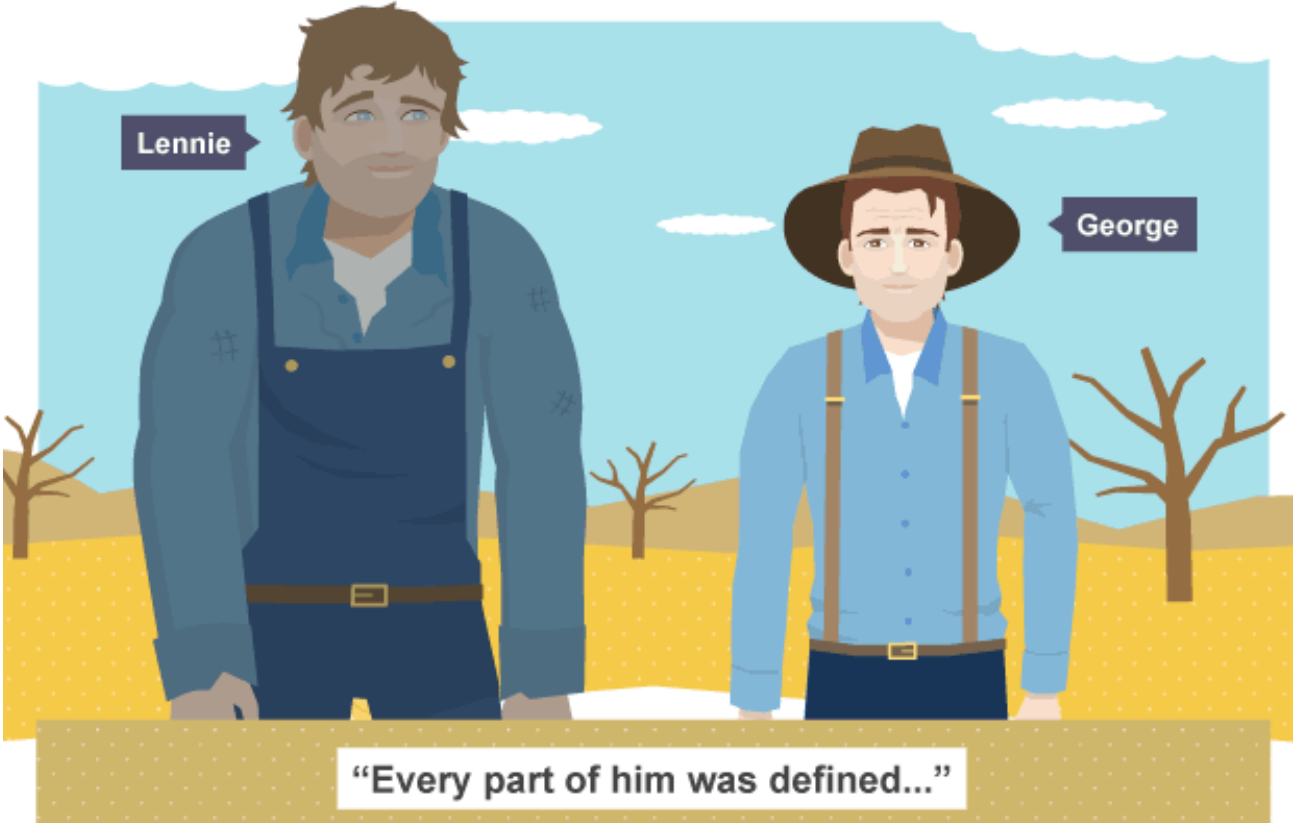
The author describes Lennie as George's complete opposite in almost every way. Where George is quick-witted and sharp, Lennie is slow-thinking and gentle. This physical and mental contrast between the two friends becomes a key element in understanding their relationship and the challenges they face together.
Example
Supporting Evidence: Physical Description
Steinbeck introduces Lennie with the description: "Behind him walked his opposite, a huge man, shapeless of face, with large, pale eyes, with wide sloping shoulders."
This quote immediately establishes the physical contrast between the two men and hints at Lennie's mental limitations through the description of his "shapeless" face and vacant eyes.
The emphasis on Lennie's size serves multiple purposes in the novel. It foreshadows the problems his strength will cause later, while also highlighting his vulnerability despite his imposing appearance. His physical description focuses on his bulk and power, which becomes tragically ironic given his gentle, childlike nature.
Mental disability and dependence
Important
Lennie's intellectual disability is central to understanding his character and the novel's themes. He cannot navigate the complex social world of the ranch without George's constant guidance and protection.
His disability manifests in several ways throughout the novel. He struggles to understand social situations, cannot remember instructions for long periods, and fails to grasp the consequences of his actions. This makes him incredibly vulnerable in the harsh environment of 1930s migrant work, where survival depends on quick thinking and social awareness.
Lennie's relationship with George demonstrates both the burden and the beauty of caring for someone with special needs. George must constantly watch over Lennie, make decisions for him, and protect him from a world that doesn't understand or accept his differences.
Note
This dependence creates both the bond between the two men and the ultimate tragedy of the story, as Lennie's vulnerability in an unforgiving world drives the plot towards its inevitable conclusion.
Lack of control and accidental violence
Important
One of Lennie's most dangerous characteristics is his complete lack of awareness regarding his own physical strength. This creates a pattern of accidental violence throughout the novel that ultimately leads to the tragic conclusion.
Lennie's fascination with soft things - mice, puppies, hair - combined with his inability to control his strength, creates deadly situations. He doesn't intend to cause harm, but his childlike desire to touch and pet soft objects results in death and destruction.
Example
Supporting Evidence: Accidental Violence
When explaining how he killed his puppy, Lennie says: "He was so little, I was jus' playin' with him ... an' he made like he's gonna bite me ... an' I made like I was gonna smack him ... an' ... an' I done it. An' then he was dead."
Literary Analysis:
- The ellipsis shows Lennie's emotional distress and inability to express himself clearly
- His repetition of "an'" reflects his childlike speech patterns
- The passive phrase "then he was dead" shows he doesn't understand his role in causing the death
Innocent nature and social understanding
Lennie's innocence is both his most endearing quality and his greatest weakness. Unlike the other ranch workers who are hardened by prejudice and bitterness, Lennie approaches everyone with kindness and openness. He doesn't understand social hierarchies or the racism and sexism that poison the ranch environment.
This innocence means he treats everyone equally - he's happy to talk to Crooks despite the racial segregation, and he shows no prejudice towards Curley's wife despite the other men's warnings. His genuine kindness stands in stark contrast to the cruelty and loneliness that surrounds him.
Example
Supporting Evidence: Innocent Response to Violence
When Curley attacks him, "Lennie covered his face with huge paws and bleated with terror. He cried, 'Make 'um stop, George.'"
Literary Analysis: The use of animalistic language ("paws," "bleated") shows how Lennie is described in terms that emphasise his lack of understanding. Rather than fighting back, which his size would easily allow, he looks to George for protection and guidance.
Sweet-natured personality
Despite his size and strength, Lennie possesses a naturally sweet and gentle disposition. He finds joy in simple pleasures and maintains an optimistic outlook even in difficult circumstances. This sweet nature makes him loveable to readers and explains why George continues to care for him despite the challenges.
Lennie's happiness is easily achieved through small gestures or simple pleasures. He doesn't require complex entertainment or sophisticated conversation - he's content with basic kindness and the promise of their shared dream of owning a farm.
Example
Supporting Evidence: Sweet Nature
After George scolds him, Lennie quickly recovers his good mood: "That's good, he said. You drink some, George. You take a good big drink. He smiled happily."
This demonstrates how Lennie moves on from negative experiences quickly and focuses on caring for George. His ability to "smile happily" after being upset shows his sweet nature and his genuine concern for his friend's wellbeing.
Relationship with George and others
Lennie's relationship with George forms the emotional heart of the novel. While George sometimes shows frustration with the responsibility of caring for Lennie, their friendship represents one of the few genuine connections in a world marked by isolation and loneliness.
Lennie only shows aggression when he perceives threats to his friendship with George. This protective instinct reveals the depth of his attachment and his understanding that George is essential to his survival. When Crooks suggests that George might abandon him, Lennie becomes genuinely angry - one of the few times he shows this emotion.
Note
His interactions with other characters reveal his social innocence. He doesn't understand why others reject Crooks or why they view Curley's wife with suspicion. This lack of social awareness makes him vulnerable but also highlights the artificial nature of the prejudices that divide the ranch workers.
Summary
Key Points to Remember:
-
Lennie Small is physically large and strong, making his surname ironic and highlighting the contrast between his physical and mental capacities
-
His intellectual disability makes him completely dependent on George for survival, creating both the central relationship and the main conflict of the novel
-
His lack of control over his strength leads to accidental violence, including the deaths of mice, his puppy, and eventually Curley's wife
-
His innocent and sweet nature sets him apart from the other ranch workers and makes him treat everyone with equal kindness
-
His only aggressive moments occur when he feels his friendship with George is threatened, showing the protective depth of their bond