Food (Junior Cert French): Revision Notes
📚Revision Notes
Food
Basic Vocabulary
Vegetables
| French | English |
|---|---|
| Les légumes (m) | Vegetables |
| Une carotte | A carrot |
| Une tomate | A tomato |
| Une pomme de terre | A potato |
| Un oignon | An onion |
| Un poivron | A pepper (bell pepper) |
| Une courgette | A zucchini |
| Un concombre | A cucumber |
| Des haricots verts (m) | Green beans |
| Des épinards (m) | Spinach |
| Un champignon | A mushroom |
| Un chou | A cabbage |
| Un brocoli | A broccoli |
| Une aubergine | An eggplant |
Fruits
| French | English |
|---|---|
| Les fruits (m) | Fruits |
| Une pomme | An apple |
| Une banane | A banana |
| Une orange | An orange |
| Une fraise | A strawberry |
| Une poire | A pear |
| Une pêche | A peach |
| Une cerise | A cherry |
| Un raisin | A grape |
| Un citron | A lemon |
| Une mangue | A mango |
| Un ananas | A pineapple |
| Une pastèque | A watermelon |
| Une prune | A plum |
| Un pamplemousse | A grapefruit |
Meat and Fish
| French | English |
|---|---|
| La viande | Meat |
| Le poulet | Chicken |
| Le bœuf | Beef |
| Le porc | Pork |
| L'agneau (m.) | Lamb |
| Le canard | Duck |
| Le jambon | Ham |
| Le poisson | Fish |
| Le saumon | Salmon |
| Le thon | Tuna |
| Les fruits de mer (m) | Seafood |
| Les crevettes (f) | Shrimp |
| Un homard | A lobster |
| Les moules (f) | Mussels |
Dairy Products
| French | English |
|---|---|
| Les produits laitiers (m) | Dairy products |
| Le lait | Milk |
| Le fromage | Cheese |
| Le beurre | Butter |
| Le yaourt | Yoghourt |
| La crème | Cream |
| La glace | Ice cream |
| La crème fraîche | Sour cream |
| Le lait entier | Whole milk |
| Le lait écrémé | Skimmed milk |
| Le lait d'amande | Almond milk |
| Le lait de soja | Soy milk |
| Le lait de coco | Coconut milk |
Desserts and Sweets
| French | English |
|---|---|
| Le dessert | Dessert |
| Un gâteau | A cake |
| Une tarte | A tart/pie |
| Un biscuit | A cookie/biscuit |
| Une glace | An ice cream |
| Une crêpe | A crepe |
| Une mousse au chocolat | A chocolate mousse |
| Une crème brûlée | A crème brûlée |
| Un bonbon | A candy/sweet |
| Une pâtisserie | A pastry |
| Une gaufre | A waffle |
| Une brioche | A brioche |
| Un macaron | A macaron |
| Un éclair | An éclair |
| Un croissant | A croissant |
Note
La gastronomie française est réputée dans le monde entier. French gourmet cuisine is renowned worldwide.
Discussing Personal Food Preferences
Here are some phrases to help you express your personal preferences for food:
| French | English |
|---|---|
| Mon plat préféré est... | My favourite dish is... |
| J'aime bien les légumes, surtout... | I really like vegetables, especially... |
| Je ne mange pas de viande parce que... | I don't eat meat because... |
| J'adore les desserts sucrés. | I love sweet desserts. |
| Ce que j'aime le plus dans ce plat, c'est... | What I like most about this dish is... |
Example Sentences:
- J'adore la cuisine italienne, surtout les pâtes. (I love Italian cuisine, especially pasta.)
- Je suis végétarien(ne), donc je ne mange pas de viande. (I'm vegetarian, so I don't eat meat.)
Note
Grammar Point: Using 'On' in French "On" is often used to mean "we," "you," "they," or even "people" in a general sense. It's a very flexible word! Instead of saying "nous" (we), French speakers often prefer to use "on" because it sounds more casual and natural in conversation.
How do you use "on"?
The verb that follows "on" is always conjugated like it would be with "il/elle" (he/she). So, if you know how to conjugate a verb in the "il/elle" form, you can use it with "on" too!
- On mange du pain au petit-déjeuner. (We eat bread for breakfast.)
- Here, "on mange" means "we eat." Notice how the verb "manger" (to eat) is conjugated in the same way as "il mange" (he eats) or "elle mange" (she eats).
- En France, on boit beaucoup de café. (In France, people drink a lot of coffee.)
- On achète des fruits et légumes au marché le samedi. (We buy fruits and vegetables at the market on Saturdays.)
Using "on" is a great way to sound more like a native speaker. It's less formal than "nous" and is used all the time in conversation.
Cooking and Recipe Vocabulary
Cooking Verbs
| French | English |
|---|---|
| Cuisiner | To cook |
| Préparer | To prepare |
| Couper | To cut |
| Mélanger | To mix |
| Rôtir | To roast |
| Griller | To grill |
| Cuire | To cook (in general) |
| Cuire au four | To bake |
| Peler | To peel |
| Faire fondre | To melt |
| Verser | To pour |
| Ajouter | To add |
| Battre | To beat/whisk |
| Réchauffer | To reheat |
| Faire dorer | To brown |
Recipe Terms
| French | English |
|---|---|
| Une recette | A recipe |
| Un ingrédient | An ingredient |
| Une étape | A step |
| Une portion | A portion |
| Une cuillère à soupe | A tablespoon |
| Une cuillère à café | A teaspoon |
| Une pincée | A pinch |
| Un verre | A glass |
| Un bol | A bowl |
| Un saladier | A mixing bowl |
| Une casserole | A saucepan |
| Une poêle | A frying pan |
| Un four | An oven |
| Un micro-ondes | A microwave |
| Un fouet | A whisk |
| Une balance | A scale |
| Un couteau | A knife |
Note
Grammar Point: "Fondre" means "to melt." You might see it like:
- Le chocolat fond. (The chocolate is melting.)
But if you're the one doing the melting, you use "faire fondre," which means "to melt" something:
- Faire fondre le beurre. (Melt the butter.)
Le chocolat fond. (The chocolate is melting.)
vs
Je fais fondre le chocolat. (I melt the chocolate.)
Common Ingredients
| French | English |
|---|---|
| La farine | Flour |
| Le sucre | Sugar |
| Le sel | Salt |
| Le poivre | Pepper |
| L'huile (f.) | Oil |
| Le vinaigre | Vinegar |
| Le beurre | Butter |
| La vanille | Vanilla |
| La cannelle | Cinnamon |
| Le miel | Honey |
| Les herbes | Herbs |
| Le persil | Parsley |
| L'ail | Garlic |
| L'oignon | Onion |
Kitchen Appliances
| French | English |
|---|---|
| Un four | An oven |
| Un micro-ondes | A microwave |
| Un réfrigérateur/le frigo | A refrigerator |
| Un congélateur | A freezer |
| Un lave-vaisselle | A dishwasher |
| Un mixeur | A blender |
| Une bouilloire | A kettle |
| Un grille-pain | A toaster |
Exam Focus
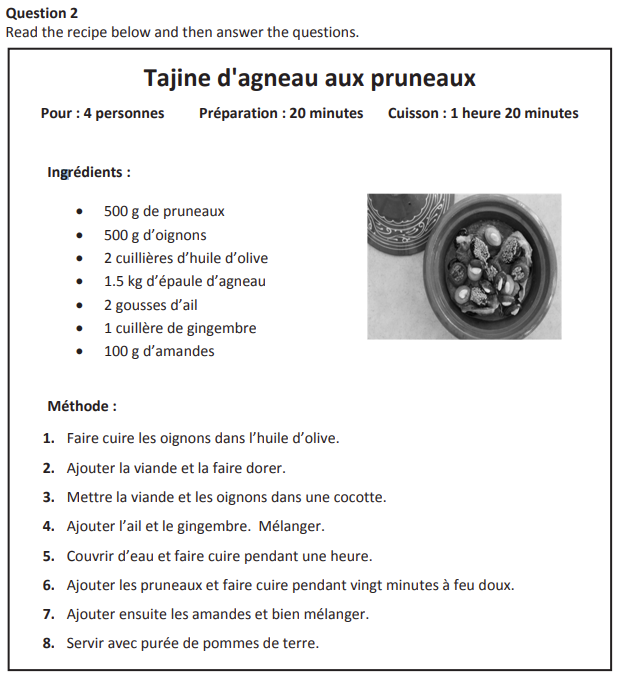
Let's take a look at how recipes have appeared in past French exams. In the old Junior Cert French course, a reading comprehension featuring a recipe was almost always included. While the new Junior Cycle French exams don't follow a strict pattern, the history of a dish—"La vraie histoire de la tarte Tatin"—along with an ingredient list, was included as Question 12 in the 2024 paper.
Although the format of the exam has evolved, practicing with these older papers is still valuable. They offer great preparation for similar types of questions that might appear, helping you become more familiar with the style of the exam.
Junior Certificate Examination 2019, Q2 (Higher Level)
Step-by-Step Strategy for Tackling Recipe Questions
- Read the Title First The title gives you a quick idea of what the recipe is about. For example, "Tajine d'agneau aux pruneaux" tells you it's a lamb tagine with prunes, so you'll know what kind of ingredients and steps to expect.
- Read the Questions Reading the questions before diving into the recipe helps you know what specific details to look for, saving time and avoiding confusion. Scan each question, noting the key words. Underline or highlight the question words (like "what," "how," "where") to make sure you understand exactly what is being asked.
- Skim the Recipe for Main Ideas Skimming gives you an overall sense of the recipe, helping you spot the main ingredients and actions without getting stuck on unfamiliar words. Focus on the title, ingredients list, and action verbs to understand the general process.
- Read the Recipe More Carefully With the questions in mind, carefully read the recipe to find the specific details you need to answer them. As you read, underline or highlight the parts that seem to answer the questions. This will help you find the answers more easily later.
- Answer the Questions Methodically Answering questions one by one ensures you cover everything thoroughly. Start with the easiest questions first, if needed. Make sure your answers are clear and directly address what's being asked. Refer back to the text as needed.
- Use Context Clues You won't always know every word, but that's okay! Use the context of the sentence or surrounding words to make an educated guess. For example, if you see the word "oignons" (onions) near an unfamiliar verb, it's likely related to cooking or preparing the onions. Use what you already know to help you figure out the rest.
- Double-Check Your Answers Double-checking ensures you haven't missed anything and helps you catch any simple mistakes. Review each answer to make sure it matches the information in the recipe. Confirm that your answers fully address the questions-check the question word.
- Stay Calm and Confident Staying calm helps you think clearly and recall what you've learned more easily. Remind yourself that you've prepared well! If a question seems difficult, don't panic—take your time and work through it logically.
Let's apply the strategy to the "Tajine d'agneau aux pruneaux" recipe question:
- Read the Title First Title: "Tajine d'agneau aux pruneaux"
This tells us the recipe is for a lamb tagine with prunes. Knowing this helps you anticipate the ingredients and steps involved.
- Read the Questions
- Before diving into the recipe, read the questions carefully:
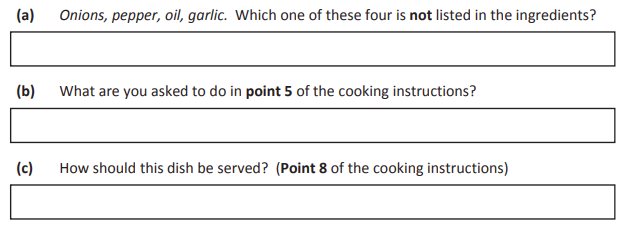
- (a) Which one of these four is not listed in the ingredients? (Onions, pepper, oil, garlic)
- (b) What are you asked to do in point 5 of the cooking instructions?
- (c) How should this dish be served? (Point 8 of the cooking instructions)
Focus on the key words like "not listed," "point 5," and "served" so you know what to look for.
- Skim the Recipe for Main Ideas
- Ingredients: Quickly scan the ingredients list to get a basic idea of them.
- Method: Skim through the method to understand the basic steps. This will give you an idea of what the recipe involves and prepare you for the detailed reading.
- Read the Recipe More Carefully
- Now, read the recipe carefully, focusing on the details that answer the questions:
- For Question (a), check the ingredient list. When you come across any of the four ingredients specified in the question (Onions, pepper, oil, garlic), make a note of it. You can then identify which one is not listed.
- For Question (b), check point 5: "Couvrir d'eau et faire cuire pendant une heure." (Cover with water and cook for an hour).
- For Question (c), check point 8: "Servir avec purée de pommes de terre." (Serve with mashed potatoes).
- Answer the Questions Methodically
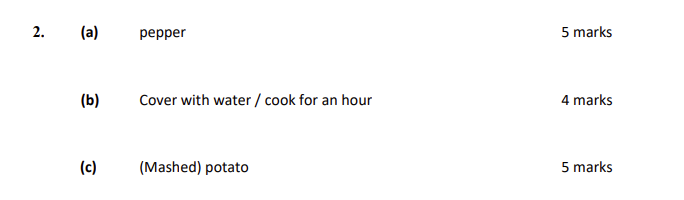
- (a) Pepper is the ingredient not listed.
- (b) Point 5 instructs you to cover with water and cook for an hour.
- (c) Point 8 says the dish should be served with mashed potatoes.
- Use Context Clues If you're unsure of a word, use the surrounding words to help you guess its meaning.
- Double-Check Your Answers Go back to the recipe and verify that your answers are correct. Make sure pepper is indeed missing from the ingredients and that you've interpreted points 5 and 8 correctly.
The Marking Scheme:
Translation
| French | English |
|---|---|
| Tajine d'agneau aux pruneaux | Lamb Tagine with Prunes |
| Pour : 4 personnes | Serves: 4 people |
| Préparation : 20 minutes | Preparation: 20 minutes |
| Cuisson : 1 heure 20 minutes | Cooking: 1 hour 20 minutes |
| Ingrédients : | Ingredients: |
|---|---|
| 500 g de pruneaux | 500 g prunes |
| 500 g d'oignons | 500 g onions |
| 2 cuillères d'huile d'olive | 2 tablespoons olive oil |
| 1.5 kg d'épaule d'agneau | 1.5 kg lamb shoulder |
| 2 gousses d'ail | 2 garlic cloves |
| 1 cuillère de gingembre | 1 teaspoon ginger |
| 100 g d'amandes | 100 g almonds |
| Méthode : | Method: |
|---|---|
| 1. Faire cuire les oignons dans l'huile d'olive. | 1. Cook the onions in olive oil. |
| 2. Ajouter la viande et la faire dorer. | 2. Add the meat and brown it. |
| 3. Mettre la viande et les oignons dans une cocotte. | 3. Place the meat and onions in a casserole dish. |
| 4. Ajouter l'ail et le gingembre. Mélanger. | 4. Add the garlic and ginger. Mix well. |
| 5. Couvrir d'eau et faire cuire pendant une heure. | 5. Cover with water and cook for one hour. |
| 6. Ajouter les pruneaux et faire cuire pendant vingt minutes à feu doux. | 6. Add the prunes and cook for twenty minutes on low heat. |
| 7. Ajouter ensuite les amandes et bien mélanger. | 7. Then add the almonds and mix well. |
| 8. Servir avec purée de pommes de terre. | 8. Serve with mashed potatoes. |