Plate Tectonics (Junior Cert Geography): Revision Notes
📚Revision Notes
Plate Tectonics
Plates and Convection Currents
Plates: Large, rigid pieces of the Earth's crust.
- The Earth's crust is not a single, solid piece. It is broken into several plates.
- Continents and oceans rest on these plates.
- These plates move very small distances each year. Movement of Plates: Plates move because of convection currents in the mantle.
Note
Convection Currents: These are circular movements of hot magma within the mantle that cause plates to shift.
Stages of Convection Currents:
- Heating and Rising: Heat from the Earth's core causes magma to heat up, expand, and rise towards the crust.
- Spreading and Dragging: When magma reaches the base of the crust, it spreads out in different directions. This movement drags the plates along with it.
- Cooling and Sinking: As magma moves away from the core and towards the crust, it cools down and becomes heavier.
- Sinking Back Down: The cooler, heavier magma sinks back towards the core.
- Cycle Repeats: This process continues, causing the plates to keep moving. This continuous cycle drives the movement of the Earth's plates.
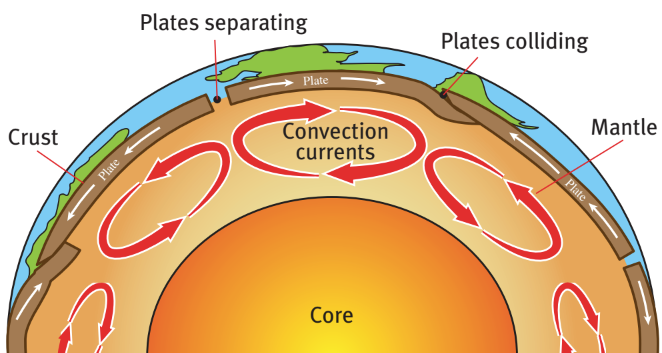
Plate Boundaries
Plate boundaries are the edges where two tectonic plates meet. These boundaries are the sites of significant geological activity such as earthquakes, volcanoes, and the formation of mountains.
There are three types of plate boundaries:
- Constructive Plate Boundaries
- Destructive Plate Boundaries
- Passive Plate Boundaries
Note
Plate boundaries are the edges where two tectonic plates meet.
Types of Plate Boundaries:
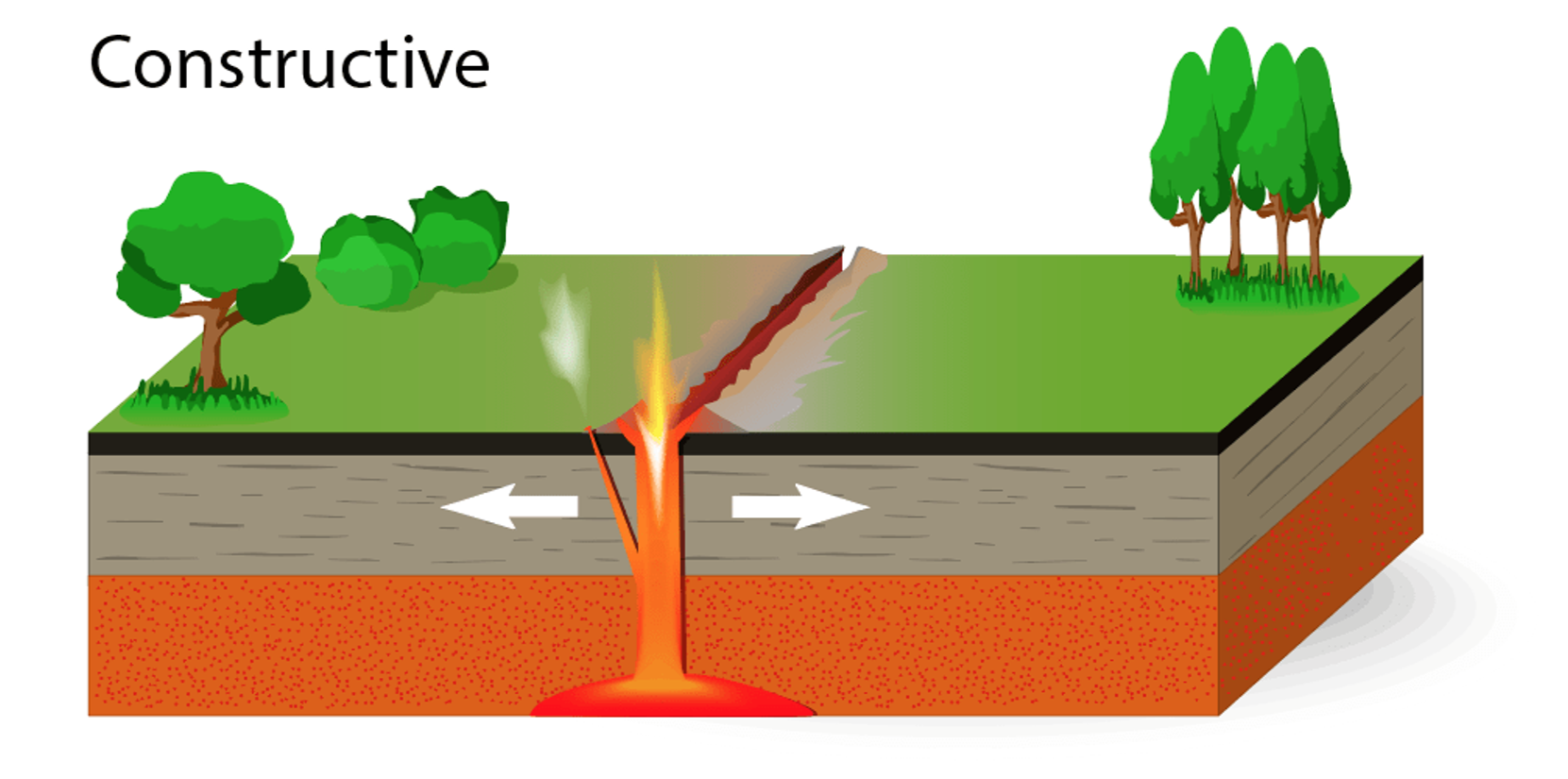
- Constructive (or Divergent) Plate Boundary
- Occurs where two plates are moving away from each other.
- The plates are pulled apart by convection currents in the mantle.
- As the plates separate, molten magma rises through the gap, creating new land. The gap is called a fissure.
- Features: New land formation, volcanoes, mid-ocean ridges, earthquakes.
- Example: The Mid-Atlantic Ridge which runs through Iceland.
- Destructive (or Convergent) Plate Boundary
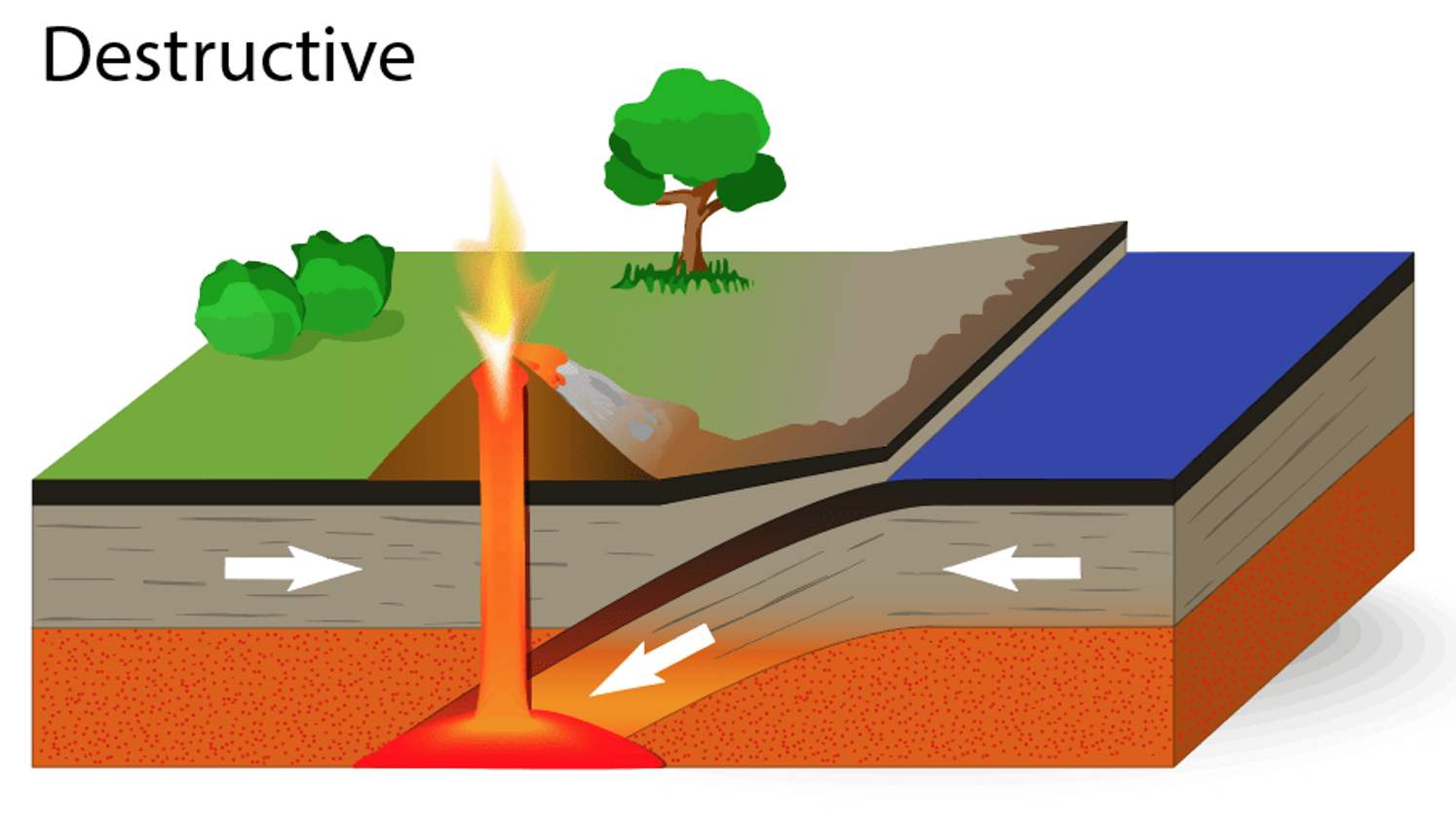
- Happens where two plates collide.
- Convection currents cause two plates to be pushed towards each other.
- One plate (usually oceanic) sinks below the other (continental) into the mantle and is destroyed.
- The collision causes the Earth's crust to buckle, forming fold mountains and sometimes triggering volcanoes.
- Features: Fold mountains, volcanoes, earthquakes.
- Example: The Andes Mountains in South America.
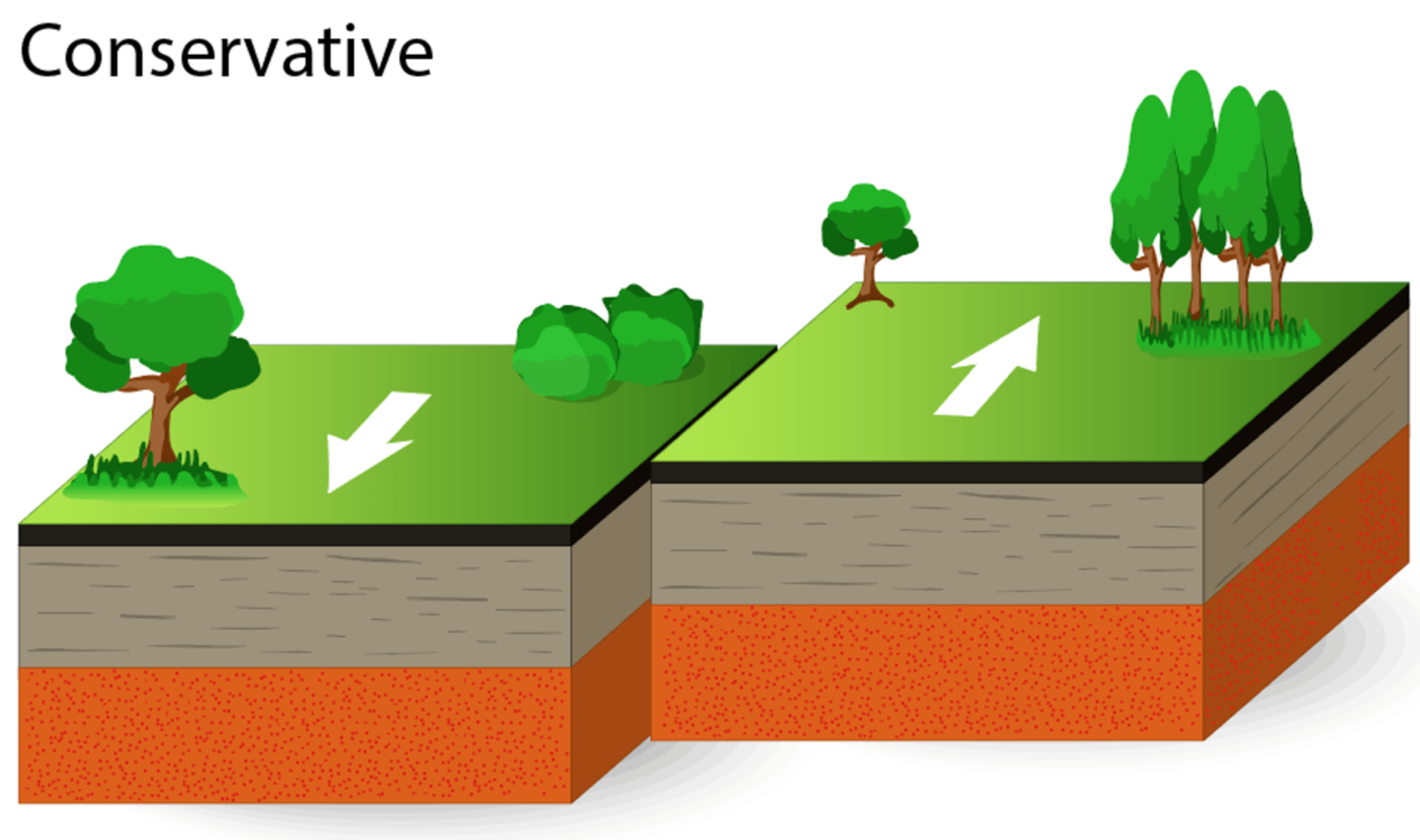
- Passive (or Conservative) Plate Boundary
- Occurs where two plates slide past each other horizontally.
- The plates move in opposite directions or at different speeds.
- The movement can cause the plates to get stuck. When they finally move, the energy released results in an earthquake.
- Features: Earthquakes.
Note
Types of Plate Boundaries:
- Constructive Plate Boundaries: Where two tectonic plates move apart, allowing magma to rise and form new crust (e.g., mid-ocean ridges).
- Destructive Plate Boundaries: Where two tectonic plates collide, and one is forced under the other, leading to volcanic activity or mountain formation.
- Passive Plate Boundaries: Where two tectonic plates slide past each other horizontally without creating or destroying crust (e.g., The Andes Mountains in South America).
The Theory of Continental Drift
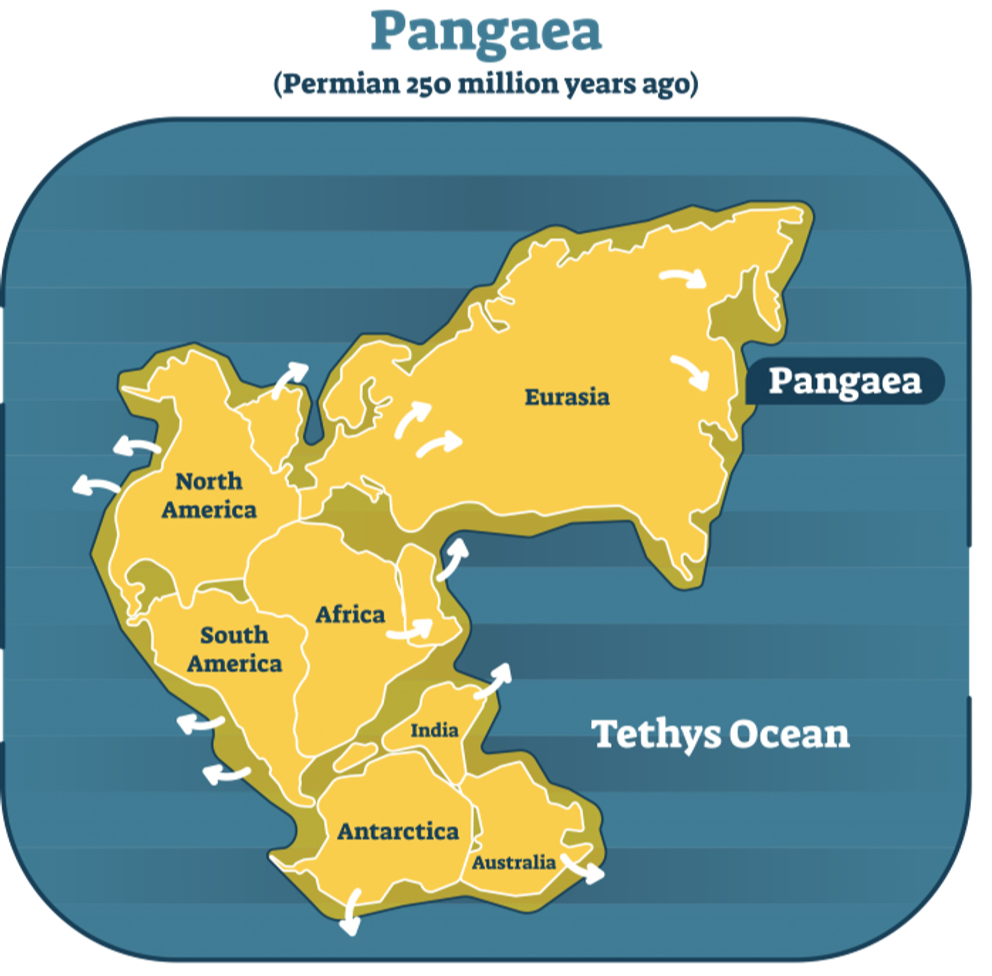
Millions of years ago, the Earth didn't look like it does today. According to the Theory of Continental Drift, all the continents were once joined together in a single supercontinent called Pangaea
Note
Continental drift is the theory that the continents were once connected as a single landmass called Pangaea and have since drifted apart.
- Alfred Wegener, a German scientist, proposed this idea in 1912.
- Wegener believed that 200 million years ago, all continents were joined together in Pangaea.
- He noticed that the continents seemed to fit together like pieces of a jigsaw puzzle. For example, if you look at a world map, you can see how the east coast of South America fits with the west coast of Africa.
- Wegener suggested that these continents were once joined but have slowly drifted apart over millions of years.
- His theory was supported by evidence such as:
- Fossils of the same animals and plants found on different continents, even though these continents are now separated by oceans.
- Similar types of rock formations found along the edges of continents that are now far apart, suggesting they were once joined together.
- Wegener's theory couldn't explain how the continents moved, so it wasn't accepted until 1963 when Plate Tectonics provided the explanation. This process is still happening today. The plates shift only a few centimetres each year, but over millions of years, this small movement has a big impact.
As the plates move, they can bump into each other, pull apart, or slide past one another. This movement is the reason we have earthquakes, volcanoes, and mountains.
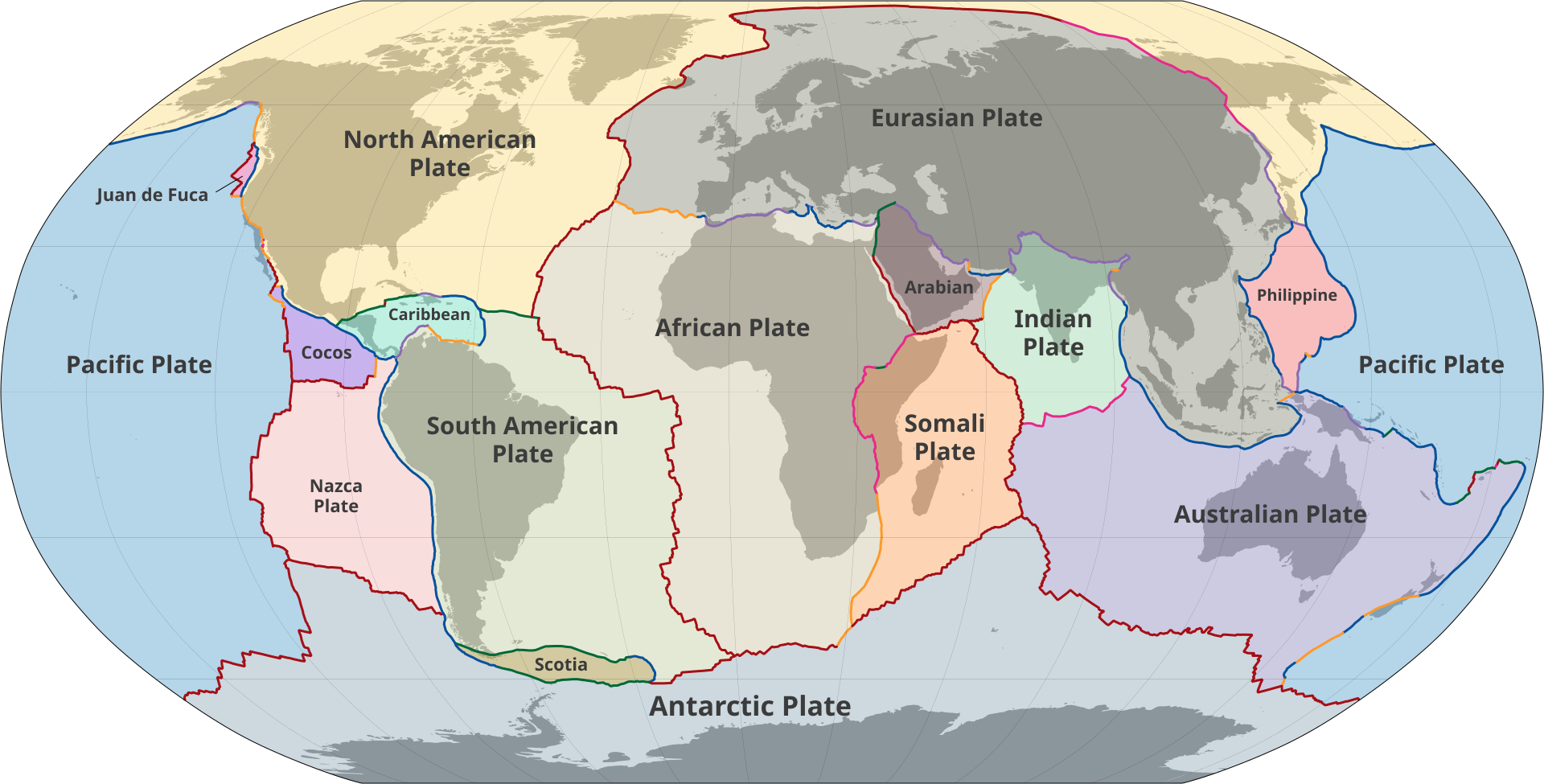
Plates of the Earth
The Earth is divided into plates. The plates roughly correspond to the continents of the earth as shown below: