History and the Historian (Junior Cert History): Revision Notes
📚Revision Notes
History and the Historian
What is History?
- History is the study of the past.
- A source provides information about people, places, or things from the past.
- Prehistory refers to the time before writing was used.
- Archaeology is the study of physical remains left by people.
The Study of History
- Studying history helps us to understand how human experiences shape society and the world, helping us learn from past mistakes and be inspired.
- Historical consciousness means placing ourselves in past experiences, connecting the past, present, and future.
- A historian is an expert or student of history.
- An archaeologist investigates ancient sites and objects, including those from before written records.
The Job of the Historian
- Historians gather evidence from multiple sources.
- An archive stores written sources and other types of sources.
- A museum collects and displays objects.
- Cross-checking involves using multiple sources to verify information.
- A primary source is from the time of the event (roman coin or a vikings helmet).
- A secondary source is created later (documentary on an event, your history textbook)
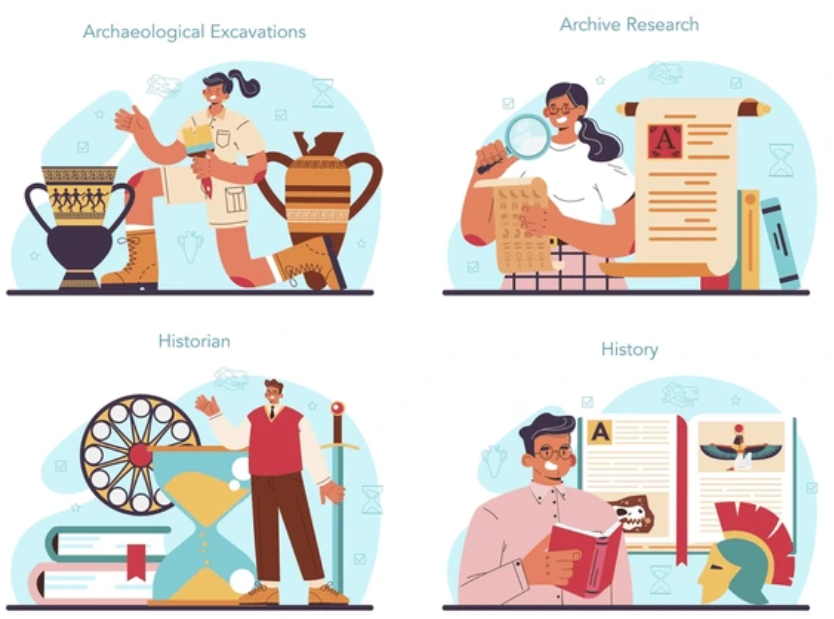
Working with Sources
-
Accuracy is assessing the correctness of information.
-
Bias is when an account unfairly favours one side.
-
Exaggeration is when something is overstated.
-
Propaganda aims to influence public attitudes. Sources can be…
-
written (diaries, letters)
-
visual (photos, posters),
-
aural (recorded interviews),
-
oral (interviews by researchers)
-
tactile (artefacts).
Time and Timelines
- Chronology orders events as they happened.
- Historians use timelines to organise events.
- A decade is 10 years, a century is 100 years, and a millennium is 1,000 years.
- New evidence can lead to reinterpretation, viewing events in a new light.
Historical Repositories
- Historical repositories store and maintain evidence of the past, such as artefacts and documents.
- Examples include the National Museum of Ireland, the National Archives of Ireland, and Titanic Belfast.
Key Terms
- History is the study of past events, particularly in human affairs. It's like a big storybook that tells us what happened in different times and places, who the important people were, and how events shaped the world we live in today.
- A source is any material that provides information or evidence about the past. There are two main types:
- Primary sources: These are original materials from the time being studied, like letters, photographs, or artefacts.
- Secondary sources: These are works that analyse or interpret primary sources, like textbooks or articles written by historians.
- Archaeology is the study of human history through the excavation of sites and the analysis of artefacts and other physical remains. Think of archaeologists as detectives who dig into the ground to uncover objects like pottery, tools, and bones that people left behind, helping us learn about how they lived.
- Chronology is the arrangement of events in the order they happened. It's like a timeline that helps us understand which events came first, which came next, and how they are related. For example, knowing that the ancient Egyptians built the pyramids before the Roman Empire existed is understanding history in chronological order.
- Propaganda is information, especially biassed or misleading, used to promote a particular political cause or point of view. It's like advertising but often used by governments or groups to influence people's opinions and actions. For example, during wars, propaganda posters might be used to encourage people to support the war effort or view the enemy in a negative light