Medieval Times (Junior Cert History): Revision Notes
📚Revision Notes
Mediaeval Times
The Feudal System
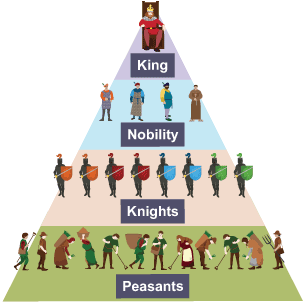
- The Middle Ages began after the fall of the Roman Empire, introducing feudalism.
- Rulers owned land, which was divided among lords and nobles in return for loyalty and taxes.
- These vassals received a fief (land) to hire peasants to farm while swearing an oath of fealty to the king.
Medieval Countryside
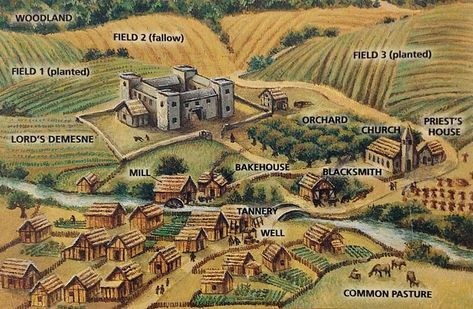
- Most people lived in the countryside in manors owned by a lord or knight.
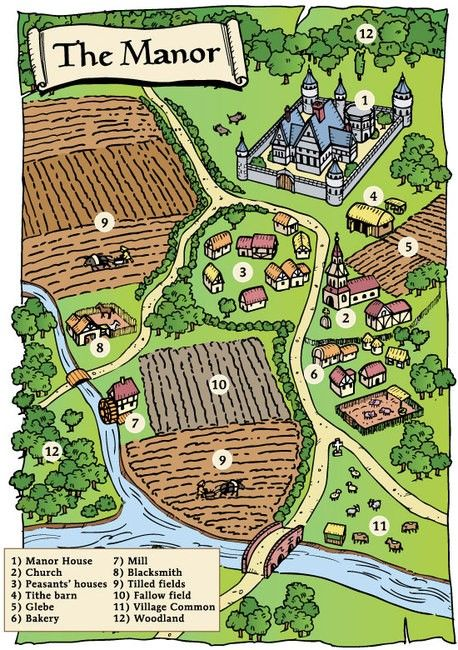
- Typical manor features included houses, a manor house, church, mill, forge, and bailiff's house.
Medieval Farming
- Peasants used the open field system with crop rotation.
- Fields were divided into strips, with one field left fallow to regain nutrients.
- The commons was used for grazing animals.
Peasants
- Freemen paid rent to the lord and a tithe (tax) to the church.
- Serfs belonged to the lord, farming his land in exchange for a small plot.
- Serfs lived in wattle-and-daub houses and had a simple diet of bread, cheese, and pottage.
Life in a Mediaeval Town-Key Points
- Location: Built near rivers, coasts, or castles for trade and protection.
- Charter: Needed from the king to operate, paying taxes to the king.
- Mayor: Ran the town, enforced curfews, and maintained order.
- Architecture: Houses were built upward, several stories high, made of wood.
- Shops: Craftsmen had shops on the ground floor with living quarters above.
- Streets: Narrow, unpaved, muddy, and filled with waste, leading to quick disease spread.
- Craftsmen: Included bakers, butchers, blacksmiths, and more; they belonged to guilds.
- Guilds: Set standards for goods, looked after craftsmen, and ensured quality.
- Education: Apprentices (age 12) learned trades, became journeymen (age 19), and then master craftsmen.
- Religion: Towns were divided into parishes, run by priests; large churches or cathedrals were common.
Sample Answer on a Mediaeval Town
Life in a medieval town was busy and lively but also tough. Towns were often surrounded by walls for protection, with gates that closed at night. Streets were narrow and crowded, lined with shops and houses made of wood and straw. The marketplace was the centre of town life, where traders sold food, clothes, and tools. Craftsmen like blacksmiths, bakers, and weavers worked in their shops, making goods for the townspeople.
Sanitation wasn't good, and diseases spread easily. Most people lived in small, cramped homes without running water or proper toilets. Guilds were important, controlling trades and ensuring good-quality products. Festivals and fairs were common, offering entertainment and chances to trade.
Despite the challenges, towns offered more freedom than the countryside. People could start businesses, and serfs could gain their freedom. Life in a mediaeval town was a mix of hard work, community, and some fun times.
Life in a Mediaeval Manor - Quick Key Points
- Manor House: The lord's home, central to the manor.
- Peasants: Lived in small houses and worked the land.
- Church: Central to community life, where peasants attended services.
- Fields: Divided for crop rotation; one field left fallow each year.
- Commons: Shared grazing land for animals.
- Mill: For grinding grain; often the lord's property.
- Forge: Blacksmith's workshop for tools and repairs.
- Bailiff: Enforced law, collected taxes, and managed the manor.
- Diet: Simple, mainly bread, cheese, and pottage; meat was rare.
- Social Structure: Clear division between freemen and serfs.
Key Terms
- Feudalism: a social and economic system in mediaeval Europe where land was exchanged for military service and labour.
- Manor: a large estate owned by a lord, including farms, villages, and the homes of the peasants who worked there.
- Serfs: peasants in mediaeval Europe who were bound to the land and worked for the lord of the manor in exchange for protection.
- Charter: a formal document granting rights or privileges, often given by a monarch to a town, company, or university.
- Guild: A Guild was an association of craftsmen or merchants who controlled the practice of their trade in a particular area.
- Bailiff: an official on a manor who managed the land and collected rents and taxes for the lord.
- Tithe: the Tithe was a tax, usually one-tenth of a person's produce or income, given to support the church.
- Crop Rotation: the farming practice of growing different types of crops in the same area in sequential seasons to maintain soil fertility.
- Wattle and Daub: a method of building walls using woven wooden strips (wattle) covered with a mixture of mud, clay, and straw (daub).
- Commons: shared lands or resources in a mediaeval village that all villagers could use for grazing animals and gathering firewood.
Exam Focus-Revision Questions
- What system of land ownership was introduced in the Middle Ages?
- True or False: Serfs could freely leave the manor and marry without permission.
- What was the purpose of a bailiff in a mediaeval manor?
- Fill in the blank: The open field system involved dividing fields into strips and using _______ to regain soil nutrients.
- What were freemen required to pay to the lord and the church?
- True or False: Houses in mediaeval towns were built upward to save space.
- What is a guild?
- Fill in the blank: Mediaeval towns needed a _______ from the king to operate.
- What was the commons used for in a mediaeval manor?
- True or False: Streets in mediaeval towns were paved and clean.
Note
Really looking to impress? Here are 3 Key events you can research to get more information on the Middle Ages:
- The Council of Clermont (1095) - This event marked the start of the First Crusade, when Pope Urban II called for Christians to reclaim the Holy Land.
- The Signing of the Magna Carta (1215)
- The Avignon Papacy (1309-1377)