Long Division (Junior Cert Mathematics): Revision Notes
📚Revision Notes
Long Division
Long Division in Algebra
Long division is a method used to divide algebraic expressions, particularly when you want to divide a polynomial by another polynomial. This method is very similar to the long division you may have learned with numbers, but with an extra step for handling variables.
When to Use Long Division?
- Algebraic Fractions: Long division is used when you need to divide one polynomial (the dividend) by another polynomial (the divisor).
- Simplification: Before using long division, always check if you can factorise the polynomials, as this might simplify the problem significantly.
Key Concept:
- Polynomial Division: This is similar to regular division but with variables involved.
- You divide the leading term (the term with the highest power) of the dividend by the leading term of the divisor.
Steps in Long Division:
Remember the mnemonic "Dad, Mam, Sister, Brother" which stands for:
- Divide
- Multiply
- Subtract
- Bring Down This mnemonic will help you remember the steps in the process of long division.
Step-by-Step Guide to Long Division in Algebra
Note
Example Problem 1:
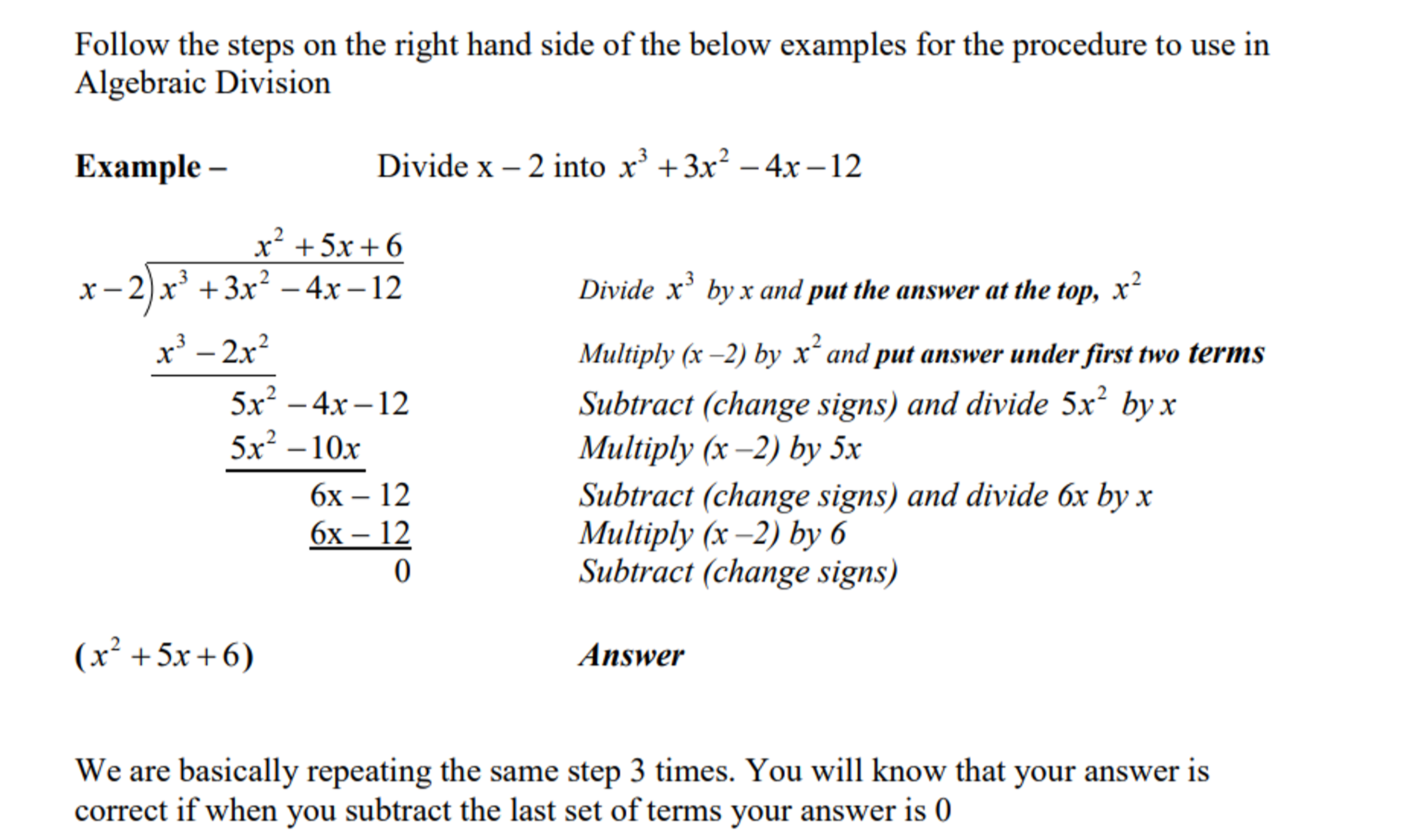
Divide by and put the answer at the top,
Multiply by and put the answer under the first two terms
Subtract (change signs) and divide by
Multiply by
Subtract (change signs) and divide by
Multiply by
Subtract (change signs)
Answer
We are basically repeating the same step 3 times. You will know that your answer is correct if when you subtract the last set of terms your answer is 0.
Note
Example Problem 2: If we are asked to divide into an expression that has some parts missing, for example there is no part, we leave space for any that may appear.
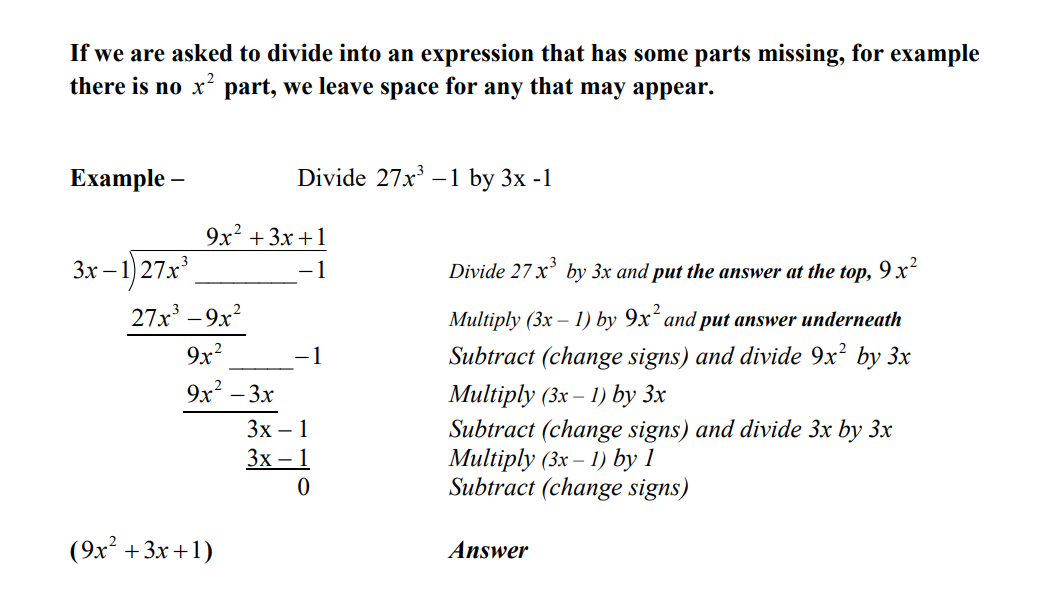
Divide by and put the answer at the top,
Multiply by and put answer underneath
Subtract (change signs) and divide by
Multiply by
Subtract (change signs) and divide by
Multiply by
Subtract (change signs)
Answer
Note
Example Problem 3: Simplify
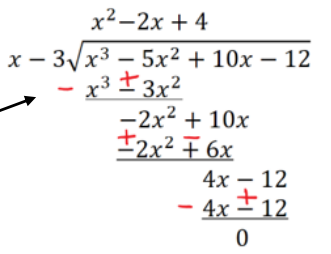
Step 1: Set Up the Division
Write the division as you would in a long division problem with numbers:
Step 2: Divide
First Division:
- Divide the first term of the dividend by the first term of the divisor :
- Write above the division line.
Step 3: Multiply
- Multiply by the entire divisor :
- Write this product under the first two terms of the dividend:
Step 4: Subtract
- Subtract the result from the previous step from the dividend:
Step 5: Bring Down
- Bring down the next term from the original dividend which is :
Step 6: Repeat the Process
Second Division:
-
Now, divide the first term of the new expression by the first term of the divisor :
-
Write above the division line next to . Second Multiplication:
-
Multiply by the entire divisor :
-
Write this product under the current terms: Second Subtraction:
-
Subtract the product from the expression above: Second Bring Down:
-
Bring down the next term from the original dividend which is :
Step 7: Final Division
Third Division:
-
Divide the first term of the new expression by the first term of the divisor :
-
Write above the division line next to . Third Multiplication:
-
Multiply by the entire divisor :
-
Write this product under the current terms: Third Subtraction:
-
Subtract the product from the expression above:
Step 8: Final Answer
- Since there's no remainder, the final answer is:
Note
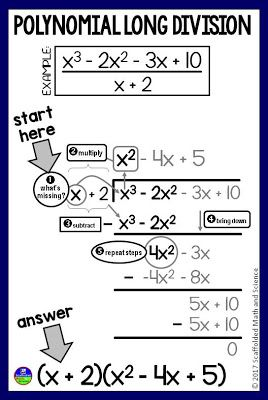
Example Problem 4:
Note
Exam Tip: Keep your work organised! Writing each step clearly will help you avoid mistakes and make it easier to spot any errors. Write like terms beneath like terms i.e. the x beneath the x when brought underneath etc.