Nets (Junior Cert Mathematics): Revision Notes
📚Revision Notes
Nets
Imagine you have a cardboard box. If you carefully cut along some of the edges and unfold the box, you would get a flat shape. This flat shape is what we call a net.
A net is like a pattern you can fold up to make a shape. It's a way to see all the surfaces (or faces) of a shape laid out flat. Understanding nets helps you to figure out how shapes are put together.
Why Do We Use Nets?
Nets are really helpful because they make it easier to:
- See how shapes work: By looking at a net, you can better understand how a shape is built.
- Find surface area: When all the faces of a shape are laid out flat, you can easily measure them and find out the total surface area.
Note
Examples of Nets for Different Shapes
Let's look at some examples of nets for common shapes:
a) Nets of Cubes
A cube is a shape with six identical square faces. When we lay these squares out flat, there are different ways they can be arranged. These arrangements are called nets.
- Example 1: A -shaped arrangement of squares.
- Example 2: A -shaped arrangement of squares.
- Example 3: An -shaped arrangement of squares.
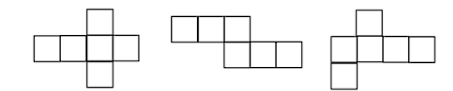
Each of these arrangements can be folded up to make a cube.
Try it yourself: Draw squares on a piece of paper. Arrange them in one of the patterns above, then cut them out and fold them to make a cube!
b) Net of a Cuboid
A cuboid is like a box, but it doesn't have to have all sides the same size (like a cube does). It has six faces, and they're all rectangles.
- The net of a cuboid shows these rectangles laid out flat. You'll see three pairs of rectangles, with each pair being the same size.
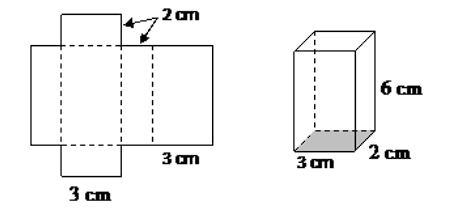
Tip: A cereal box is a good example of a cuboid. If you carefully open it up, you'll see a net!
When you fold this net, it turns into a cuboid.
Why Nets Matter
Understanding nets helps you see how shapes are built and how they fit together. When you can visualise the net, you'll find it easier to solve problems related to surface area and volume. Practice drawing and folding nets – it's a great way to get comfortable with shapes!
Summary
Nets are the building blocks of shapes. They let you unfold a shape into a flat pattern, making it easier to understand and work with. By practising with nets, you'll get better at visualising how shapes work and how to calculate their surface areas.