Parallel Lines (Junior Cert Mathematics): Revision Notes
📚Revision Notes
Parallel Lines
In this section, we will learn about parallel lines, how they relate to slope, and how to spot them on a graph. Understanding parallel lines is important in co-ordinate geometry, and we'll break it down step by step.
What Are Parallel Lines?
Parallel lines are lines that never meet or cross, no matter how far you extend them. Imagine two straight train tracks that run side by side—they don't get closer or farther apart as you follow them. That's exactly what parallel lines do on a graph.
So, the key points are:
- Parallel lines never cross each other.
- They always stay the same distance apart.
Parallel Lines and Slope
To understand why parallel lines never meet, we need to talk about slope. The slope of a line tells us how steep the line is—whether it rises or falls as you move along it.
Here's the important rule to remember:
- Parallel lines have the same slope. This means that if two lines are parallel, they tilt the same way—they rise and fall at the same rate. However, they start from different points on the graph.
If you see two lines with the same slope but different (starting points on the ), those lines are parallel.
How to Spot Parallel Lines on a Graph
There are two main ways to recognise parallel lines:
- Check the Slopes:
- If you know the equations of the lines, you can calculate their slopes. If the slopes are the same, the lines are parallel.
- Look at the Graph:
- If you have a graph, look at the direction the lines are moving. Do they go in the same direction and never touch? If they do, then they are parallel.
Note
Example 1: Finding Parallel Lines Using Slope
Equations of the lines:
- Line 1:
- Line 2:
Step 1: Find the Slope of Each Line
- For Line 1: The equation is in slope-intercept form, where the slope is the number in front of . So, the slope of Line is .
- For Line 2: The equation is also in slope-intercept form, and the slope .
Step 2: Compare the Slopes
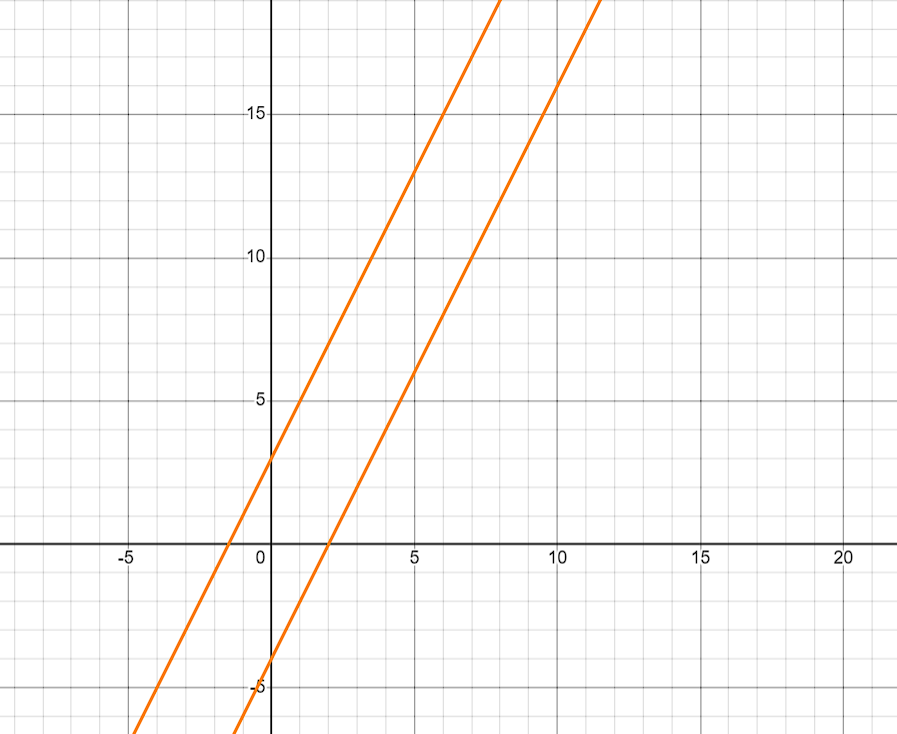
Both lines have the same slope of . Since the slopes are the same, the lines are parallel. This means they will never cross each other.
Note
Example 2: Spotting Parallel Lines on a Graph
Let's say you're looking at a graph with two lines and you want to check if they are parallel.
Step 1: Check the Direction of the Lines
Look at the lines on the graph. Do they go in the same direction? If both lines are either rising or falling at the same angle, they could be parallel.
Step 2: Check if the Lines Stay the Same Distance Apart
Now, check if the lines keep the same distance between them as they move across the graph. If the lines never get closer or farther apart and don't cross, they are parallel.
Imagine a graph here showing two lines that move in the same direction without touching—these lines are parallel.
Key Points to Remember
- Same Slope: Parallel lines always have the same slope. If the slopes of two lines are equal, and their y-intercepts are different, those lines are parallel.
- Never Cross: On a graph, parallel lines never meet. They stay the same distance apart.
- Visual Cues: When looking at a graph, think of parallel lines as train tracks—always side by side, never crossing.