Intersecting Lines (Junior Cert Mathematics): Revision Notes
📚Revision Notes
Intersecting Lines
In this section, we will explore how to find the point where two lines intersect on the Cartesian Plane by solving simultaneous equations. This method directly connects co-ordinate geometry with algebra. We'll focus on the method taught in Junior Cycle Maths, where we eliminate one variable (either or ) by adding or subtracting the equations.
What Are Intersecting Lines?
When two lines cross each other on the Cartesian Plane, they intersect at a specific point. To find the coordinates of this point, we need to solve the equations of both lines simultaneously. This means we solve both equations at the same time to find the values of and that work for both equations.
To do this, we use algebra to eliminate one of the variables (either or ) so we can solve for the other. Once we find the value of one variable, we substitute it back into one of the original equations to find the value of the other variable. These values of and give us the point where the two lines meet.
Steps to Find the Point of Intersection
Let's walk through an example step by step, explaining each step clearly.
Note
Example: Finding the Intersection by Solving Simultaneous Equations
Equations of the lines:
- Line 1: ()
- Line 2: ()
Step 1: Label the equations.
We label the first equation as and the second as to make it easier to follow.
Step 2: Make the coefficients of the same.
The goal is to eliminate one of the variables so that we can solve for the other. In this case, we'll eliminate .
To do this, we need to make the coefficients (the numbers in front of ) in both equations the same. This will allow us to eliminate by adding or subtracting the equations.
-
In Equation A, the coefficient of is (since ) is the same as .
-
In Equation B, the coefficient of is . To make the coefficients the same, we can multiply Equation B by . This will make the coefficient of in Equation B equal to , which will allow us to eliminate when we add the equations.
-
Multiply Equation by :
Now, Equation and Equation are:
- Equation :
- Equation :
Step 3: Subtract the equations to eliminate .
Now that the coefficients of are different enough, we can subtract Equation C from Equation A. This will eliminate the terms because they will cancel each other out.
- Subtract Equation C from Equation A:
Simplifying this gives:
Now, is the only variable left, which allows us to solve for .
Step 4: Solve for .
To solve for , we need to isolate on one side of the equation.
-
First, add to both sides of the equation:
-
Then, divide both sides by :
Now we know that .
Step 5: Substitute back into one of the original equations to find .
We've found the value of , but we still need to find the value of . To do this, we substitute back into one of the original equations. This is called back-substituting. The reason we do this is to find the value of the other variable after we have solved for .
Let's use Equation B for this:
Simplify this:
Combine like terms:
Finally, add to both sides:
Now we know that .
Step 6: Write the solution as a coordinate pair.
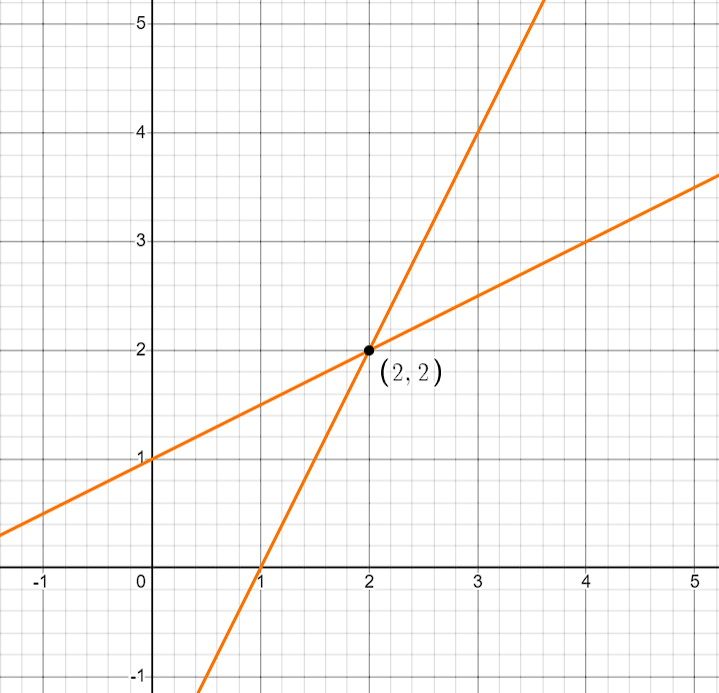
The values and give us the point where the two lines intersect. We can write this as a coordinate pair .
So, the point of intersection is .
This is the point where the two lines meet on the Cartesian Plane.
Linking Co-ordinate Geometry with Algebra
Here's how this method connects algebra with co-ordinate geometry:
- The equations of the lines tell us the slope and position of each line.
- Solving the equations simultaneously finds the specific values of and that satisfy both equations at the same time.
- The solution is the point of intersection, which can be plotted on the Cartesian Plane as .
Note
Key Tips for Success
- Label Everything Clearly: Use labels like , , and for your equations to keep track of your work.
- Check Your Work: After finding the values of and , substitute them back into the original equations to ensure they satisfy both equations.
- Understand the Connection: Remember that solving simultaneous equations in algebra is directly related to finding the point of intersection in co-ordinate geometry. By practising these steps, you'll become more confident in solving intersection problems and connecting algebra with co-ordinate geometry!