The Basics of Counting (Junior Cert Mathematics): Revision Notes
📚Revision Notes
Different Strategies
When solving problems using the Fundamental Principle of Counting, you can use different strategies to help you figure out the total number of possible outcomes. Let's go through three common strategies step by step, with simple explanations and examples.
1. Listing All Possible Outcomes
Listing outcomes means writing down every possible combination or result that could happen. This method is very straightforward and works well when there aren't too many outcomes to keep track of.
Note
Example: Tossing a Coin Twice Imagine you toss a coin twice. The coin can land on heads () or tails (). What are all the possible outcomes? You can list them like this:
- Heads, Heads ()
- Heads, Tails ()
- Tails, Heads ()
- Tails, Tails () So, there are 4 different outcomes that could happen when you toss a coin twice.
How it Helps: Listing all possible outcomes helps you see every possible result clearly. It's like making a checklist to make sure you didn't miss anything. This strategy is especially useful when the number of outcomes is small because you can write down each one and count them easily.
Tip: If you're ever unsure about how many possibilities there are, try writing them all out. It can make a problem that seems confusing at first a lot easier to understand.
2. Making a Two-Way Table
A two-way table is like a chart or grid that helps you organise the outcomes when you have two different things to choose from. This strategy is helpful because it allows you to see all the possible combinations without getting confused.
Note
Example: Spinning Two Small Spinners Let's say you have two spinners. The first spinner has 3 colours: Red, Blue, and Green. The second spinner has 2 numbers: and . Here's what the two-way table looks like:
| Colour \ Number | ||
|---|---|---|
| Red | ||
| Blue | ||
| Green |
In this table, each row shows the colour from the first spinner, and each column shows the number from the second spinner. You can see that there are 6 possible outcomes when you spin both spinners:
How it Helps: The two-way table helps you organise all the outcomes in a neat and easy-to-see way. Instead of trying to keep everything in your head, you can use the table to make sure you see all the combinations at once. It's like putting all your options into boxes so you can count them easily.
Tip: Use a two-way table when you have two things to choose from, and you want to see all the different ways they can match up. It's a great way to avoid missing any possibilities.
3. Using Tree Diagrams
A tree diagram is like a picture that shows all the different choices you can make. It looks like a tree because each choice branches out into more choices, just like the branches of a tree. This method is really helpful when you have more than two choices or steps to consider.
Note
Example: Choosing School Subjects Imagine you have to pick a language, a science subject, and a business subject at school. You can choose from:
- 3 languages: (French), (German), (Spanish)
- 2 science subjects: (Biology), (Physics)
- 2 business subjects: (Accounting), (Business Studies) The tree diagram would start with the 3 language choices. From each language, you would draw branches for the 2 science subjects. Then, from each science subject, you would draw branches for the 2 business subjects.
At the end of the branches, you can see all the possible combinations of subjects. There are 12 different combinations in total .
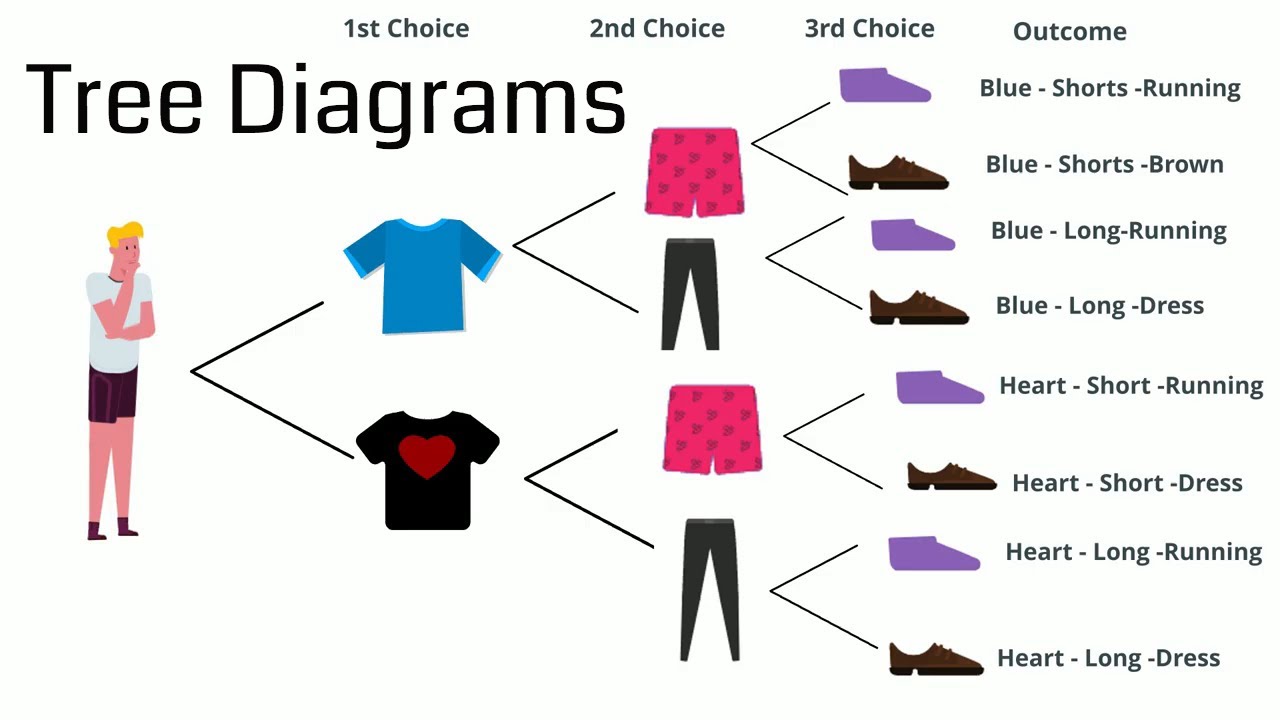
How it Helps: The tree diagram breaks down each decision into smaller steps. This makes it easier to see how each choice leads to a different outcome. By following the branches, you can count all the possibilities without missing any.
Tip: If a problem has several steps or choices, drawing a tree diagram can help you see the whole picture. It's a simple way to track every possible outcome, one step at a time.
Conclusion
These three strategies—listing outcomes, using two-way tables, and drawing tree diagrams—are great tools to help you solve counting problems.
- Listing outcomes is perfect when there are only a few possibilities. It helps you see each one clearly.
- Two-way tables work well when you have two choices, and you want to organise all the combinations neatly.
- Tree diagrams are helpful when there are multiple steps or choices, allowing you to see how each choice leads to a different outcome.
By practising these methods, you'll get better at finding the total number of outcomes in different situations. Keep practising, and remember, each time you solve a problem, you're building your maths skills!