Circle Terminology (Junior Cert Mathematics): Revision Notes
📚Revision Notes
Circle Terminology
A circle is a round shape that has some special parts. Knowing these parts will help you understand and solve problems about circles. Let's explore each part, one by one.
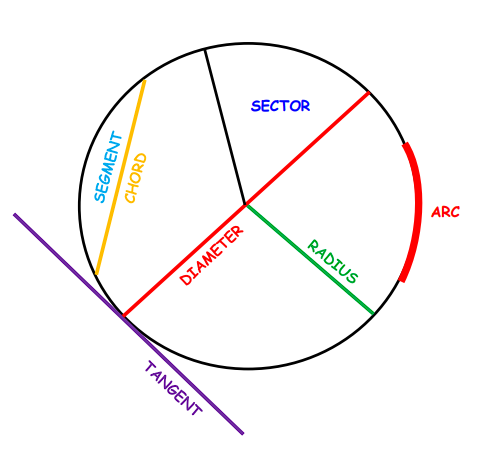
1. Radius
- What It Is: The radius is like the arm of the circle. It starts from the very centre of the circle and stretches out to the edge. Every radius in the same circle is the same length.
- Why It's Important: The radius helps you measure how big or small a circle is.
2. Diameter
- What It Is: The diameter is like the full stretch of the circle. It's a line that goes from one side of the circle, through the centre, all the way to the other side. It's like putting two radii together!
- Why It's Important: The diameter is always twice as long as the radius. Knowing this can help you solve problems about the circle's size.
3. Chord
- What It Is: A chord is a line that connects two points on the circle's edge. It doesn't have to pass through the centre, though it could.
- Why It's Important: Chords help you divide the circle into parts and are useful for solving different types of circle problems.
4. Arc
- What It Is: An arc is just a part of the circle's edge. It's a curved line that connects two points on the circle.
- Why It's Important: Arcs help you measure parts of the circle's boundary. If you've ever seen part of a circle drawn on paper, that's an arc.
5. Sector
- What It Is: A sector is like a slice of pizza. It's a part of the circle that's made by two radii and the arc between them.
- Why It's Important: Sectors help you measure areas within the circle. Imagine you're cutting out a piece of pie—each piece is a sector.
6. Segment
- What It Is: A segment is a smaller part of the circle, made by a chord and the arc above it. Imagine slicing off the top of a circle—what's left is a segment.
- Why It's Important: Segments are another way to divide the circle and are useful in geometry problems.
7. Tangent
- What It Is: A tangent is a straight line that touches the circle at just one point. It doesn't go inside the circle—it just skims the edge.
- Why It's Important: Tangents are important for solving problems involving angles and distances from the circle.
Note
Tips for Understanding:
- Label Your Circles: When you draw a circle, label the radius, diameter, and other parts. This will help you remember where everything is.
- Think of Real-World Examples: Imagine a pizza for sectors, or a bike wheel for the whole circle. Connecting these terms to things you see every day makes them easier to understand.
- Keep Practising: The more you work with circles, the more comfortable you'll get. Try drawing different parts of a circle and labelling them.