Corollaries (Junior Cert Mathematics): Revision Notes
📚Revision Notes
Corollaries
When you learn a theorem, sometimes you get bonus facts that naturally follow from it. These are called corollaries. Think of them as shortcuts—they let you find answers quickly because you already know a theorem is true. Let's break down each corollary and see how it connects to the theorems we've learned.
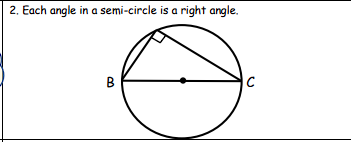
Angle in a Semi-Circle
- What It Says: If you draw a triangle inside a circle where one side of the triangle is the diameter of the circle, the angle opposite that side (at the edge of the circle) will always be 90°. This is called a right angle.
- Why It Works: This follows from the Triangle Angle Sum Theorem and the Exterior Angle Theorem. When one side of the triangle is the diameter, the angles on either end of the diameter are equal, and the third angle must be 90° to add up to 180°.
Right Angle on a Chord
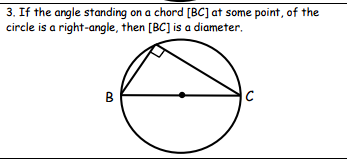
- What It Says: If you have a right angle (90°) that stands on a chord (a line connecting two points on a circle), then that chord must be the diameter of the circle.
- Why It Works: This is a specific case of the Angle in a Semi-Circle Corollary. If the angle is 90°, it splits the circle in half, meaning the chord it stands on has to be the diameter.
Note
Tips for Understanding:
- Draw It Out: Whenever you're dealing with corollaries, drawing a diagram can make the idea much clearer.
- Relate Back to Theorems: Always connect the corollary to the theorem it comes from. This will help you understand why it's true.
- Practice, Practice, Practice: The more you use these corollaries in problems, the easier they'll be to remember.