Pythagoras' Theorem (Junior Cert Mathematics): Revision Notes
📚Revision Notes
Pythagoras' Theorem
Pythagoras' Theorem is a really useful tool in maths. It helps us find the length of a side in a right-angled triangle if we know the lengths of the other two sides. But remember, this only works for right-angled triangles (triangles with one angle that is exactly ).
What is Pythagoras' Theorem?
The theorem says:
That might sound complicated, but here's what it means in simpler terms:
- The hypotenuse is the longest side of the triangle. It's the side that is directly opposite the right angle (the angle).
- The other two sides are sometimes called the legs of the triangle.
The formula for Pythagoras' Theorem is:
Where:
- is the hypotenuse (the longest side).
- and are the other two sides.
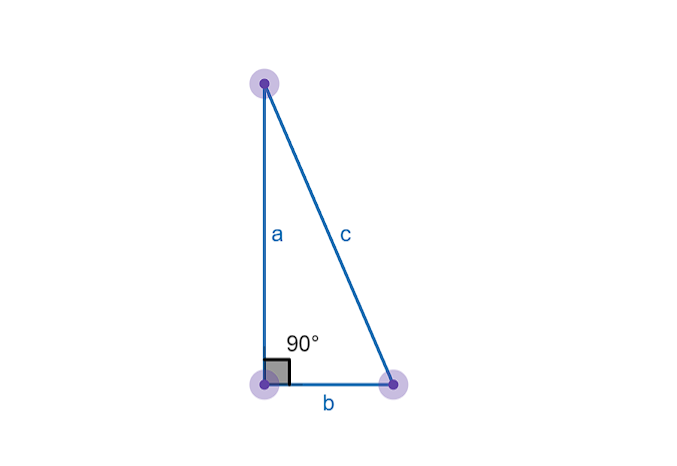
Step 1: Identify the Sides of the Triangle
- Hypotenuse: This is always the longest side and is opposite the right angle.
- Other sides: These are the two sides that make up the right angle.
Step 2: Write Down the Formula
The formula is:
If you're trying to find the hypotenuse, you'll use the formula as it is. But if you're trying to find one of the other sides, you need to rearrange the formula.
To find side :
To find side :
Note
Example 1: Finding the Hypotenuse
Let's start with a problem where we need to find the hypotenuse.
Problem: You have a right-angled triangle where one side is 3 cm and the other side is 4 cm. Find the length of the hypotenuse.
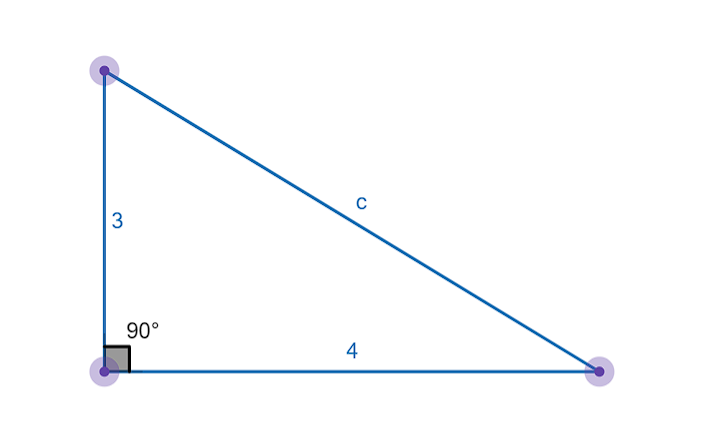
Step 1: Identify the sides.
- is the hypotenuse (unknown). Step 2: Write down the formula.
Step 3: Substitute the known values.
Step 4: Calculate the squares.
Step 5: Add the squares.
Step 6: Find by taking the square root.
Final Answer: The length of the hypotenuse is 5 cm.
Note
Example 2: Finding One of the Other Sides
Now, let's try a problem where you need to find one of the other sides.
Problem: You have a right-angled triangle where the hypotenuse is 13 cm and one side is 5 cm. Find the length of the other side.
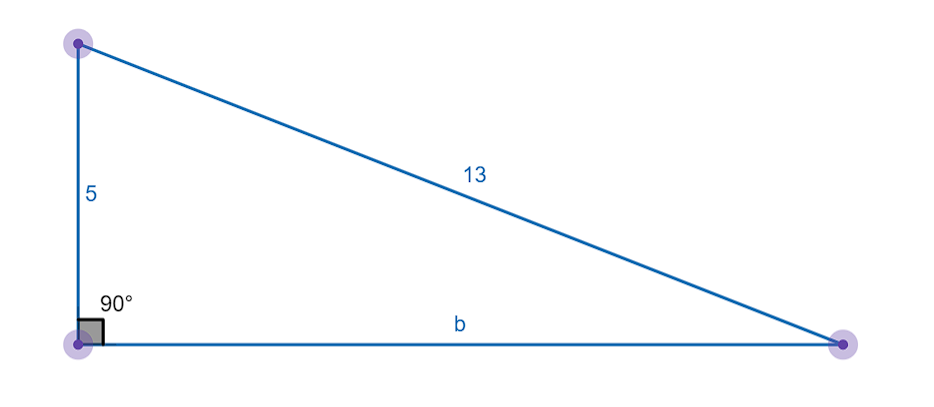
Step 1: Identify the sides.
- ()
- is the unknown side. Step 2: Rearrange the formula to solve for .
Step 3: Substitute the known values.
Step 4: Calculate the squares.
Step 5: Subtract the squares.
Step 6: Find by taking the square root.
Final Answer: The length of side is 12 cm.
Note
Exam Tip: Show Your Work!
When using Pythagoras' Theorem in an exam, make sure to show every step of your working out. Even if you make a small mistake, you can still get marks for using the right method. And remember to double-check your units—use , etc., and squared numbers (like area) need squared units.
Summary of Steps to Follow:
- Draw a diagram: Label the sides and identify the hypotenuse and the other two sides.
- Write down the formula: Start with the Pythagoras' Theorem formula, .
- Substitute the known values: Plug the numbers from your problem into the formula.
- Calculate the squares: Work out the squares of the numbers.
- Solve for the unknown side: Add or subtract the squares as needed, then take the square root to find the length of the unknown side.
- Include units: Don't forget to write the correct units (e.g., ) in your final answer.