Major Scales (Junior Cert Music): Revision Notes
📚Revision Notes
Major Scales
Note
A scale is a series of notes that move by step in ascending and descending order, following a specific pattern of tones and semitones.
-
A major scale is a set of eight notes arranged in ascending or descending order.
-
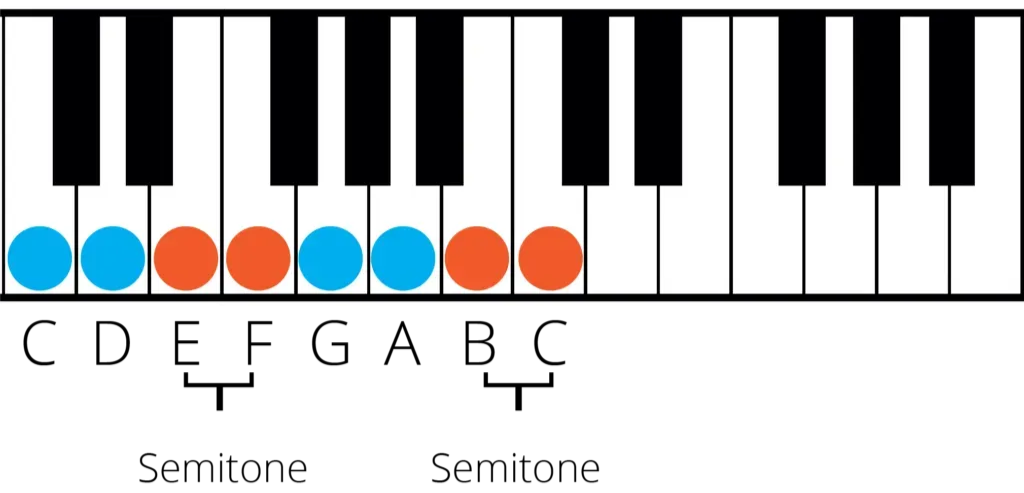
It starts with the tonic and follows a specific pattern of tones (T) and semitones (ST).
-
Semitone (ST): The smallest interval in Western music. It is the distance from one note to the next nearest note. It is also known as a half-step.
-
Tone (T): Consists of two semitones. It is also known as a whole step.
-
Major scale pattern: T – T – ST – T – T – T – ST
-
This pattern is the same in every major key and helps create the bright, happy sound of major tonality.
Constructing Major Scales
Use these four key rules when building a major scale:
- Every major scale consists of seven different notes, plus the tonic repeated at the octave.
- Every major scale begins on the keynote/tonic.
- Each letter name (A to G) is used only once in a major scale, in order, before reaching the tonic again an octave higher.
- The interval pattern for all major scales is: T – T – ST – T – T – T – ST