Anacrusis and Syncopation (Junior Cert Music): Revision Notes
📚Revision Notes
Anacrusis and Syncopation
Anacrusis (Upbeat)
-
An anacrusis is a note or group of notes that appear before the first full bar.
-
As the first bar is incomplete due to the anacrusis, the missing beats are removed from the final bar to ensure the total beats match the time signature.
-
It's also called an upbeat.
-
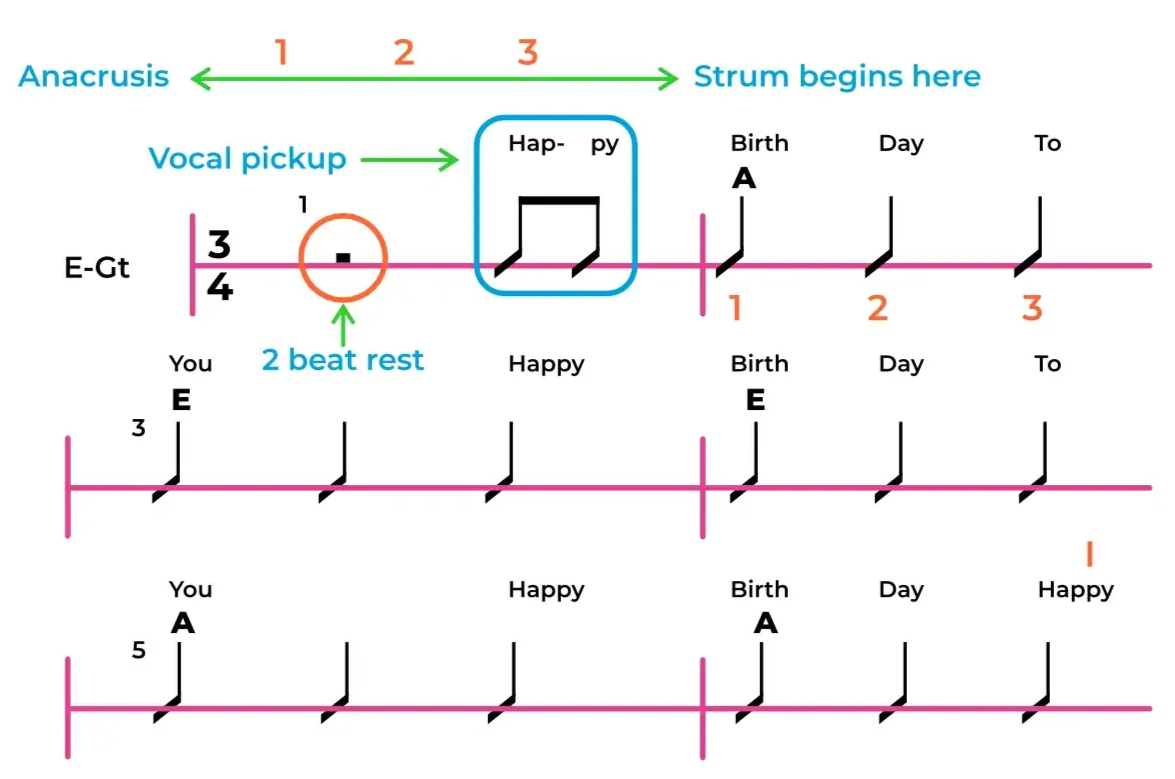
Happy Birthday is an example – the word Happy appears before the first beat of the bar, and then 'Birthday' is the first proper beat of the song.
-
It gives the music a sense of momentum and flow.
-
The song starts with the word "Happy", but that's not when the counting starts.
-
Before singing, there is a two-beat rest, followed by two quavers (eighth notes) on the word "Hap-py".
-
If you were directing a choir to sing Happy Birthday, you would count them in like this: One – Two – Three – One – Two – Hap – py – Birth – day – To – You
-
The different colours in the image highlight separate bars, showing where the beats fall.
-
Why is "Happy" Softer Than "Birthday"?
- The word "Ha-ppy" is part of the anacrusis, meaning it happens before the first full bar.
- Because of this, it is sung lighter and softer than the strong beat of "Birth-day," which lands on beat one of the first full bar (also called the downbeat).
- This creates a natural sense of flow and phrasing in the music.
- How Does an Anacrusis Affect the Last Bar?
-
If a piece starts with an anacrusis, the final bar is often shortened so the combined beats of the first and last bars equal one full bar.
-
This maintains balance with the time signature.

-
This image shows how beats are counted in a 4/4 time signature when a piece begins with an anacrusis.
-
The first full bar starts on beat 1, but the music actually begins earlier with a pickup note (anacrusis).
-
Since the first bar is missing part of a beat, the last bar is shortened to balance the rhythm.
-
The number in parentheses (2) shows a missing beat in the last bar, ensuring that the total beats in the piece match the time signature.
-
Syncopation
-
Syncopation happens when the emphasis is placed on weak beats instead of strong beats.
-
It creates an "off-beat" feel.
-
In regular rhythms: Strong beats are 1 and 3 → ("ONE-two-THREE-four").
-
In syncopated rhythms: Accents happen on the weak beats (e.g., "one-TWO-three-FOUR").
-
Syncopation is common in jazz, funk, Latin, and pop music.
-
How to Count Syncopation:
- Syncopated rhythms often follow a quaver–crotchet–quaver pattern, where the emphasis falls between the main beats.
- Example: 1 –&– 2 (accent on the '&' off-beat)
-
Example Songs with Syncopation:
- We Don't Talk About Bruno from Disney's 'Encanto'