Graphic Scores (Junior Cert Music): Revision Notes
📚Revision Notes
Graphic Scores
1. What is a Graphic Score?
- A graphic score is a way of writing music using symbols, pictures, words, or shapes instead of traditional music notation.
- It gives a visual representation of sound.
- It can show pitch, dynamics, rhythm, and instructions for how the music should be played.
2. Traditional Score vs. Graphic Score
- A traditional score uses musical notation on the stave (five lines and spaces).
- A graphic score uses other visual cues to represent how the music should be played.
- It is often used in modern, experimental, and electronic music.
3. How to Read a Graphic Score
- Lines going up = Pitch rising (higher sounds).
- Dots = Short notes (staccato sounds).
- Thicker lines = Louder sounds (forte).
- Curved lines = Smooth, flowing melodies (legato).
- Sharp, jagged lines = Abrupt, sharp sounds.
4. Why Use Graphic Notation?
- It allows more freedom and expression.
- Composers can create new ways of writing music.
- It helps performers interpret sounds in a creative way.
- Famous Example:
- Bergstrom Nielsen – Towards an Unbearable Lightness
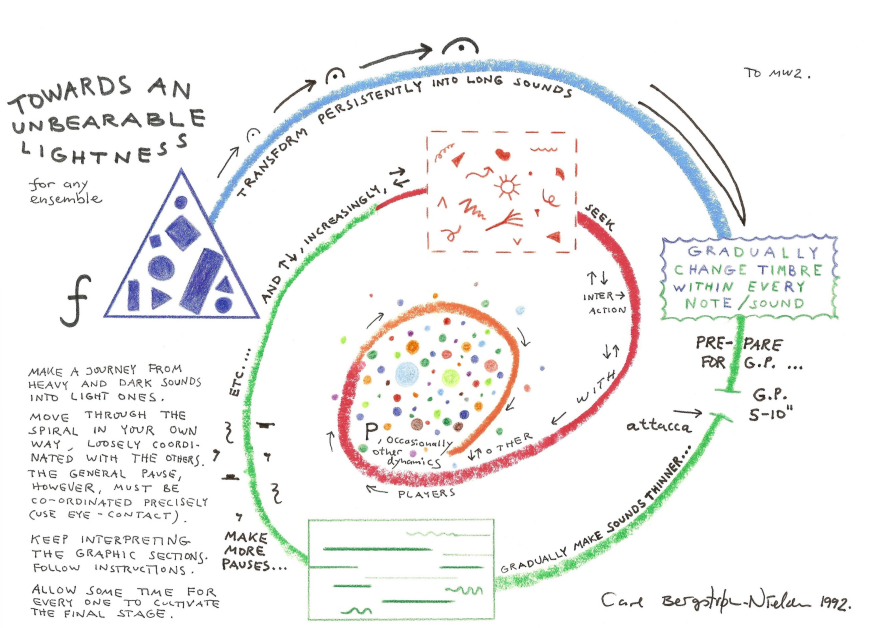
- Bergstrom Nielsen – Towards an Unbearable Lightness