Woodwind Family (Junior Cert Music): Revision Notes
📚Revision Notes
Woodwind Family
What is the Woodwind Family?
- The woodwind family is a group of instruments in the orchestra that were originally made of wood.
- Today, some woodwind instruments are made of metal or plastic, but they still belong to the woodwind family because of the way they produce sound.
How Do Woodwind Instruments Make Sound?
- Air is blown into or across the mouthpiece.
- Most woodwind instruments have a reed, which vibrates when air passes through it.
- Keys and holes on the instrument change the pitch.
Note
The flute is an exception, as it does not use a reed.
Where is the Woodwind Section in the Orchestra?
- The woodwind family sits in the middle of the orchestra, between the strings and brass sections.
- The instruments are arranged from highest to lowest pitch.
Types of Woodwind Instruments
There are two main types of woodwind instruments:
- Flute family (no reed)
- Reed instruments
1. Flute Family (No Reed)
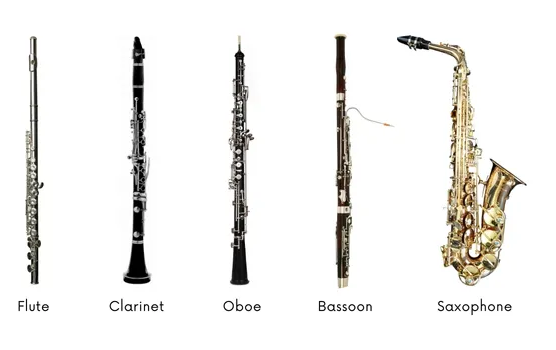
- Flute – A high-pitched instrument made of metal, played by blowing across a hole in the mouthpiece.
- Piccolo – A smaller flute that plays an octave higher than the flute and has a bright, piercing sound.
2. Reed Instruments (Use a Reed)
These instruments use a thin piece of cane called a reed, which vibrates to create sound.
- Single-Reed Instruments
- Clarinet – Has a warm, smooth sound and can play a large range of notes.
- Bass Clarinet – A larger version of the clarinet with a lower, deeper sound.
- Saxophone (sometimes included) – Uses a single reed and is mostly used in jazz, marching band and pop music.
- Double-Reed Instruments
- Oboe – A bright-sounding instrument with a double reed (two pieces of reed tied together).
- Cor Anglais (English Horn) – A larger oboe with a softer, lower sound.
- Bassoon – A large, low-pitched instrument with a deep, warm sound.
- Contrabassoon – An even larger version of the bassoon that plays the lowest notes of the woodwind family.
The Role of the Woodwind Family in the Orchestra
- Plays melodies and harmonies – Woodwind instruments can play solo parts and blend with other instruments.
- Adds different moods and colours – The flute sounds light and airy, while the bassoon can sound deep and dark.
- Supports other sections – The clarinet and oboe often play counter-melodies or harmonies with the strings.
Famous Composers Who Used Woodwinds
- Claude Debussy – Wrote Syrinx for solo flute.
- Wolfgang Amadeus Mozart – Featured clarinets in Clarinet Concerto in A Major.
- Igor Stravinsky – Used the bassoon for the famous opening of The Rite of Spring.