Conservation of Ecological Biodiversity (Junior Cert Science): Model Answers
📚Model Answers
Impact of Human Activities on Climate and Polar Bear Populations
Sample Answer
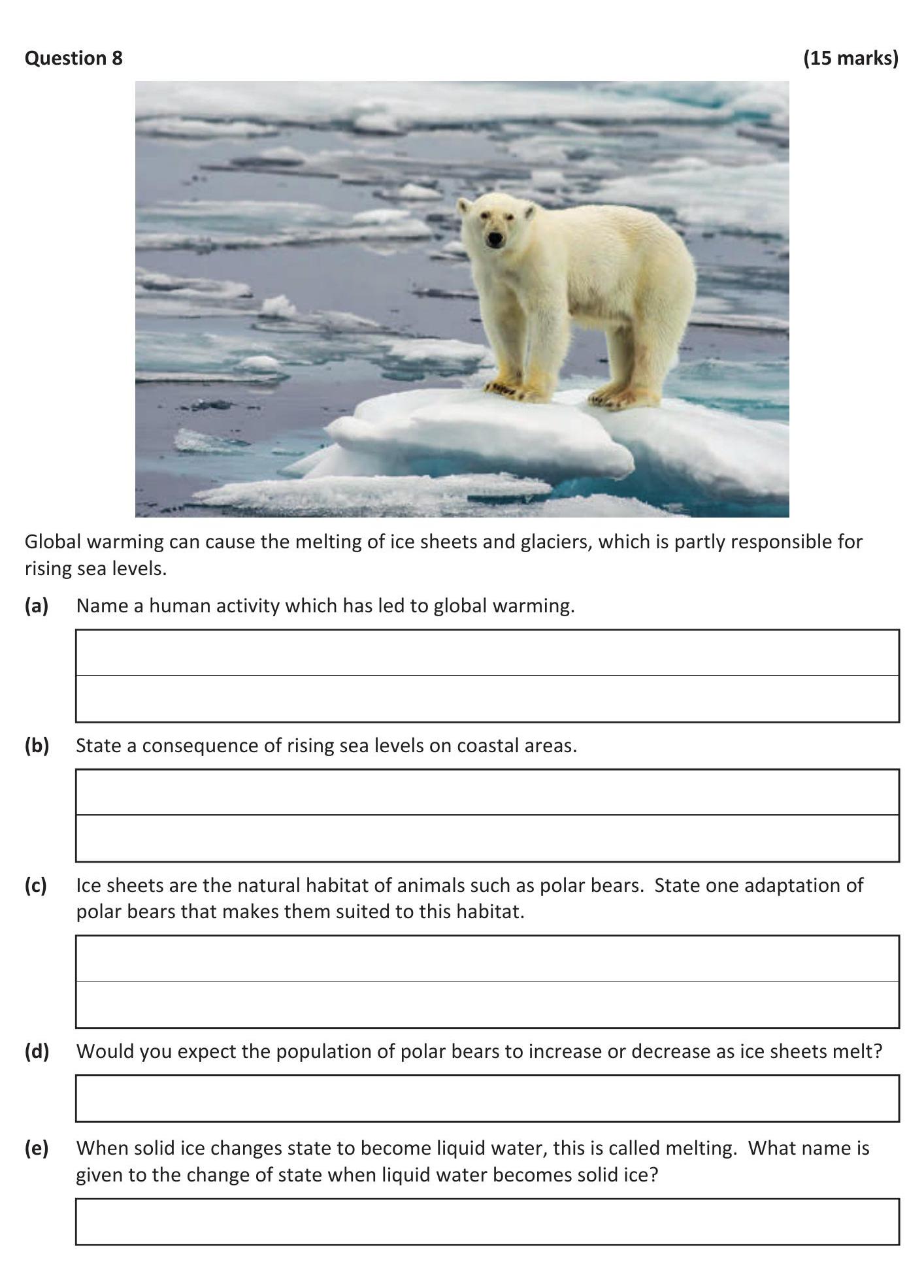
Question 8
(a) Name a human activity which has led to global warming.
Answer
Burning fossil fuels (coal, oil and natural gas) for energy production and transportation releases carbon dioxide into the atmosphere, which is a greenhouse gas that traps heat and contributes to global warming.
Note
[3/3 Marks] This answer identifies one of the main human activities responsible for greenhouse gas emissions. Burning fossil fuels is the largest contributor to anthropogenic climate change, accounting for approximately 87% of all human-produced carbon dioxide emissions.
(b) State a consequence of rising sea levels on coastal areas.
Answer
Coastal flooding and erosion will increase, potentially leading to the destruction of homes, businesses, and infrastructure in low-lying coastal communities.
Note
[3/3 Marks] This answer clearly identifies a significant consequence of sea level rise on coastal areas. It includes both the immediate impact (flooding/erosion) and the broader implications for human settlements.
(c) Ice sheets are the natural habitat of animals such as polar bears. State one adaptation of polar bears that makes them suited to this habitat.
Answer
Polar bears have thick layers of fat (blubber) and a dense fur coat that provide excellent insulation against the extreme cold of their Arctic ice sheet habitat.
Note
[3/3 Marks] The answer correctly identifies a physiological adaptation specifically evolved for the polar bear's ice habitat. The insulation from blubber and fur is crucial for survival in subzero temperatures.
(d) Would you expect the population of polar bears to increase or decrease as ice sheets melt?
Answer
The population of polar bears would decrease as ice sheets melt because they depend on sea ice as a platform for hunting seals, their primary food source. With less ice, polar bears have fewer hunting opportunities, leading to malnutrition, lower reproductive rates, and population decline.
Note
[3/3 Marks] This answer correctly identifies the expected trend (decrease) and provides a clear ecological explanation linking habitat loss to population decline through the specific mechanism of reduced hunting opportunities.
(e) When solid ice changes state to become liquid water, this is called melting. What name is given to the change of state when liquid water becomes solid ice?
Answer
Freezing
Note
[3/3 Marks] This answer provides the correct scientific term for the change of state from liquid water to solid ice. The term "freezing" is the precise physical process being described.
Marking Scheme