Space and the Origin of the Universe (Junior Cert Science): Model Answers
📚Model Answers
Big Bang Theory and Implications of Space Exploration
Sample Answer
Question (a)
Answer
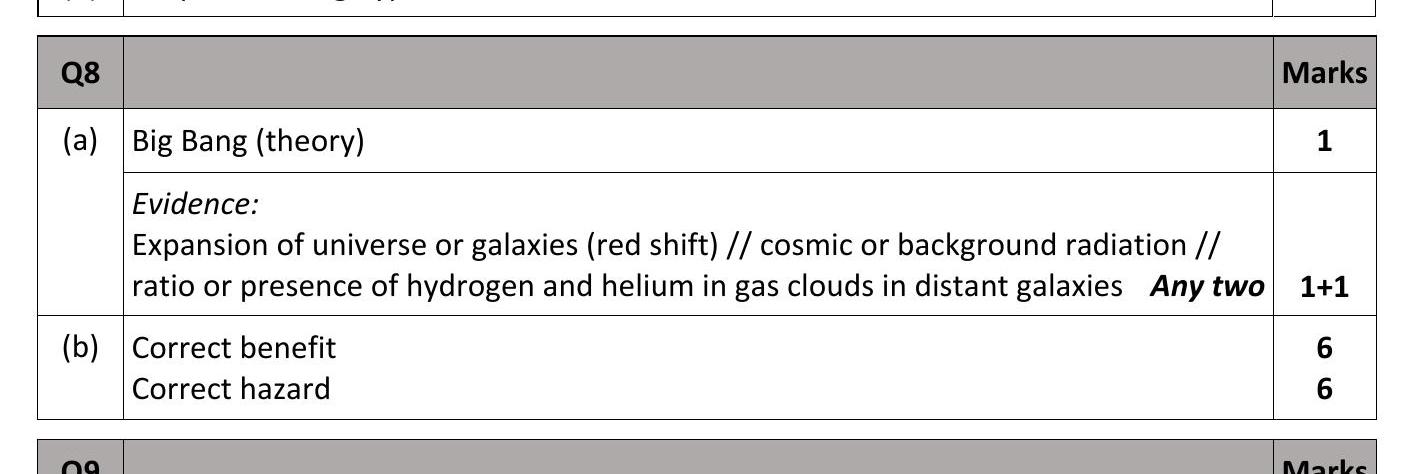
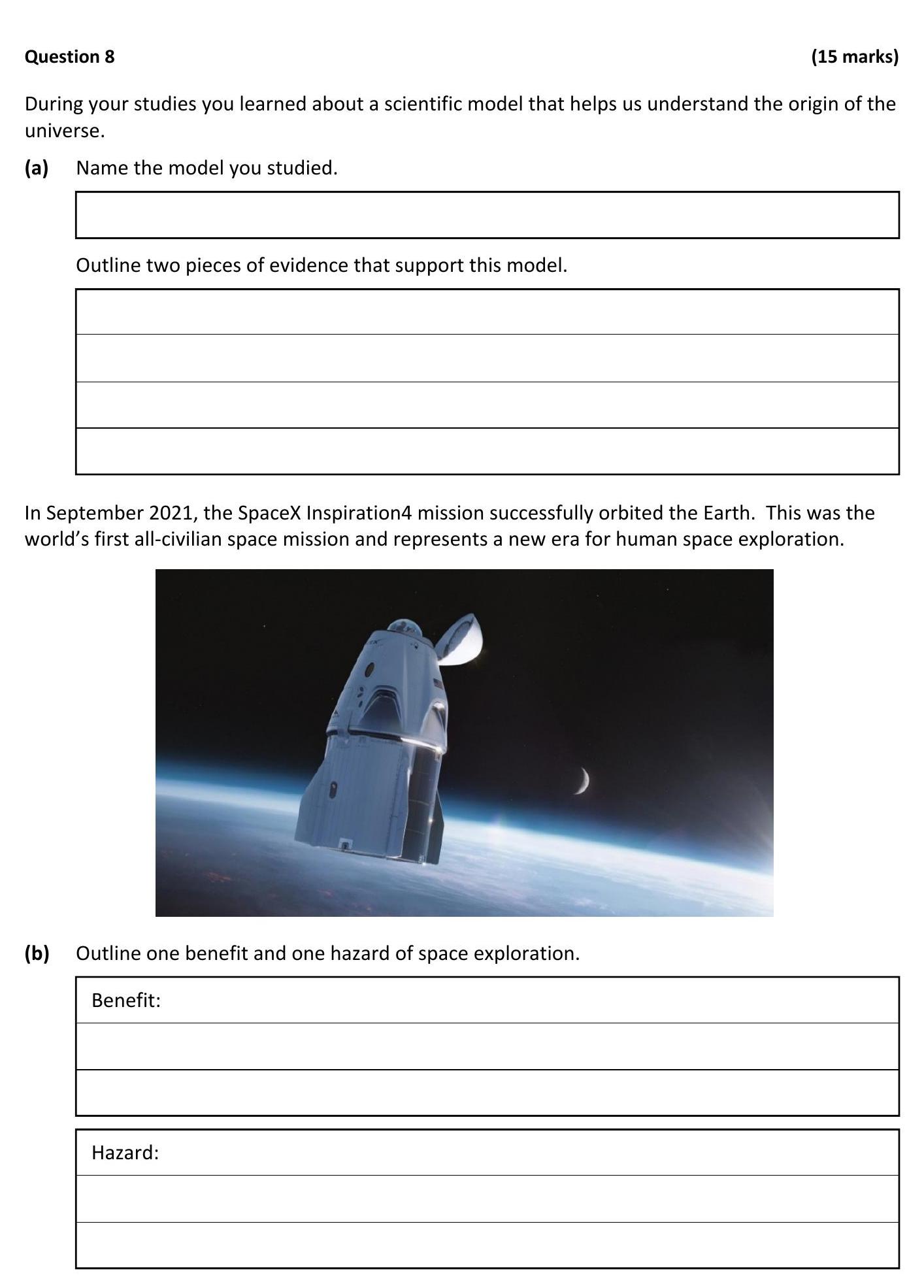
The model studied is the Big Bang theory. This scientific model proposes that the universe began approximately 13.8 billion years ago from an extremely hot, dense point (singularity) and has been expanding ever since.
Two pieces of evidence that support this model include:
-
The observed expansion of the universe, demonstrated by the redshift of distant galaxies. Edwin Hubble discovered that galaxies are moving away from us, with more distant galaxies moving faster. This suggests the universe is expanding in all directions from a single point of origin.
-
The cosmic microwave background radiation (CMBR), discovered accidentally by Penzias and Wilson in 1965. This faint radiation permeates all of space and represents the remnant heat from the Big Bang, cooled over billions of years as the universe expanded. Its uniformity and temperature (approximately 2.7 Kelvin) match precisely what the Big Bang theory predicts.
Note
[3/3 Marks] This answer correctly identifies the Big Bang theory (1 mark) and provides two valid pieces of evidence from the marking scheme (redshift showing expansion and cosmic background radiation) with detailed explanations of each (1+1 marks).
Question (b)
Answer
Benefit: Space exploration provides significant technological advancement and innovation that benefits life on Earth. Technologies developed for space missions have led to numerous spinoff technologies in medicine, communications, materials science, and computing. For example, satellite technology has revolutionised global communications, weather forecasting, and navigation systems. Medical imaging technologies like MRI and CAT scans were developed from technologies initially created for space exploration. Additionally, research conducted in space environments has enhanced our understanding of human physiology, leading to medical breakthroughs.
Hazard: A significant hazard of space exploration is the extreme danger to human life. Astronauts face numerous risks including exposure to cosmic radiation which can cause cancer and damage to the central nervous system, prolonged weightlessness leading to muscle atrophy and bone density loss, psychological challenges from isolation, and catastrophic equipment failures that can be fatal in the vacuum of space. The Columbia and Challenger disasters demonstrate the potentially fatal consequences of space exploration. Additionally, the enormous financial cost of human missions diverts resources that could address pressing problems on Earth.
Note
[6/6 Marks] This answer provides a comprehensive explanation of a valid benefit of space exploration (3 marks) with specific examples and detailed explanation. It also thoroughly describes a significant hazard (3 marks) with specific examples and context. Both parts demonstrate clear understanding of the implications of space exploration.
Marking Scheme