Speed, Displacement, Velocity, and Acceleration (Junior Cert Science): Model Answers
📚Model Answers
Analysing Speed and Motion
Sample Answer
Question 7(a)
Answer
Stopwatch
Note
[1/1 Mark] A stopwatch is the most appropriate instrument for measuring the time taken for a journey like this. Other acceptable answers could include timer, chronometer, or digital watch with timing function.
Question 7(b)
Working
-
Identify the coordinates of point A and point B from the graph
-
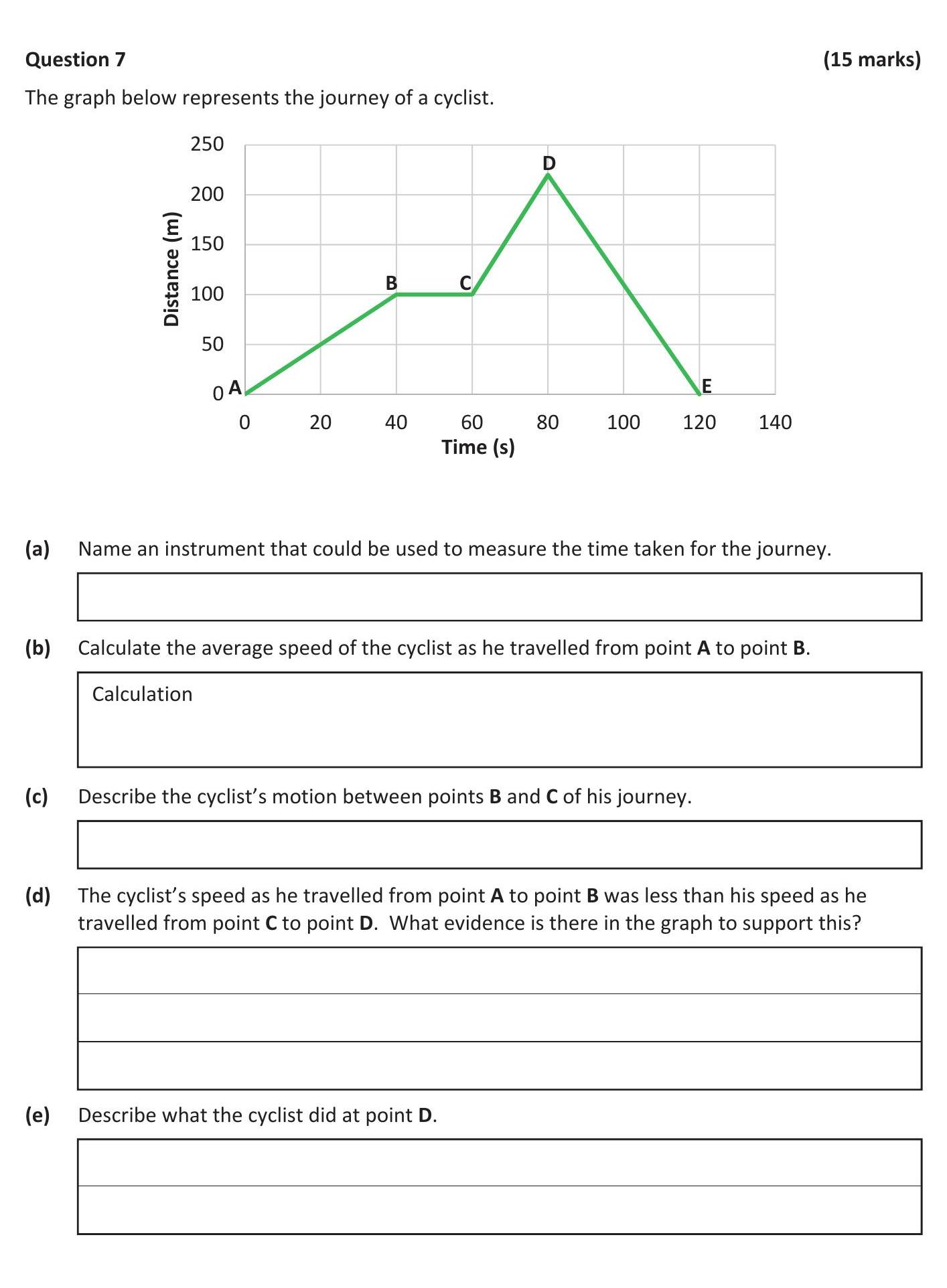
Point A: (0 seconds, 0 metres)
-
Point B: (40 seconds, 100 metres)
-
Apply the formula for average speed = distance/time
-
Average speed = (100 - 0) metres ÷ (40 - 0) seconds
-
Average speed = 100 metres ÷ 40 seconds
-
Average speed = 2.5 metres/second
Final Answer: 2.5 m/s
Note
[3/3 Marks] Full marks for correctly identifying coordinates, setting up the calculation, and obtaining the correct answer with appropriate units.
Question 7(c)
Answer
The cyclist remained stationary (did not move) between points B and C. This is shown on the graph as a horizontal line where the distance stays constant at 100 metres while time increases from 40 seconds to 60 seconds.
Note
[3/3 Marks] Full marks for correctly identifying that the cyclist was stationary and explaining how this is shown on the graph by the horizontal line segment.
Question 7(d)
Answer
The graph shows that the gradient (slope) of the line from C to D is steeper than the gradient of the line from A to B. Since gradient on a distance-time graph represents speed, this indicates a higher speed.
Calculating both speeds:
- Speed from A to B: 100 metres in 40 seconds = 2.5 m/s
- Speed from C to D: 100 metres in 20 seconds = 5 m/s
The steeper slope from C to D provides clear evidence that the cyclist moved faster during this part of the journey.
Note
[3/3 Marks] Full marks for correctly identifying the steeper gradient and explaining what this represents in terms of speed, with supporting calculations.
Question 7(e)
Answer
At point D, the cyclist changed direction and began travelling back towards the starting point. This is shown by the change from a positive gradient (increasing distance) to a negative gradient (decreasing distance) at point D.
Note
[2/2 Marks] Full marks for correctly identifying that the cyclist changed direction at point D and providing the evidence from the graph (change from positive to negative gradient).
Marking Scheme