Materials (Junior Cert Science): Model Answers
📚Model Answers
Melting Point, Physical Changes, and Material Properties
Sample Answer
Question (a)
Answer
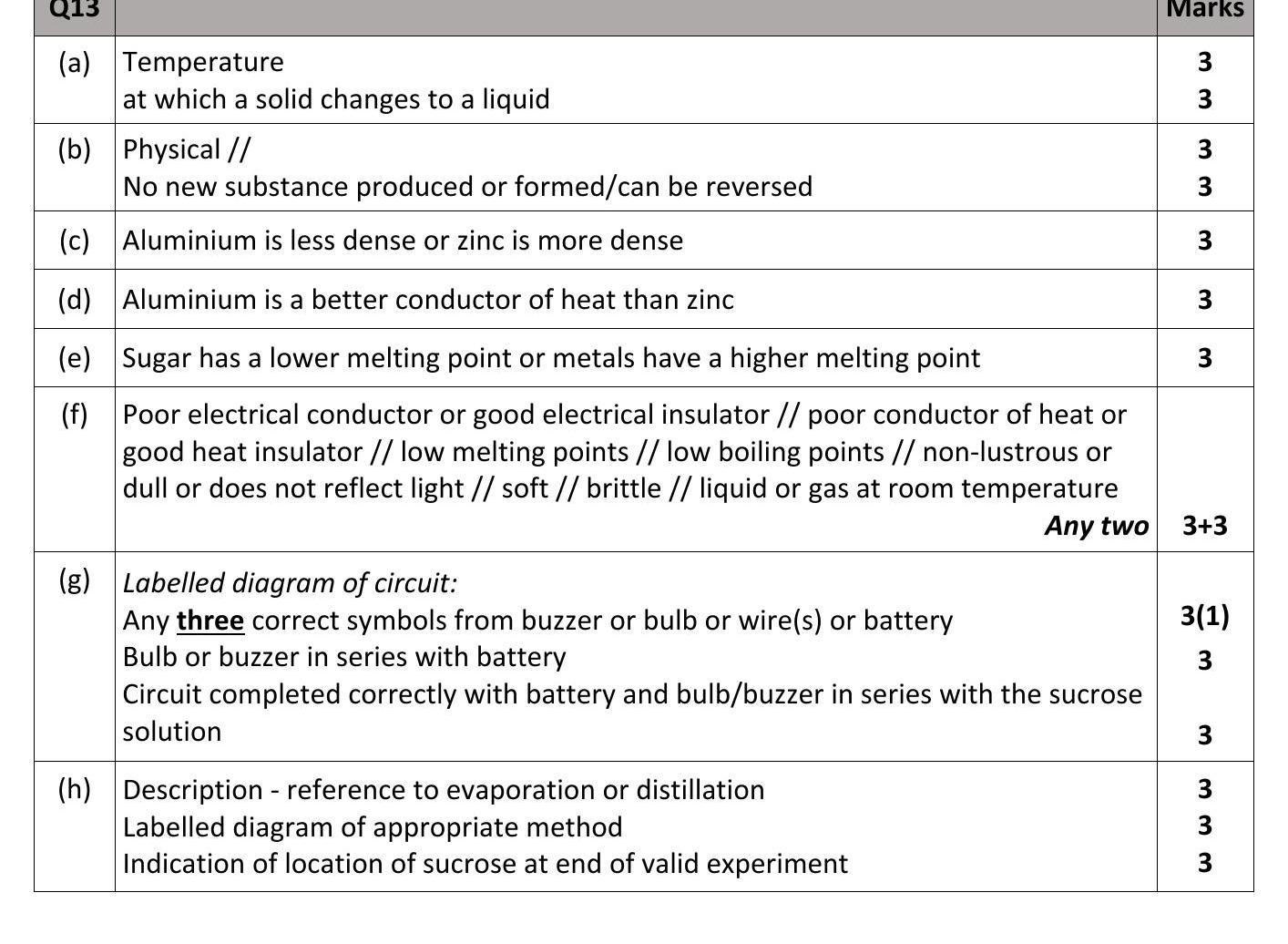
The melting point of a substance is the specific temperature at which a solid changes to a liquid state. At this temperature, the substance undergoes a phase change from solid to liquid while remaining chemically identical.
Note
[3/3 Marks] This answer earns full marks as it clearly defines the melting point in terms of the temperature at which the phase change from solid to liquid occurs, which matches the marking scheme requirement.
Question (b)
Answer
Melting is an example of a physical change. During melting, there is only a change in the physical state of the substance (from solid to liquid), but no new substance is produced. The chemical composition remains unchanged, and the process is reversible - the liquid can be frozen back to a solid with the same chemical identity.
Note
[3/3 Marks] This answer receives full marks as it correctly identifies melting as a physical change and explains that no new substance is formed and the process is reversible, which aligns with the marking scheme criteria.
Question (c)
Answer
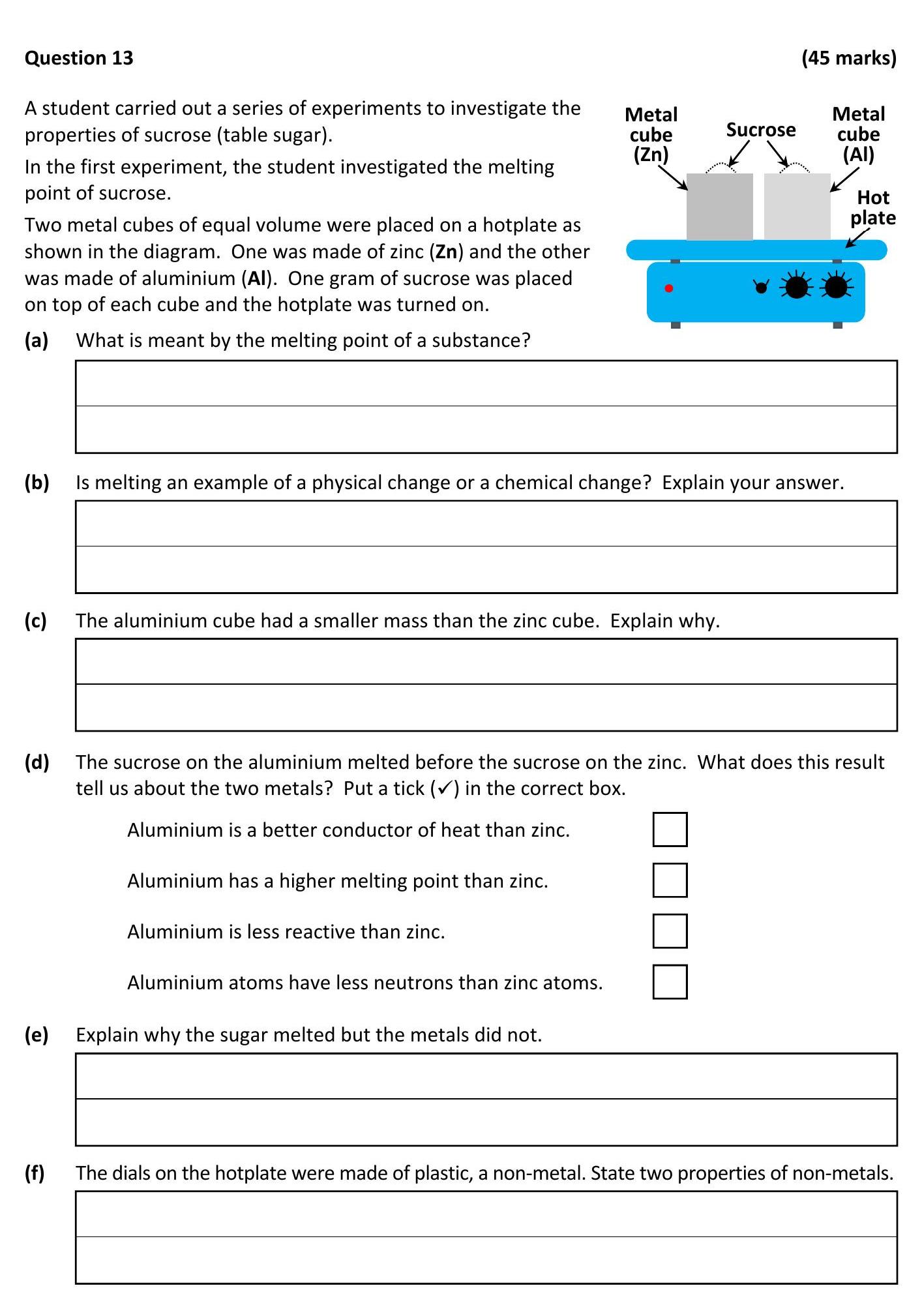
The aluminium cube had a smaller mass than the zinc cube because aluminium is less dense than zinc. Since both metal cubes have equal volume (as stated in the question), the cube made of the less dense metal (aluminium) will have a lower mass compared to the cube made of the more dense metal (zinc).
Note
[3/3 Marks] This answer earns full marks as it correctly explains that aluminium is less dense than zinc, which directly matches the marking scheme criteria.
Question (d)
Answer
The correct answer is: Aluminium is a better conductor of heat than zinc.
Since both metal cubes were placed on the same hotplate and the sucrose on the aluminium melted before the sucrose on the zinc, this indicates that heat transferred more quickly through the aluminium, reaching the sucrose faster and causing it to melt first. This demonstrates that aluminium conducts heat better than zinc.
Note
[3/3 Marks] This answer receives full marks as it correctly identifies that aluminium is a better conductor of heat than zinc, which matches the marking scheme.
Question (e)
Answer
The sugar (sucrose) melted but the metals did not because sugar has a significantly lower melting point than metals like aluminium and zinc. The temperature of the hotplate was high enough to exceed the melting point of sucrose (which is approximately 186°C) but was not high enough to reach the melting points of aluminium (660°C) or zinc (420°C), which are much higher.
Note
[3/3 Marks] This answer earns full marks as it clearly explains that sugar has a lower melting point compared to the metals, which aligns with the marking scheme criteria.
Question (f)
Answer
Two properties of non-metals like the plastic used for the hotplate dials are:
-
Poor conductors of heat (good heat insulators) - this makes plastic suitable for dials as they won't get too hot to touch when the hotplate is operating.
-
Poor electrical conductors (good electrical insulators) - this provides safety by preventing electrical current from flowing through the dials to the user.
Note
[6/6 Marks] This answer receives full marks (3+3) as it correctly identifies two valid properties of non-metals from the list in the marking scheme. The answer includes poor conductors of heat and poor electrical conductors, both of which appear in the marking criteria.
Marking Scheme