The Circulatory System (Junior Cert Science): Revision Notes
📚Revision Notes
The Circulatory System
What is the circulatory system?
The circulatory system is made up of the heart and blood vessels. It also includes the blood that flows through them. This system is essential for keeping your body healthy and functioning properly.
The circulatory system allows blood to transport substances to the cells of the body. It also transports waste away from the cells.
Note
The circulatory system is like a highway network in your body, with blood acting as delivery trucks that carry essential supplies to every cell and remove waste products.
Why do we need a circulatory system?
Your body needs the circulatory system for several important reasons:
- Delivering oxygen and nutrients: Each cell in your body needs food and oxygen to get energy. Some cells also need other substances such as hormones to control the functions of the cell.
- Removing waste products: Each cell in your body needs to get rid of waste such as carbon dioxide and water. The circulatory system picks up waste from cells and carries it in the blood to the lungs and kidneys to be expelled from the body.
- Transporting nutrients from digestion: To pick up nutrients from the digestive system and take them in the blood to all the cells in the body.
- Carrying oxygen: To pick up oxygen from the lungs and take it in the blood to all the cells in the body.
Important
Without the circulatory system, cells would quickly run out of oxygen and nutrients, and toxic waste products would build up. This is why the circulatory system must work continuously, 24 hours a day, throughout your entire life.
Blood
Composition of blood
Blood is a type of tissue because it is made up of similar cells that work together. Blood is made up of a straw-coloured liquid called plasma. Plasma carries nutrients, oxygen and heat to the cells of the body. There are three types of blood cells floating in the plasma:
- Red blood cells
- White blood cells
- Platelets

Plasma is the liquid part of blood. It is water and dissolved substances including plasma proteins, glucose, salts, and urea.
Note
Blood Composition at a Glance:
Blood is approximately 55% plasma (the liquid portion) and 45% cells (red blood cells, white blood cells, and platelets). This precise balance is crucial for proper blood function.
Functions of blood components
Each component of blood has a specific function:
Red blood cells
- Contain a red pigment called haemoglobin which carries oxygen
- Transport oxygen from the lungs to all cells in the body
White blood cells
- Fight infection
- Protect the body against disease
- Help to clot blood when blood vessels are damaged
Platelets
- Small cell fragments
- Help to clot blood when blood vessels are damaged
- Form a plug to stop bleeding
Important
Red blood cells make up about 99% of all blood cells in your body. A single drop of blood contains millions of red blood cells! This high number is necessary because every cell in your body needs a constant supply of oxygen.
Blood vessels
Blood vessels carry the blood around the body. There are three types of blood vessels:
- Arteries
- Veins
- Capillaries
Arteries
Arteries are blood vessels with thick walls. They always carry blood away from the heart.
Blood in arteries is under high pressure from the pumping action of the heart. This is why arteries need thick muscular walls - to withstand this pressure. The thick walls are also elastic, which helps to push the blood along.
Note
Think of arteries like high-pressure hoses. Just as a garden hose needs strong walls to handle water pressure, arteries need thick, muscular walls to handle the pressure created by the beating heart.
Veins
Veins are blood vessels with thin walls. They always carry blood towards the heart.
Blood in veins is not under pressure. Because the blood pressure is low, veins have valves to prevent the blood flowing backwards. The valves open to let blood flow towards the heart and close to stop blood flowing backwards.
Note
The valves in veins work like one-way doors. When you move your muscles (like when walking), they squeeze the veins and help push blood back to the heart. The valves ensure blood can only move in one direction - toward the heart.
Capillaries
Capillaries are very tiny blood vessels. They have walls that are only one cell thick. This makes them very thin.
The very thin walls of capillaries allow substances to pass in and out of cells in the blood. This is where oxygen and nutrients move from the blood into body cells, and where carbon dioxide and waste products move from body cells into the blood.

Arteries divide into capillaries, and capillaries come together as veins. Blood in arteries is shown as red because it is oxygenated (carrying a lot of oxygen). The blood in veins is shown as blue because it is deoxygenated (not carrying much oxygen).
Important
Why Capillaries Must Be So Thin:
The walls of capillaries are only one cell thick for a crucial reason - to allow efficient exchange of materials. If the walls were thicker, oxygen and nutrients couldn't pass through easily to reach body cells, and waste products couldn't be removed effectively.
The heart
The heart is an organ made of a unique type of muscle known as cardiac muscle. Unlike the muscles on the skeleton (skeletal muscle), cardiac muscle never tires.
The function of the heart is to pump oxygenated blood all around the body. It also pumps blood to the lungs to remove carbon dioxide and collect oxygen.
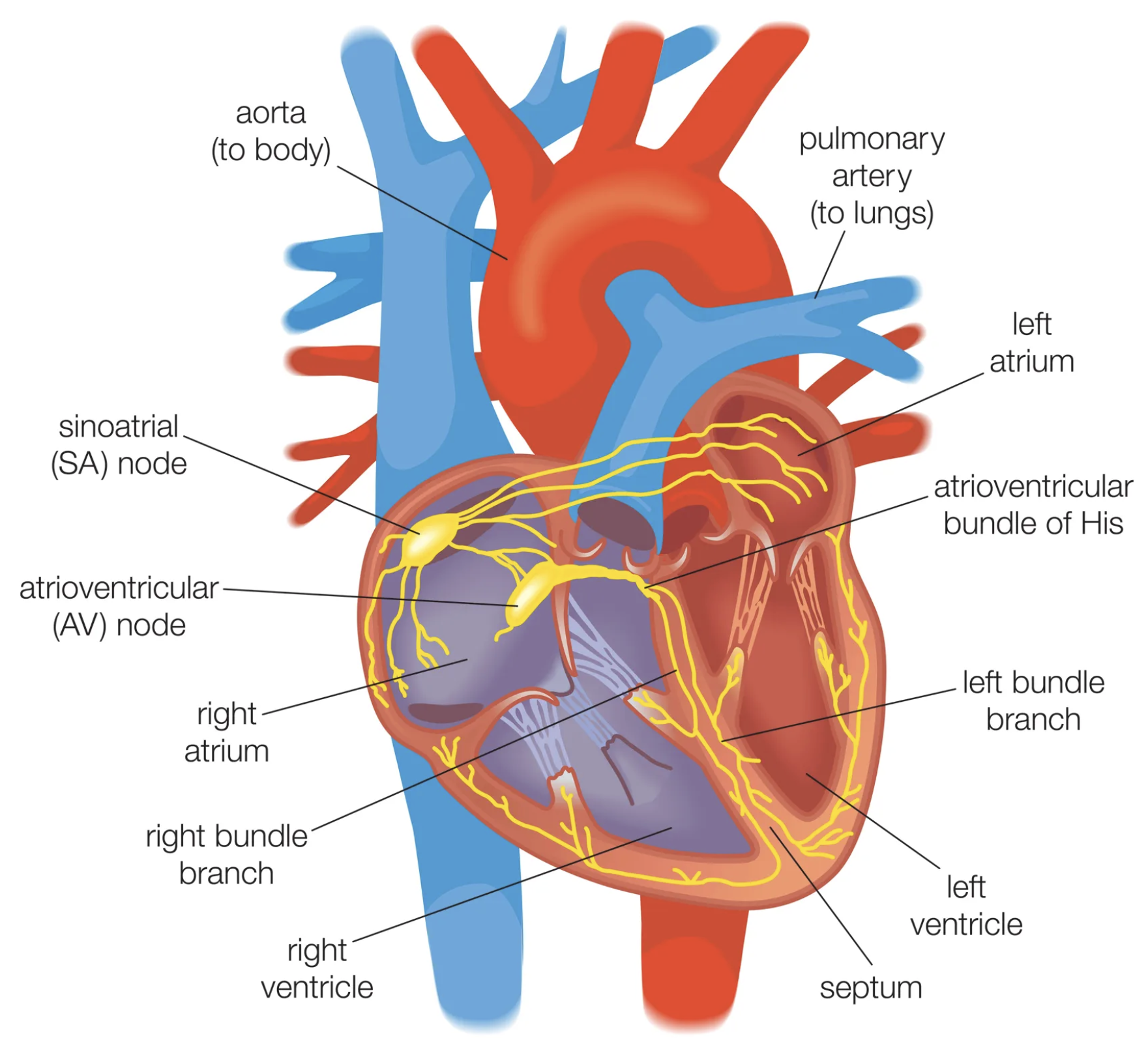
Structure of the heart
The heart is divided into the right and left sides by a wall called the septum. Each side has an upper chamber (the atrium) and a lower chamber (the ventricle).
Key features:
- The left ventricle has the thickest muscle because blood is pumped all around the body from here. It needs more muscle power to push blood to all parts of the body.
- Valves in the heart prevent blood flowing backwards. They ensure blood flows in one direction only.
- The heart has four chambers in total:
- Right atrium
- Right ventricle
- Left atrium
- Left ventricle
Note
Why the Left Ventricle is the Strongest:
The left ventricle has walls about three times thicker than the right ventricle. This is because it must pump blood through the entire body - from your head to your toes - while the right ventricle only needs to pump blood to the nearby lungs.
Blood circulation
Blood enters both the right atrium (through the vena cava) and the left atrium (through the pulmonary vein).

Pathway of blood through the heart
Example
Worked Example: Complete Blood Flow Through the Heart
Follow the journey of blood through the heart step by step:
Step 1: The right atrium and the left atrium contract to squeeze the blood into the right and left ventricles.
Step 2: The right ventricle contracts to force blood into the pulmonary artery to the lungs. The left ventricle contracts to force blood into the aorta.
Step 3: The heart valves in the artery and the aorta have valves to prevent blood flowing back into the chambers of the heart.
Step 4: Blood carries oxygen from the heart to send around the body via the aorta.
Step 5: Blood carries carbon dioxide back from the lungs to the left atrium via the pulmonary vein.
Step 6: Blood receives oxygenated blood from the pulmonary vein, which flows into the left atrium.
Step 7: Blood receives deoxygenated blood from the vena cava, which flows into the right atrium.
Step 8: Valves prevent the blood flowing backwards.
The diagram shows the complete circulatory pathway. Blood travels from the heart through arteries to all organs of the body, then returns through veins back to the heart.
How the organs of the circulatory system interact with each other
Heart and arteries
Arteries are the blood vessels that carry blood away from the heart and carry it towards the organs of the body.
Heart and veins
Veins are the blood vessels that carry blood away from the organs of the body and deliver it back to the heart.
Note
The heart, arteries, and veins all work together to transport blood around the body in a continuous cycle. This cycle never stops - it continues beating approximately 100,000 times per day, pumping about 7,500 liters of blood!
Effect of exercise on heart rate
What is pulse?
A pulse is a vibration in an artery due to the beat of the heart. You can feel your pulse by placing your fingers on your wrist or neck.
The normal resting heart rate for adults, including older-aged adults and everyone over the age of years, is between and heartbeats a minute. Athletes who have done a lot of training may have their resting heart rate fall below beats a minute, possibly as low as beats a minute.
The average resting heart rate is beats per minute.
Note
How to Measure Your Pulse:
Place two fingers (not your thumb) on your wrist below the base of your thumb, or on the side of your neck. Count the beats you feel for 60 seconds, or count for 30 seconds and multiply by 2. This gives you your heart rate in beats per minute.
Why does exercise increase heart rate?
Exercise involves the movement of muscles. When more energy is needed, the heart rate increases in order to send more blood with more glucose and oxygen to the muscle cells.
Exercise also causes more carbon dioxide to be produced by the cells. This must be removed from the cells into the blood because it is poisonous.
Important
During intense exercise, your heart rate can more than double! This dramatic increase ensures that working muscles receive enough oxygen and glucose to produce the energy they need, and that waste products like carbon dioxide are quickly removed.
Why does rest decrease heart rate?
During sleep, the body needs less energy. Key reasons include:
- Less food and oxygen are needed by cells for respiration
- Less carbon dioxide is produced by the cells
- Less blood needs to get to the cells
- The heart rate can slow down
Note
While you sleep, your heart rate typically drops to its lowest level of the day. This gives your heart a chance to rest and recover, which is one of the many reasons why getting enough sleep is so important for your health.
Remember!
Summary
Key Points to Remember:
-
The circulatory system is made up of the heart, blood vessels, and blood. It transports oxygen, nutrients, and waste products around the body.
-
Blood consists of plasma (liquid) with three types of cells: red blood cells (carry oxygen), white blood cells (fight infection), and platelets (help blood clot).
-
There are three types of blood vessels: arteries (thick walls, carry blood away from heart), veins (thin walls with valves, carry blood to heart), and capillaries (one cell thick, allow exchange of substances).
-
The heart is a four-chambered organ made of cardiac muscle. The left ventricle has the thickest wall because it pumps blood around the entire body.
-
Exercise increases heart rate to deliver more oxygen and glucose to working muscles and to remove carbon dioxide more quickly.