Density (Junior Cert Science): Revision Notes
📚Revision Notes
Density
What is density?
Density is a fundamental property of materials that helps us understand how much matter is packed into a given space. When we look at different materials, even if they have the same size or volume, they can have very different masses. This difference is due to their density.
Think about it this way: if you have two identical boxes, one filled with feathers and one filled with rocks, they would feel very different when you try to lift them. The box with rocks is much heavier because rocks have a higher density than feathers. The rocks have more mass packed into the same volume.

The diagram above shows cubes that are all the same size (they have equal volumes). However, they have very different masses. Lead has a mass of , while polystyrene (a type of plastic foam) has a mass of only . This demonstrates that different materials have different densities.
Note
Density is defined as the mass of one cubic centimetre () of a substance. In other words, it tells us how much mass is squeezed into a specific volume of material. Materials with high density have lots of mass in a small space, while materials with low density have less mass spread out in the same space.
Understanding density helps us explain many everyday observations. For example, why does iron sink in water but wood floats? Why are some materials chosen for building aeroplanes while others are not? The answer lies in their densities.
The density formula
To calculate the density of any material, we use a simple mathematical formula that relates three important quantities: density, mass, and volume.
The formula is:
This can be remembered using the triangle method or the abbreviation "DMV":
- D = Density
- M = Mass
- V = Volume
The unit for density is grams per cubic centimetre, written as . This tells us how many grams of material are present in one cubic centimetre of space.
Important
Important note about units: When using this formula, you must always include the correct units in your answer. In your exam, you may lose marks if you write down a number without the units. Always write your density with after the number.
Calculating density
To find the density of any object, you need to follow four clear steps. Let's work through the process systematically.
Step 1: Find the mass Use a balance or scales to measure the mass of the object in grams.
Step 2: Find the volume For regular shaped objects (like cubes or rectangular blocks), calculate the volume using:
For irregular shaped objects, you can use the water displacement method (described in experiments).
Step 3: Use the density formula Write down the formula and substitute your values:
Step 4: Write the answer with correct units Always include with your answer.
Example
Worked Example: Calculating the Density of a Cube
A cube has dimensions of and a mass of . What is the density?
Solution:
First, calculate the volume:
Then, write the density formula:
Fill in the values:
Note
Exam tip: In your examination, you may receive marks for showing your working even if you make a calculation mistake. Always show each step clearly as demonstrated above. This method is especially important in the Maths section of your exam.
Example
Worked Example: Calculating the Density of Brass
A cube of brass has sides measuring each and a mass of . Calculate the density of brass.
Solution:
Calculate the volume:
Use the density formula:
Example
Worked Example: Calculating the Density of a Liquid
A beaker contains a liquid with a mass of . The volume of the liquid is measured as using a graduated cylinder. What is the density of the liquid?
Solution:
Write the density formula:
Substitute the values:
Note: We subtract the mass of the empty beaker () to find just the mass of the liquid ().
Density values of different materials
Different materials have very different densities. This table shows the densities of common substances, organized by whether they are lighter or heavier than water.
The density of water is , which makes it a useful reference point. Substances with densities lower than will float on water, while substances with densities higher than will sink.
Substances lighter than water
These materials have densities less than :
| Substance | Density (g/cm³) |
|---|---|
| Expanded polystyrene | 0.02 |
| Cork | 0.3 |
| Paraffin oil | 0.8 |
| Ice | 0.9 |
| Polythene | 0.9 |
Note
Notice that ice has a lower density than liquid water ( compared to ). This is why ice floats in your drink! When water freezes, it expands slightly, making the same mass take up more space, which reduces its density.
Substances heavier than water
These materials have densities greater than :
| Substance | Density (g/cm³) |
|---|---|
| Aluminum | 2.7 |
| Lead | 11.2 |
| Mercury | 13.6 |
| Gold | 19.3 |
| Osmium | 22.6 |
Osmium is the densest naturally occurring element. A small piece of osmium would feel incredibly heavy for its size because it has so much mass packed into a small volume.
Density of gases
Gases also have density, although their densities are much lower than solids and liquids because the particles are much more spread out.
| Gas | Density (g/cm³) |
|---|---|
| Helium | 0.0002 |
| Air | 0.0013 |
| Carbon dioxide | 0.0020 |
Helium has a lower density than air, which is why helium balloons float upwards. Carbon dioxide has a higher density than air, which is why it sinks and can collect in low-lying areas.
Why is density important in our everyday lives?
Understanding density helps us explain many phenomena we observe in daily life and allows engineers and designers to create useful products.
Flotation
Knowledge of density helps us predict whether objects will float or sink in liquids. This principle is called flotation.
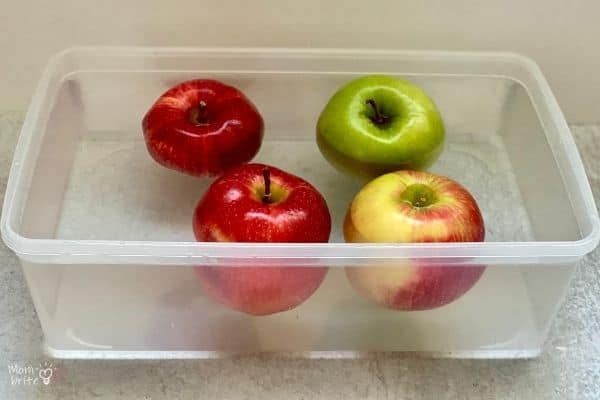
An apple floats on water because it has a lower density than water (approximately ). The apple slice may initially sink because cut fruit can absorb water, but a whole apple with air pockets inside typically floats.
Important
Objects will float in a liquid if their density is less than the density of the liquid. Objects will sink if their density is greater than the density of the liquid.

The density column experiment demonstrates this principle beautifully. Different liquids are layered according to their densities:
- Syrup (highest density) sinks to the bottom
- Water sits in the middle layer
- Oil (lowest density) floats on top
Objects placed in the column settle at different levels:
- The ping-pong ball floats at the very top (lowest density)
- The nail lies at the bottom
This happens because each object sinks until it reaches a liquid layer that has a higher density than itself.
Practical applications of flotation:
Helium balloons float in air because helium gas has a much lower density than air. This principle is used for party balloons, weather balloons, and even airships.

Note
Water wings and flotation devices help children learn to swim safely. These devices are made from materials with very low density (like expanded polystyrene or air-filled plastic), so they float and help support the child in water.
Identifying substances
If you know the density of a substance, you can identify what material it is made from. Different materials have unique densities, like a fingerprint. This is particularly useful for identifying rocks and minerals, or for detecting fake jewellery.
Geologists use density to help identify rock types. For example, if you find a rock and measure its density to be around , it might be granite.
Design of lightweight objects
Engineers use materials with low density to make objects easier to carry and more efficient.
Modern aeroplanes are designed using metals with relatively low density, such as aluminum (). This makes the aircraft light enough to fly efficiently while still being strong. Engineers carefully choose materials that are both strong and lightweight.
Laptops and mobile phones are also designed using low-density materials where possible. This makes them portable and easy to carry around. The cases are often made from lightweight plastics or aluminum alloys.
Formula 1 racing cars use low-density carbon fiber materials. Keeping the car's mass as low as possible helps it accelerate more efficiently and use less fuel. The materials must also be strong to protect the driver, so engineers select materials with the best strength-to-density ratio.
Note
Key point: Energy-efficient cars and aircraft use low-density components to keep them light. This means they require less energy to move, which saves fuel and reduces environmental impact.
Why does an iron ship float?
You might wonder why a massive iron ship can float when a small piece of iron sinks in water. Iron has a density of about , which is much higher than water's density of . So why doesn't the ship sink?

The answer lies in the average density of the entire ship. While the iron hull itself is denser than water, the ship contains large air pockets and compartments. These include the deck areas, cabins, and cargo holds.
When you calculate the total mass of the ship (including the iron and the air inside) and divide it by the total volume (including all the hollow spaces), the average density of the whole ship is less than the density of water. This is why the ship floats.
Ships also have ballast tanks which can be filled with water to increase the ship's density and make it sit lower in the water (for stability), or emptied to decrease density. This helps control how the ship floats and maintains balance.
Important
The key principle is: an iron ship floats because the average density of the air and iron together is less than the density of water.
Remember!
Summary
Key Points to Remember:
- Density tells us how much mass is packed into one cubic centimetre of a material
- The formula for density is:
- Always include units () in your answer
- Substances with density less than float on water; substances with density greater than sink
- Density is used in everyday life for flotation devices, identifying materials, designing lightweight objects, and understanding why ships float