The Earth, Sun, and Moon (Junior Cert Science): Revision Notes
📚Revision Notes
The Earth, Sun, and Moon
Introduction
Our planet Earth is part of an amazing cosmic dance involving the Sun and the Moon. Understanding how these three celestial bodies move and interact helps explain many patterns we observe in our daily lives, from the cycle of day and night to the changing seasons throughout the year.
Note
The movements of Earth, the Sun, and the Moon create predictable patterns that affect our daily lives. These include the 24-hour day-night cycle, the 365-day year, and the 28-day lunar cycle.
The Earth, Sun, and Moon system
Earth's relationship with the Sun
Earth continuously travels along a nearly circular path around the Sun. We call this path an orbit, and the movement around the Sun is called revolution. Earth acts as a satellite of the Sun, held in orbit by the force of gravity.
Important
Key Definition - Year:
The time it takes for a planet to orbit around the sun. For Earth, this is approximately 365.25 days, which we call a year.
Earth's rotation
While Earth orbits the Sun, it also spins on its own axis. This spinning motion is called rotation. Earth completes one full rotation every 24 hours, which we call a day.
The Moon's orbit
The Moon is a natural satellite of Earth. It orbits our planet in approximately 27.3 days, though we often round this to 28 days for simplicity. This period is called a lunar month.
Days and nights
Why do we have day and night?
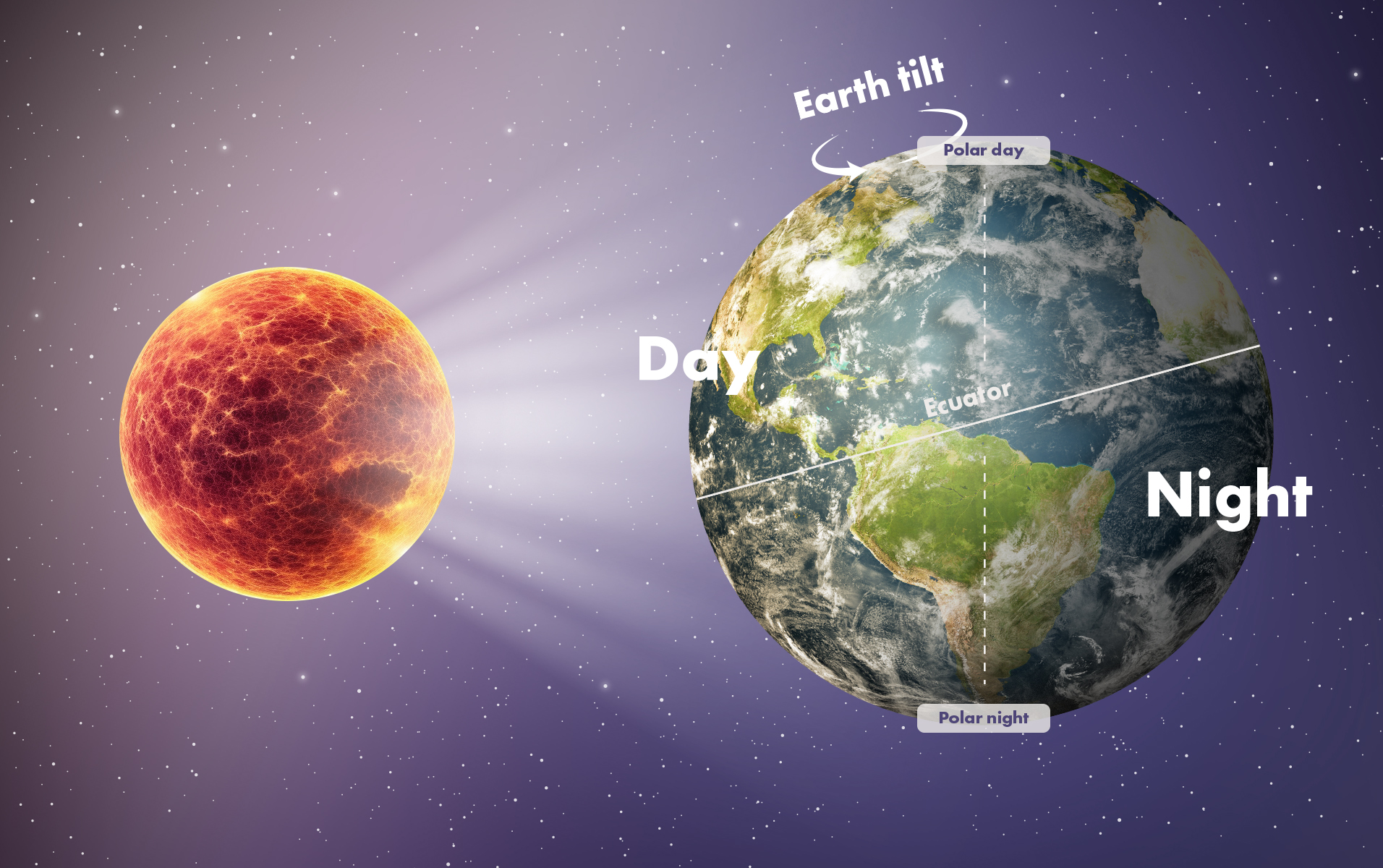
Day and night occur because Earth rotates on its axis. At any moment, only half of our planet faces the Sun and receives sunlight. This half experiences daytime. The other half faces away from the Sun and remains in darkness, experiencing night-time.
As Earth rotates, different parts of the planet move into and out of sunlight. This is why we see the Sun appear to rise in the east and set in the west. In reality, it's Earth that's moving, not the Sun!
Note
At any one time, only half of Earth faces the Sun. The boundary between day and night is constantly moving as Earth rotates, creating the appearance of the Sun moving across our sky.
Seasons
Earth's axial tilt
One of the most important facts about Earth is that it doesn't stand upright as it orbits the Sun. Instead, Earth is tilted at an angle of 23.5° relative to its orbital plane. This tilt remains constant throughout the year—Earth always points in the same direction as it travels around the Sun.
Important
The Cause of Seasons:
The tilt of Earth's axis at 23.5° causes the seasons. Without this tilt, we wouldn't experience seasonal changes! Remember: Earth is always tilted at the same angle as it orbits the Sun.
How the tilt creates seasons
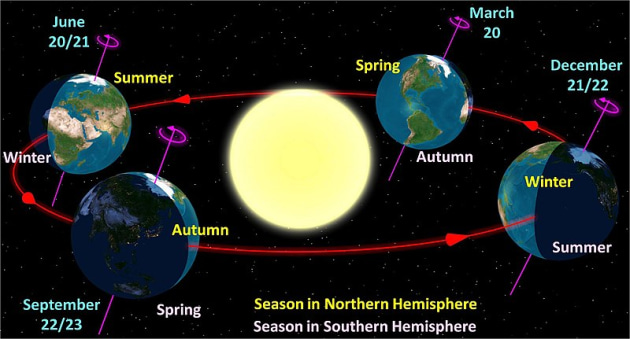
Because Earth is tilted, different parts of the planet receive varying amounts of sunlight throughout the year. When the Northern Hemisphere tilts toward the Sun, it receives more direct sunlight and experiences summer. At the same time, the Southern Hemisphere tilts away from the Sun and experiences winter.
Six months later, the situation reverses. The Northern Hemisphere tilts away from the Sun (experiencing winter), while the Southern Hemisphere tilts toward the Sun (experiencing summer).
Why does the angle of sunlight matter?
The angle at which sunlight strikes Earth's surface significantly affects how much it heats that area.
Perpendicular rays: When sunlight hits Earth's surface at a right angle (perpendicular), the energy concentrates over a smaller area. This produces stronger heating. For example, if of energy strikes perpendicularly, all that energy heats a small area.
Oblique rays: When sunlight strikes at a slanted (oblique angle), the same amount of energy spreads over a much larger surface area. This means each part of that larger area receives less energy, resulting in weaker heating. The same might spread to cover twice the area, providing only to each part.
Example
Worked Example: Understanding Solar Heating
Imagine of solar energy hitting Earth's surface:
Perpendicular rays (summer):
- Energy concentrates on
- Power per square meter =
- Result: Strong heating
Oblique rays (winter):
- Same spreads across due to angle
- Power per square meter =
- Result: Weak heating
This explains why summer is warmer than winter—the angle of sunlight matters more than the distance from the Sun!
Key dates in Earth's orbit
Summer solstice (June 21): The Northern Hemisphere tilts most directly toward the Sun. This is the longest day of the year in the Northern Hemisphere and marks the start of summer. The Southern Hemisphere experiences its shortest day and the start of winter.
Winter solstice (December 21): The Northern Hemisphere tilts most directly away from the Sun. This is the shortest day of the year in the Northern Hemisphere and marks the start of winter. The Southern Hemisphere experiences its longest day and the start of summer.
Spring equinox (March 21): Neither hemisphere tilts significantly toward or away from the Sun. Day and night have roughly equal length everywhere on Earth.
Autumn equinox (September 21): Again, neither hemisphere tilts significantly toward or away from the Sun, and day and night are roughly equal in length.
Note
At the Equator:
There is very little seasonal variation at the equator. Days remain close to 12 hours long throughout the year because the equator receives relatively direct sunlight all year round.
The phases of the Moon
Why does the Moon appear to change shape?
The Moon doesn't actually change shape—it's always a sphere! What changes is how much of the Moon's illuminated surface we can see from Earth.
The Sun constantly illuminates half of the Moon, just as it illuminates half of Earth. However, as the Moon orbits Earth, our viewing angle changes. Sometimes we see all of the illuminated half (full moon), sometimes none of it (new moon), and sometimes just a portion of it (various phases).
The lunar cycle
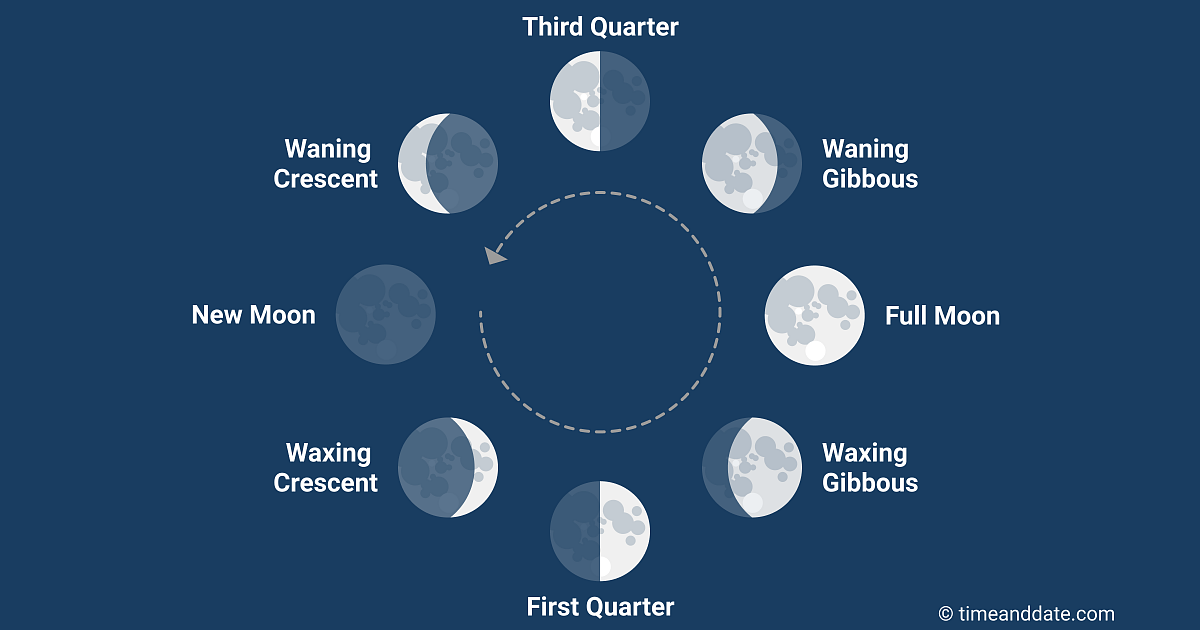
The Moon takes approximately 28 days to complete one orbit around Earth. During this time, we observe the following sequence of phases:
Waxing phases (Moon appears to grow larger):
- New moon (Day 1): The Moon sits between Earth and the Sun. We cannot see the illuminated side, so the Moon appears dark or invisible.
- Waxing crescent: A small, crescent-shaped sliver of the Moon becomes visible.
- First quarter (Day 7): Half of the Moon's face appears illuminated. (It's called "quarter" because the Moon has completed one quarter of its orbit.)
- Waxing gibbous: More than half of the Moon's face appears illuminated. The word "gibbous" means "bulging."
- Full moon (Day 14): The entire illuminated side faces Earth, and we see the full circular disc.
Waning phases (Moon appears to shrink):
- Waning gibbous: The illuminated portion begins to decrease, but more than half remains visible.
- Third quarter (Day 21): Half of the Moon's face appears illuminated again, but it's the opposite half from the first quarter.
- Waning crescent: Only a small crescent remains visible.
- New moon (Day 28): The cycle completes and begins again.
Note
Memory Aids for Moon Phases:
- Waxing = getting bigger (think of wax building up on a candle)
- Waning = getting smaller (think of interest waning or fading away)
- Crescent = less than half of the Moon's face is visible
- Gibbous = more than half of the Moon's face is visible
Important details about moon phases
The Moon always shows the same face toward Earth because it rotates on its axis at the same rate it orbits Earth. We never see the "far side" of the Moon from Earth.
Changes in the Moon's appearance happen from right to left as seen from Earth in the Northern Hemisphere. During waxing, the bright part grows from right to left. During waning, the Moon darkens from right to left.
Eclipses
An eclipse occurs when one celestial body blocks sunlight from reaching another celestial body. There are two main types of eclipses involving Earth, the Sun, and the Moon.
Lunar eclipses
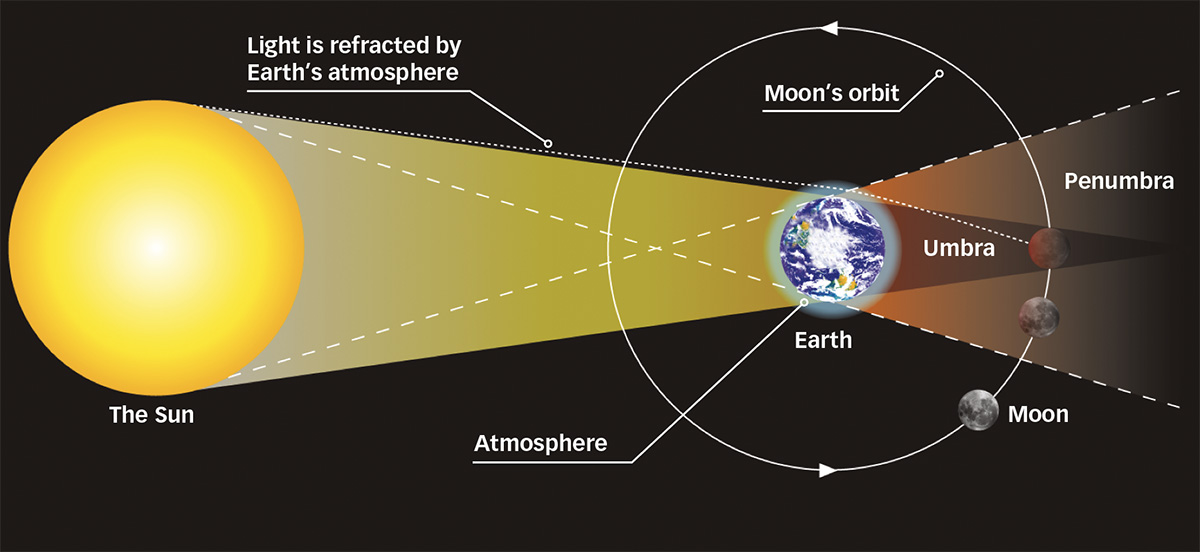
A lunar eclipse happens when the Moon passes into Earth's shadow. During a lunar eclipse:
- The Sun, Earth, and Moon align in that order
- Earth blocks sunlight from reaching the Moon
- The Moon may appear darkened or take on a reddish colour
- Lunar eclipses can only occur during a full moon
- They can last for a few hours
Important
Key Definition - Lunar Eclipse:
A lunar eclipse happens when the Moon passes into Earth's shadow. The Sun, Earth, and Moon must be aligned with Earth in the middle.
Solar eclipses
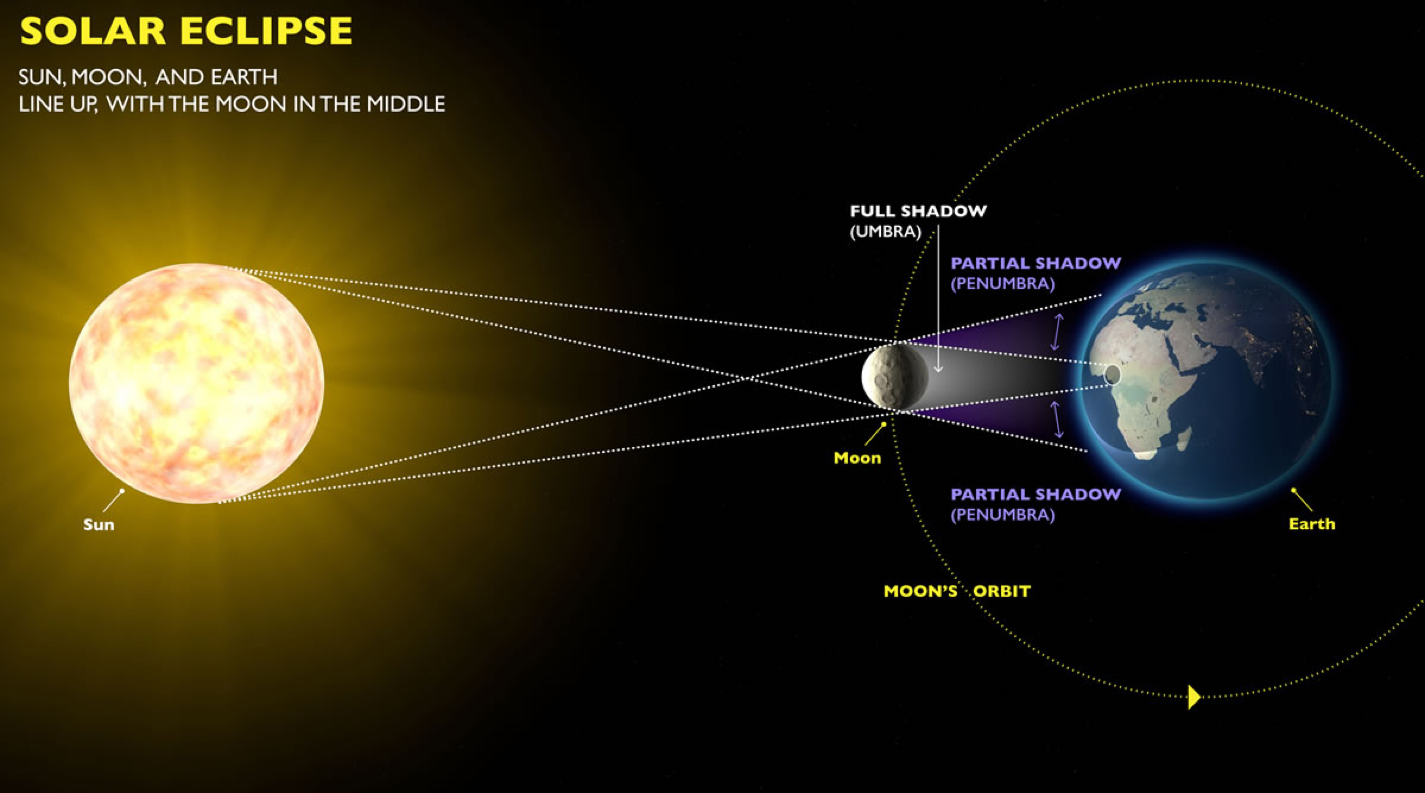
A solar eclipse occurs when the Moon passes between Earth and the Sun. During a solar eclipse:
-
The Sun, Moon, and Earth align in that order
-
The Moon blocks sunlight from reaching part of Earth
-
People in the Moon's shadow experience the eclipse
-
The sky can go completely dark during a total solar eclipse
-
Solar eclipses can only happen during daytime on Earth
-
They are relatively rare events from any given location
Important
Key Definition - Solar Eclipse:
A solar eclipse occurs when the Moon passes between Earth and the Sun, blocking the Sun's light from reaching part of Earth's surface.
Remember: Lunar eclipses occur when Earth blocks light to the Moon, while solar eclipses occur when the Moon blocks light to Earth.
Benefits of space exploration
Space exploration has provided many benefits to life on Earth. Technologies developed for space often find important applications in everyday life.
Satellites
Weather satellites orbit Earth and provide crucial information for accurate weather forecasting. Television and internet signals rely on satellite technology to transmit information across large distances quickly and efficiently.

Note
Satellites have revolutionized our ability to predict weather patterns, communicate globally, and monitor environmental changes. Many of the technologies we use daily depend on satellite systems orbiting Earth.
Efficient solar panels
Space stations like the International Space Station require efficient solar panels to generate electricity. These panels convert sunlight into electrical energy to power systems necessary for human survival in space. This technology has improved solar panels used on Earth, making them more efficient sources of electricity for buildings and homes.
New materials
Materials developed for space exploration have found many uses on Earth. For example:
- Heat-resistant roof glass used in buildings was originally developed for space
- Teflon-coated fibreglass used to make flexible roofing for large structures was initially created for spacecraft
- Many lightweight, strong materials developed for spacecraft now benefit everyday products
Hazards of space exploration
Space exploration presents numerous challenges and dangers that scientists and engineers must overcome.
Explosion risks
Launching rockets into space is extremely dangerous. Rockets contain enormous amounts of fuel that can explode. Controlled explosions propel the rocket upward, but accidents can and have happened during launch.
Important
Critical Danger - Explosions:
Rockets require massive amounts of fuel to escape Earth's gravity. While engineers design controlled explosions to provide thrust, any malfunction can lead to catastrophic explosions that destroy the spacecraft and endanger lives.
Heat during re-entry
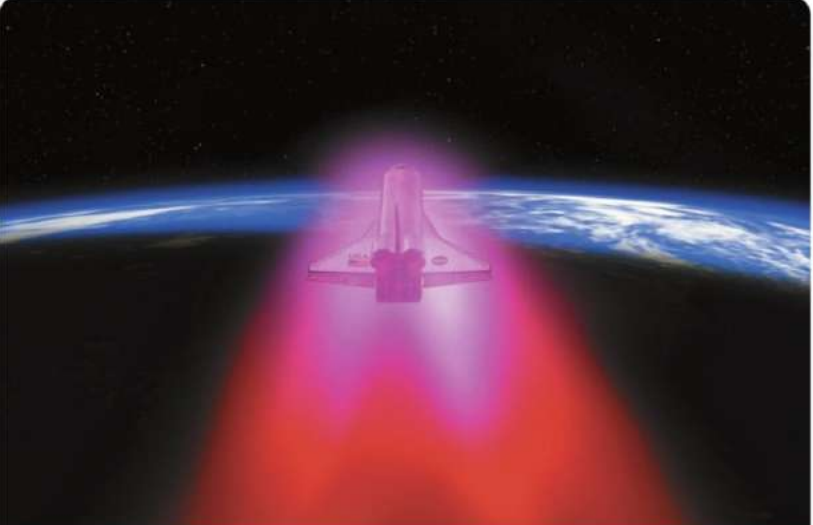
When a spacecraft returns to Earth, it must pass through the atmosphere at very high speed. This creates extreme heat due to friction with air molecules. The intense heat can damage or destroy the spacecraft if proper heat shields aren't in place. Temperatures can reach thousands of degrees Celsius.
Cosmic radiation
Space lacks the protective atmosphere that shields us from harmful radiation on Earth. This cosmic radiation comes from the Sun and other cosmic sources. It can damage DNA and cause serious health problems including cancer. Astronauts face significant exposure to radiation, particularly during extended missions or trips beyond Earth's magnetic field protection.
Note
Airline pilots also experience some exposure to cosmic radiation because they fly at high altitudes where the atmosphere provides less protection. However, the exposure is much less than what astronauts experience in space.
Lack of gravity
The absence of gravity in space causes several problems:
- Muscle and bone weakness develop quickly without the constant pull of gravity
- Astronauts must exercise rigorously to maintain their strength
- The cardiovascular system doesn't have to work as hard, which can cause health issues
- Body fluids redistribute, causing puffy faces and thin legs
- Upon returning to Earth, astronauts need time to recover their strength and readjust to gravity
Important
Long-term Health Effects:
Without gravity, astronauts experience rapid muscle atrophy and bone density loss. Extended missions can result in significant health challenges that require months of rehabilitation upon return to Earth.
Space debris
Human-made objects called space debris orbit Earth and pose risks to spacecraft and satellites. This debris includes:
- Old satellites that no longer function
- Spent rocket stages
- Fragments from collisions or explosions
- Paint flecks and other small particles
Even tiny pieces of debris can cause serious damage because they travel at extremely high speeds. A paint fleck moving at orbital velocity can pierce a spacecraft's hull.
Psychological effects
Living and working in the confined, isolated environment of a spacecraft takes a psychological toll. Astronauts experience:
- Lack of sleep due to unusual light-dark cycles
- High stress from dangerous conditions
- Isolation from loved ones
- Pressure from public scrutiny
- Extreme change of environment
- Extended periods with small groups in cramped quarters
- Challenges working with people from different cultures who speak different languages
Note
Maintaining good mental health is just as important as physical health for mission success. Space agencies carefully screen and train astronauts to handle the psychological challenges of space travel.
Remember!
Summary
Key Points to Remember:
-
Day and night are caused by Earth's rotation on its axis, which takes 24 hours. Half of Earth always faces the Sun (day) while the other half faces away (night).
-
Seasons are caused by Earth's axial tilt of 23.5°. When a hemisphere tilts toward the Sun, it receives more direct sunlight and experiences summer. When it tilts away, it receives less direct sunlight and experiences winter.
-
The angle of sunlight matters: Perpendicular rays heat more effectively than oblique rays because the energy concentrates over a smaller area.
-
Moon phases occur because we see different amounts of the Moon's illuminated surface as it orbits Earth. The cycle from new moon to new moon takes approximately 28 days.
-
Eclipses happen when celestial bodies align. A lunar eclipse occurs when Earth blocks sunlight to the Moon. A solar eclipse occurs when the Moon blocks sunlight to Earth.
-
Space exploration provides benefits including weather satellites, efficient solar panels, and new materials, but also involves hazards such as explosions, extreme heat, cosmic radiation, lack of gravity, space debris, and psychological stress.