Ecology and Habitat Study (Junior Cert Science): Revision Notes
📚Revision Notes
Ecology and Habitat Study
What is ecology?
Ecology is the scientific study of how living organisms interact with each other and with their physical surroundings. It helps us understand the complex relationships that exist in nature.
Note
At a time when damage to our environment is a serious concern, the study of organisms and their relationships has become more important than ever. Understanding ecology helps us protect and preserve the natural world.
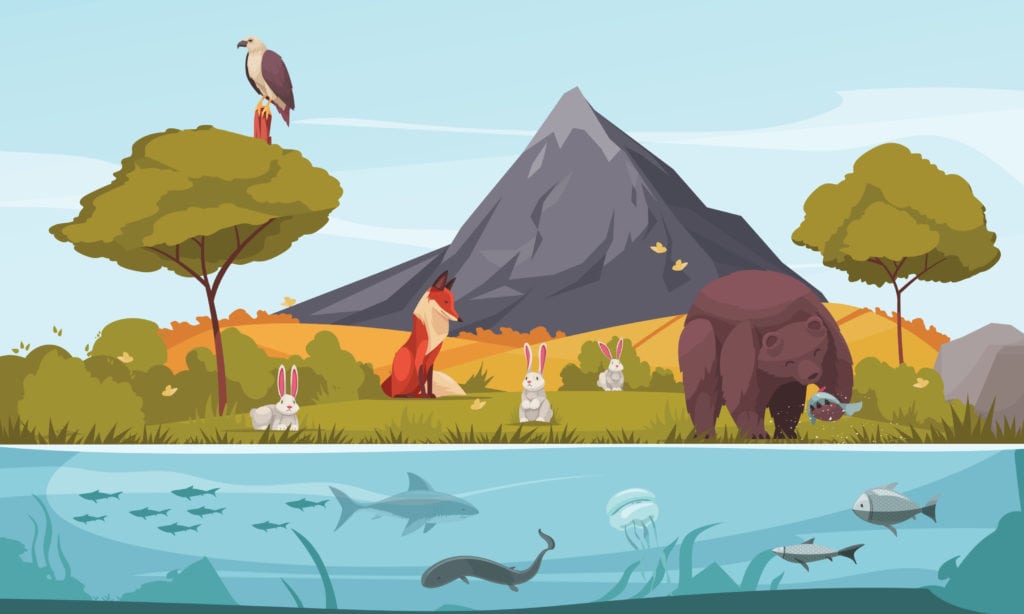
Populations, habitats and ecosystems
To understand ecology, we need to know some key terms that describe where and how organisms live.
Population
A population consists of all the members of a particular species that live in the same area. For example, all the rabbits living in a field form a population of rabbits.
Habitat
A habitat is the specific place where a particular organism lives. It provides everything the organism needs to survive, including:
- Food and water
- Shelter and protection
- A suitable climate
- A place to breed
Organisms breed in their natural habitat, and the climate of the habitat, the food available, and competition from other species all affect whether a species will survive or not.
Ecosystem
An ecosystem is a community of living organisms that interact with each other and with their environment. Ecosystems can be large or small - a lake, a forest, or even a small pond can be an ecosystem.
Understanding the difference
The key differences between habitats and ecosystems are:
| Ecosystem | Habitat |
|---|---|
| Can contain many habitats | Part of an ecosystem |
| Larger | Smaller |
| Contains many species | Contains one or a few species |
Note
An ecosystem is made up of multiple habitats. For example, a lake ecosystem might contain different habitats such as the lake itself, the grassland around it, and woodland areas nearby. Each habitat within the ecosystem is home to different species that have adapted to live there.
Food chains and food webs
Food chains
A food chain shows the pathway that energy takes as it passes from one organism to another through food. Energy flows in one direction through a food chain.
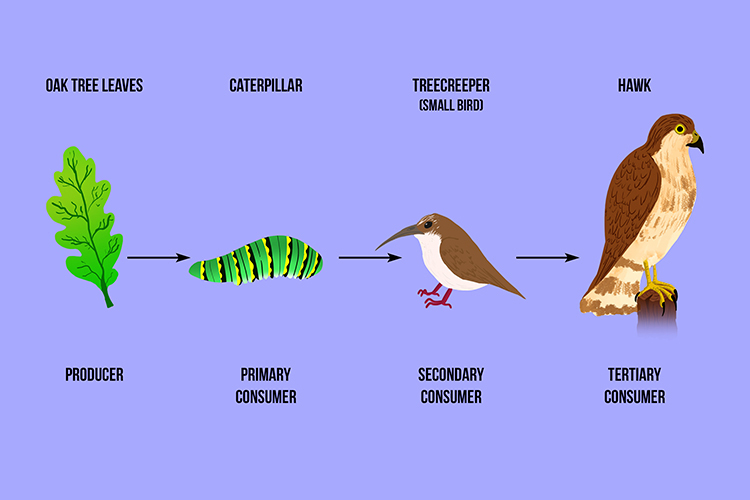
The diagram shows a simple food chain where:
- The leaf is eaten by
- The caterpillar, which is eaten by
- The small bird, which is eaten by
- The hawk
In this example, energy flows from the leaf through to the hawk.
Important
Energy flows in one direction only through a food chain - from producers to consumers. This is a fundamental principle of ecology.
Food webs
In reality, organisms usually have more than one food source. They may also be eaten by more than one type of predator. A food web shows a number of interconnected food chains, giving us a more realistic picture of feeding relationships in nature.
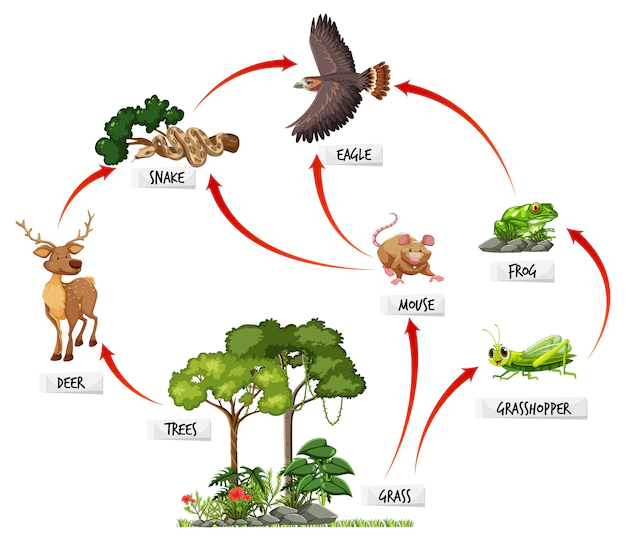
If one organism at the beginning of a food chain dies off, the rest of the organisms in that food chain are also in danger of dying due to lack of food.
Energy flow in an ecosystem
How energy enters an ecosystem
For life to be sustained, organisms need energy to flow from one organism to the next. Light energy is trapped by plants during photosynthesis. These plants convert this light energy to chemical energy in carbohydrates.
Producers and consumers
Organisms that make their own food are known as producers. Plants are producers because they can make food through photosynthesis.
When a producer is eaten by a consumer (an organism that does not make its own food), only 10% of the chemical energy is passed on through the food chain. The other 90% of the energy is used by the organism for movement, reproduction, heat and other life processes.
The 10% rule

This diagram shows how energy flows through a food chain:
- Energy from the sun is trapped by the producers (e.g. grass)
- This is the energy that is taken in by the primary consumer (e.g. grasshopper)
- Only 10% of the energy consumed by the primary consumer will transfer to the secondary consumer (e.g. frog)
- Only 10% of the energy consumed by the secondary consumer will transfer to the tertiary consumer (e.g. owl)
Example
Energy Transfer Through a Food Chain
Starting with 1000 energy units from sunlight:
- Grass captures 1000 units
- Grasshopper gets 100 units (10% of 1000)
- Frog gets 10 units (10% of 100)
- Owl gets 1 unit (10% of 10)
By the fourth level, there is only 0.1% of the original energy remaining!
Important
Why are food chains limited to 3-4 levels?
Food chains only contain three or four trophic levels (positions in a food chain) because by the fourth level, there simply isn't enough energy left to support another level. This is a direct result of the 10% rule.
Types of consumers
As a result of this energy loss, food chains typically have only three or four trophic levels:
- Primary consumers get their energy from the producers by eating them
- Secondary consumers get their energy from primary consumers by eating them
- Tertiary consumers get their energy from secondary consumers by eating them
Decomposers are a group of organisms that feed on dead plant and animal matter. They break down the dead matter and recycle their nutrients back into the food chains. Fungi and bacteria are among the main decomposers.
We can also classify consumers by what they eat:
- A carnivore is an organism that feeds on animals only
- A herbivore is an organism that feeds on plants only
- An omnivore is an organism that feeds on both plants and animals
Habitat study
Why study a habitat?
Studying a habitat can:
- Give us information about the different life forms that live in it
- Help us understand how different animals and plants are adapted to their habitat
- Help us prevent harmful conditions that can easily destroy that habitat
How to conduct a habitat study
We are going to describe the steps taken to carry out a study of a grassland habitat. The study of a grassland habitat will be different to a seashore habitat or a woodland habitat.
Steps in a habitat study
Step 1: Which habitat?
The first step is to identify which grassland area you will study. This could be a local park, a school field, school grounds, or even your garden. You need to clearly define the boundaries of your study area.
Step 2: Measure factors affecting the habitat
There are two types of factors that affect organisms in a habitat:
Abiotic factors are the non-living things that affect organisms in their habitats. Examples include temperature, soil temperature, soil pH, and light intensity.
Biotic factors are the living things that affect other living things. Examples include what organisms each organism feeds on, competition, interdependence, and adaptation.
Important abiotic factors need to be measured in a habitat:
| Factor | Apparatus | Method |
|---|---|---|
| Air temperature | Thermometer/temperature sensor | Place a thermometer or sensor in the air and take the reading |
| Soil temperature | Soil thermometer/temperature probe | Place a soil thermometer or sensor in the soil and take the reading |
| Soil pH | Universal indicator/pH sensor | Collect a soil sample and test it with universal indicator or pH sensor |
| Light intensity | Light meter/light sensor | Expose a light meter/sensor and take the reading |
Step 3: Identify the producers
Plants convert light energy into chemical energy in food. Plants are described as producers because they make the food that all the organisms in the habitat depend on for their energy.
A key helps you ask questions about the organism you want to identify. By answering the questions, you are led to the identity of the organism.
Note
Using a botanical key
This is an example of a key to help identify trees. The key asks a series of yes/no questions about the leaves:
- Are the leaves single or divided into leaflets?
- Do the leaves have lobes?
- Does the edge of the leaf have spikes?
- Are the leaves arranged like fingers of a hand?
By answering these questions, you can identify whether the tree is an oak, beech, holly, or horse chestnut.
Step 4: Identify the consumers
Animals can be identified using a key - this is similar to the plant key but focuses on characteristics of the particular habitat in which they are found.
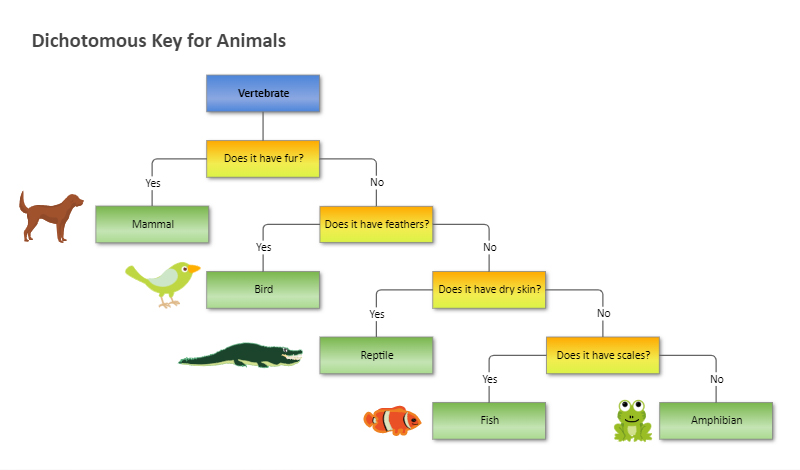
This flowchart shows an example of how to identify animals by asking questions about their physical features.
Following the yes/no paths leads you to identify the organism.
Methods of collecting animals
Different apparatus and methods are used to collect small animals in the field:
| Apparatus | How it is used | Organisms collected |
|---|---|---|
| Pooter | A pooter has two tubes. You place one tube near the organism and you suck through the second tube with gauze. The gauze prevents you swallowing the organism. | Small insects (such as greenflies and spiders) |
| Beating tray | A white sheet or tray is held under the leaves of a tree or shrub. The branches are shaken or beaten with a stick. This dislodges the animals and they fall onto the sheet. | Insects and small animals that live on the leaves of shrubs and trees |
| Pitfall trap | A jar is sunk into the ground at day in advance. The mouth of the jar must be level with the surface of the ground. A flat stone supported by small stones forms a lid. The lid prevents rain getting in. | Animals, e.g. ground beetles, that walk along the surface of the ground. Useful to compare animals that are around during the day with those that are around at night. |
Step 5: Identify the decomposers
Decomposers in a grassland include earthworms, beetles, woodlice, bacteria, and fungi. These organisms break down dead plants and animals into materials that go back into the soil, recycling nutrients for new plant growth.
Step 6: Adaptation
Adaptation is the way an organism is suited to survive in its environment. Different organisms have different adaptations depending on their habitat.
Examples of adaptations in different habitats:
| Habitat | Plant adaptation and benefit | Animal adaptation and benefit |
|---|---|---|
| Grassland | Buttercups have bright yellow petals to attract insect pollinators | Earthworms are a dark colour for camouflage. They are not easily seen by birds |
| Woodland | Primroses flower early in spring and get more light before the leaves come out on the trees | Sparrowhawks have large feet with needle-sharp talons for catching their prey |
| Rocky seashore | Seaweeds produce a slimy mucilage that prevents them drying out at low tide | Limpets have a muscular foot to anchor them to the rocks and prevent them from being swept away |
Note
Notice how each adaptation is perfectly suited to the specific challenges of that habitat. Organisms that are well-adapted to their environment are more likely to survive and reproduce.
Step 7: Competition
Competition is the struggle between organisms for resources that are in short supply.
Plants may compete for:
- Light
- Water
- Space
- Minerals
Animals may compete for:
- Food
- Shelter
- Mates
- Territory
Example
Competition Between Red and Grey Squirrels in Ireland
A good example of competition in Ireland is between the red squirrel and the grey squirrel:
- The red squirrel is a native species found in Ireland since the last ice age
- The grey squirrel was introduced in 1911 to County Longford
- The grey squirrel has moved into the territory of the red squirrel and now competes with it for food
- Although there is not great aggression between these two species, the grey squirrel is bigger and stronger than the red squirrel
- The grey squirrel is generally the winner in terms of feeding
- Red squirrels usually disappear from woodland areas within 15 years of the appearance of the grey squirrel
This shows how competition for limited resources can lead to one species displacing another.
Step 8: Interdependence
Interdependence is the way in which organisms rely on one another for survival.
Animals largely depend on plants for their food - either directly by feeding on plants or indirectly by feeding on other animals that feed on plants.
However, plants also depend on animals:
- For pollination - plants rely on animals to carry pollen from flower to flower to ensure the formation of fruit
- For seed dispersal - plants rely on animals to disperse (spread) their seeds to ensure germination of the next year's crop
Important
Interdependence means that if one species is removed from an ecosystem, it can have cascading effects on many other species. This is why protecting biodiversity is so important.
Step 9: Counting populations
To carry out a direct count (counting every individual) of a species in a habitat is usually very difficult. There are two methods we can use to estimate the number of a particular species (population) in a habitat.
The quadrat method
Frequency is the percentage chance of finding a particular organism in one throw of a quadrat.
A quadrat is an open square of wood, metal, or plastic, usually a square of side 50 cm (i.e. ).
The steps to investigate the frequency of a number of plant species in a habitat are:
- Choose the plants to be counted
- Throw a pencil at random, then place a quadrat where the pencil lands
- If the plant is in the quadrat, place a tick in the appropriate box in the results table
- If a plant is not in the quadrat, leave the box in the results table empty
- Repeat steps 2-4 nine more times
- Calculate the frequency of each plant as shown in the table
The frequency can be calculated using:
The capture-recapture method
This method can be used to count animals. The following steps are used:
- As many woodlice as possible are captured, counted, and recorded
- Each animal is tagged and released
- A day or two later, as many woodlice as possible are captured and counted again
- The number of tagged animals in the second capture is counted and recorded
- The size of the population is estimated using the formula below
Example
Worked Example: Estimating Snail Population
Students wanted to estimate the number of snails in the school garden. On Monday, they found as many snails as they could. They marked them with a non-toxic marker to make sure that the mark didn't make the snails obvious to predators.
Day 1: The students found 50 snails, marked them and released them again.
Day 2: A few days later, the students collected as many snails as they could find. They found 40 snails and 20 of the 40 snails had the tag mark.
Calculation:
Using the formula:
Answer: The estimated population of snails in the school garden is 100 snails.
Remember!
Summary
Key Points to Remember:
- Ecology is the study of how organisms interact with each other and their environment - it helps us understand how nature works
- A habitat is where an organism lives, while an ecosystem is a larger area containing many habitats and species
- Food chains show linear energy transfer, while food webs show complex interconnected feeding relationships
- Only 10% of energy passes from one trophic level to the next - this limits food chains to 3-4 levels
- Producers make their own food through photosynthesis; consumers eat other organisms; decomposers break down dead matter
- Adaptation is how organisms are suited to survive in their specific habitat
- Competition occurs when organisms struggle for resources in short supply
- Interdependence describes how organisms rely on each other for survival
- Use quadrats to measure plant frequency and the capture-recapture method to estimate animal populations