Extended Experimental Investigations (Junior Cert Science): Revision Notes
📚Revision Notes
Extended Experimental Investigations
What is an extended experimental investigation?
An extended experimental investigation is a scientific task where you need to find answers through careful planning and experimentation. Unlike routine classroom work where you might already know the method or answer, an investigation requires you to design your own approach to solving a problem or answering a question.
Note
These investigations are an important part of your Junior Cycle Science course. You will complete a Classroom-Based Assessment (CBA) where your teacher will assess your investigation skills. This assessment focuses on your ability to plan, conduct, analyse, and communicate scientific work.
Types of investigations
Scientists carry out two main types of investigations to answer different kinds of questions.
Exploratory-type investigation
This type involves observing and studying a particular situation without changing anything. You gather information, make observations, and then write a report based on what you found. For example, you might study the plant species in a local habitat or investigate noise levels in different areas of your school. The key feature is that you are observing rather than actively changing variables.
Variable-type investigation
This is the type you will focus on for your extended experimental investigation. In a variable-type investigation, you actively change one thing (a variable) to see how it affects something else. For example, you might test how different materials affect sound insulation, or investigate how temperature affects the bounce height of a ball.
The word "variable" refers to anything that can be changed in an experiment. Variable-type investigations help you understand cause-and-effect relationships in science.
Understanding variables
When you carry out a variable-type investigation, you need to understand three different types of variables. Getting these right is essential for conducting a fair and valid experiment.
Independent variable
The independent variable is the one thing you deliberately change in your experiment. You have control over this variable and you choose its different values or types.
For example, if you were investigating how different materials affect sound insulation, the independent variable would be the type of material (denim, cardboard, bubble wrap, plastic, foam). You decide which materials to test.
Important
Key point: The independent variable is what you change.
Dependent variable
The dependent variable is what you measure to see the effect of your changes. This variable depends on the independent variable - it responds to the changes you make.
In the sound insulation example, the dependent variable would be the amount of sound detected (measured in decibels). You measure this to see how each material affects sound transmission.
Important
Key point: The dependent variable is what you measure.
Controlled variables
Controlled variables (also called control variables) are all the other factors that could affect your results but that you deliberately keep the same throughout the experiment. Keeping these constant ensures that any changes in your dependent variable are only due to changes in your independent variable.
Note
In the sound insulation investigation, controlled variables would include:
- The sound source (same buzzer throughout)
- The distance from the sound source to the sound-level meter
- The size and thickness of each material being tested
- The room conditions
- The position of the clamp holding the material
Important
Key point: Controlled variables are what you keep constant.
Fair tests
A fair test is a crucial concept in science. It means that only one variable is changed at a time while all other conditions are kept exactly the same. This allows you to be confident that any changes in your results are caused by the independent variable and nothing else.
Important
Think of a running race. For the race to be fair, all runners must start at the same time, run the same distance, and follow the same rules. The only variable should be how fast each person can run. If one runner had a shorter distance or started earlier, the test would not be fair.
The same principle applies to scientific experiments. If you change more than one variable at a time, you cannot be sure which change caused your results.
Steps for carrying out an investigation
The scientific method provides a structured approach to conducting investigations. Follow these steps to ensure your work is thorough and scientific.
Step 1: Identify the research question
Every investigation starts with a question you want to answer. Your research question should be clear and specific. It should identify what you want to investigate and what you think might affect it.
Note
Examples of good research questions:
- How does the type of material affect the level of sound insulation?
- How does physical exercise affect heart rate?
- How does the temperature of a coil of wire affect the electric current flowing through it?
Step 2: Carry out background research
Before conducting your experiment, research what is already known about your topic. This helps you understand the science behind your investigation and might give you ideas about what to expect.
For the sound insulation investigation, background research might reveal that the decibel scale is used to measure the loudness of different sounds. You might learn that sound travels as waves and that different materials absorb or transmit sound waves differently.
Step 3: Construct a hypothesis
A hypothesis is a prediction about what you think will happen in your experiment. It should be based on your background research and your own observations. The hypothesis is written as an "IF...THEN" statement that can be tested.
Your hypothesis does not need to be correct to get full marks. What matters is that you show understanding of the word hypothesis and can write one properly.
Note
Examples of hypotheses:
- "I think that IF I put a sheet of glass in front of something giving out sound, THEN the glass will absorb some of the sound"
- "I think that IF I pass sound through various materials, THEN denim will absorb the most sound compared to other materials"
- "I think that IF I carry out physical exercise such as running, THEN my heart rate will increase"
Note
Exam tip: When writing a hypothesis, you should state what you think will happen using an IF...THEN format. Do not write it as a question. The important thing is showing you understand what a hypothesis is.
Step 4: Carry out an experiment to test your hypothesis
This is where you conduct your practical work. The worked example below shows how to apply all the concepts you have learned.
Example
Worked Example: Sound Insulation Investigation
Research question: How does the type of material affect the level of sound insulation provided by a range of materials?
Hypothesis: "I think that IF I pass sound through various materials, THEN denim will absorb the most sound compared to other materials"
Apparatus and method:
A battery-powered buzzer produces a constant sound at the bottom of a plastic tube. Different materials are held in place using a clamp at the top of the tube. A sound-level meter measures how much sound passes through each material.
To ensure this is a fair test:
- Use the same buzzer throughout (controlled variable)
- Keep the same distance from buzzer to sound-level meter (controlled variable)
- Test materials of similar size and thickness (controlled variable)
- Measure sound levels in the same room conditions (controlled variable)
- Change only the type of material being tested (independent variable)
To ensure results are reliable, repeat each measurement three times and calculate an average.
Materials tested:
- No material (control measurement)
- Denim cloth
- Cardboard
- Bubble wrap
- Plastic sheet
- Foam
Step 5: Analyse the data and draw conclusions
After collecting your data, you need to organise it clearly and look for patterns.
Quantitative vs qualitative data:
Quantitative data involves measurements and numbers. In this investigation, we collect quantitative data because we measure sound levels in decibels (). This allows us to compare materials mathematically.
Qualitative data involves descriptions without numbers. For example, simply describing materials as "good" or "poor" insulators would be qualitative.
Example
Results from the investigation:
| Material | Average sound detected when each experiment is repeated three times () |
|---|---|
| None | |
| Denim cloth | |
| Cardboard | |
| Bubble wrap | |
| Plastic sheet | |
| Foam |
Presenting data graphically:
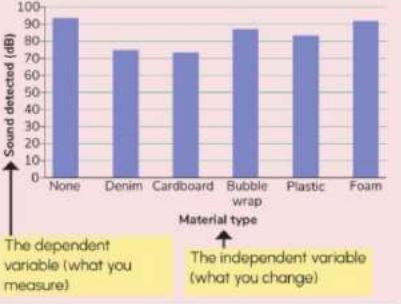
The bar chart shows the results clearly. The independent variable (material type - what you change) is on the x-axis. The dependent variable (sound detected - what you measure) is on the y-axis.
Drawing conclusions:
From the results, we can see that different materials absorb sound to different extents. The best absorber of sound is cardboard (only detected), followed closely by the plastic sheet and then by the bubble wrap. Foam is found to be the worst sound insulator since almost all the sound passed through it ( detected).
The hypothesis was not correct - denim did not absorb the most sound. In fact, cardboard performed better at absorbing sound than denim. However, this does not mean the investigation failed. Science is about testing ideas and learning from the results.
Step 6: Communicate your results
Scientists share their findings so others can learn from their work. For your CBA, you will present your investigation report to your teacher. This might include:
- A written report in your Student Laboratory Notebook
- A PowerPoint presentation
- A poster display
Your report should include all the steps above and present your data clearly. In some cases, scientists must follow ethical guidelines, especially when experiments involve human beings or animals.
Reliability and accuracy
Understanding reliability is important for producing trustworthy scientific results.
Reliability means getting consistent results when you repeat an experiment. If you repeat the same experiment several times and get the same or very similar results each time, your measurements are reliable.
Note
In the sound insulation investigation, each material was tested three times. If the cardboard showed similar sound absorption each time (, , ), the results are reliable. However, if measurements varied wildly (, , ), the results would not be reliable.
When other scientists repeat the experiment, they should get similar results. This allows the scientific community to verify findings.
Accuracy refers to how close your measurements are to the true value. An accurate measurement is one that is clearly not wrong. For example, in the investigation, you might improve accuracy by taking an average of several measurements rather than relying on just one reading.
Note
Exam tip: You need to mention the word "reliability" when discussing repeated experiments. Remember that reliability is about repeating experiments to check that you get the same or very similar results each time.
Safety in investigations
Important
When carrying out laboratory work, you must always follow safety precautions. This includes:
- Using ear protection if working with loud sounds
- Not leaving items on the floor where someone might trip
- Avoiding sources of error in measurements
- Choosing appropriate locations for experiments (e.g., selecting a quiet room for sound investigations to avoid interference from outside noise)
Remember!
Summary
Key Points to Remember:
- An investigation requires you to plan and conduct your own scientific work to answer a question
- There are two types: exploratory (observational) and variable-type (experimental)
- Variables come in three types: independent (what you change), dependent (what you measure), and controlled (what you keep constant)
- A fair test changes only one variable at a time
- The scientific method involves: identifying a question, researching, forming a hypothesis, experimenting, analysing data, and communicating results
- Reliability means getting consistent results when repeating experiments - always repeat your measurements at least three times
- Your hypothesis does not need to be correct - what matters is showing you understand how to write and test one properly