Measurement in Physics (Junior Cert Science): Revision Notes
📚Revision Notes
Measurement in Physics
Introduction to measurements
Taking accurate measurements is a crucial skill in physics. To measure something properly, you need to use the correct instrument for the task. Understanding which tool to use and how to use it correctly is essential for obtaining reliable results.
Note
Different measurements require different instruments. For example, you would use different tools to measure the length of a pencil, the area of a room, or the volume of water in a jug. Choosing the right tool is the first step toward accurate measurement.
It's also important to understand the units we use, such as metres, seconds, and kilograms, which allow scientists around the world to communicate their findings clearly.
Measuring length
Basic length measurement
A metre stick or ruler is the most common tool for measuring length. The standard unit of length is the metre (m). When using a metre stick, you need to be aware of potential errors:
Important
Common Measurement Errors:
-
Zero error: The scale on some metre sticks and rulers does not start at zero at the beginning of the ruler. If this is not taken into account, it can lead to inaccuracies in measurement.
-
Parallax error: When reading a measurement on a metre stick, it is important to place your head directly over the measurement you are reading. If this is not done, the reading will be inaccurate. This is known as parallax error.
Digital calipers
A digital caliper can be used to measure small distances very accurately. It is especially useful for measuring the diameter of circular objects.
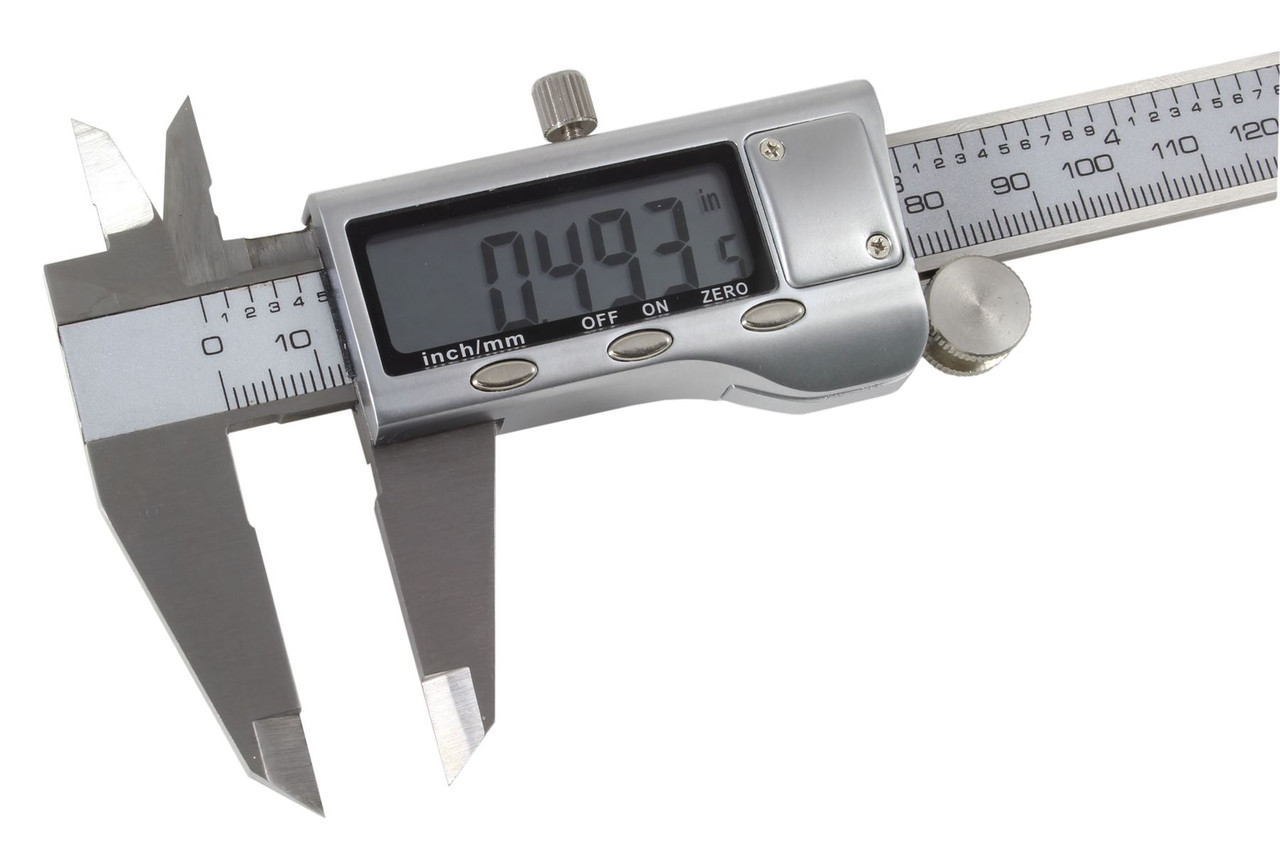
The tool has two main functions:
- The lower jaws can be used to determine the external diameter of an object
- The upper jaws can be used to determine the internal diameter of an object
Digital calipers provide precise measurements and display the result on a digital screen, making them easy to read.
Measuring curved lines
A metre stick is only useful for measuring straight lines. To measure the length of a curved line, we use an opisometer. This instrument consists of a wheel on a screw. An opisometer can be used to measure the length of a road on a map, for example.
Measuring larger distances
Long measuring tapes can be used to measure longer distances. However, it is more convenient to use a trundle wheel. A gardener might use this tool to measure the dimensions of a lawn to calculate the cost of reseeding it.
Every time the wheel turns, it covers a distance of metre. A counter can be fitted to count the number of times the wheel turns, giving the distance travelled.
| Instrument | Use |
|---|---|
| Trundle wheel | Measuring large distances, such as the length of a field |
| Metre stick | Measuring lengths up to metre |
| Digital calipers | Measuring small distances accurately Measuring the diameter of a circular object |
| Opisometer | Measuring the length of a curved line |
Measuring area
What is area?
The area of an object is the amount of surface enclosed within its lines.
When we look at an irregular shape drawn on spaced centimetre grid paper, each square on the graph represents square centimetre. If we count the number of square centimetres within the lines, we can determine the area. The area of the shape shown is square centimetres ().
Calculating the area of a square
Instead of counting the number of squares enclosed, we can calculate the area of a square or rectangle. The total number of squares can be determined as follows:
Formula: Area of square = length × width
Example
Worked Example: Finding the Area of a Square
For a square with side length :
Step 1: Write the formula
Area of square = length × width
Step 2: Fill in the formula
Area =
Step 3: Write the answer with the correct units
Area =
Calculating the area of a rectangle
The same method can be used to find the area of a rectangle.
For a rectangle, we count the number of shaded squares in the centimetre grid paper. The area of the rectangle shown is . We don't need centimetre grid paper to find the area of the rectangle. The total number of squares can be calculated as follows:
Example
Worked Example: Finding the Area of a Rectangle
Step 1: Write the formula
Area of rectangle = length × width
Step 2: Fill in the formula
Area =
Step 3: Write the answer with the correct units
Area =
Estimating the area of an irregular shape
To estimate the area of an irregular shape using centimetre grid paper:
- Trace the outline of an irregular-shaped object onto centimetre grid paper
- Count the total number of boxes within the line. Each box equals
Note
Counting rules for irregular shapes:
- Boxes more than half filled count as
- Boxes less than half filled are not counted
- Boxes exactly half filled count as
The area of the irregular shape shown is approximately .
Measuring volume
What is volume?
If you were asked to measure out of milk at home, you could use a measuring jug. The volume of the milk is a measure of the amount of space taken up by the milk in the jug.
The volume of an object is the amount of space that an object takes up.
Measuring the volume of a liquid
In the laboratory, we need to measure volumes very accurately. We use a graduated cylinder to measure volumes of liquids accurately.
In order to accurately measure the volume of liquid, we need to take precautions when using the graduated cylinder:
Important
Critical Reading Techniques:
-
The dark line on the surface of a liquid is called the meniscus. The graduated cylinder should be read accurately if the bottom of the meniscus is read at eye level.
-
The meniscus should be read at eye level to avoid parallax error, as mentioned previously.
When we measure liquid in a graduated cylinder, we note the volume in cubic centimetres (). The amount of liquid shown in the graduated cylinder is . This means that there is the same amount of liquid as cubes of side .
Calculating the volume of a cube
The volume of a cube can be calculated by breaking it down into cubes of side .
Example
Worked Example: Finding the Volume of a Cube
For a cube with side length :
Step 1: Write the formula
Volume of cube = length × width × height
Step 2: Fill in the formula
Volume =
Step 3: Write the answer with the correct units
Volume =
Calculating the volume of a rectangular object
The volume of a rectangular-shaped object can be calculated by breaking it down into cubes of side . The cube is made of such cubes. This can be calculated as follows:
Example
Worked Example: Finding the Volume of a Rectangular Object
For a rectangular object with dimensions :
Step 1: Write the formula
Volume = length × width × height
Step 2: Fill in the formula
Volume =
Step 3: Write the answer with the correct unit
Volume =
Finding the volume of an irregular object
The volume of a larger irregular-shaped object can be found by finding the volume of liquid that flows from the overflow can into a graduated cylinder.
Water displacement method:
- Fill the overflow can until water overflows
- Place a graduated cylinder under the spout when dripping stops
- Attach string to stone for lowering into overflow can
- Read the water level at the bottom of the meniscus when flow stops
- The volume of water in the graduated cylinder equals the volume of the stone
Note
An overflow can is filled with water until it overflows and water stops dripping from the spout. If a stone is now submerged in the water, a volume of liquid equal to the volume of the stone will overflow. The volume of water collected in the graduated cylinder is equal to the volume of the stone.
For objects that float:
The volume of a smaller stone can be found by placing it into a graduated cylinder half-filled with liquid. The increase in volume is the volume of the stone.
If an object floats (like a cork), it needs to be forced underwater with a needle. The volume increase still equals the volume of the cork.
Important
Exam Tip: If you are asked to give a use for a graduated cylinder, a vague answer such as "to measure a liquid" will not gain full marks. The correct answer is "to measure the volume of a liquid". Many students lose marks by not being clear when stating the function of instruments.
Measuring time
Watches, clocks and electronic timers can be used to measure time. The unit of time is the second (s). However, a timer can be a rather inaccurate tool for measuring times less than seconds. For example, if you were asked to time how long it took you to run metres, there would be some inaccuracy in terms of when you would start and stop using a timer.
Note
To lessen this error, it would be more accurate to count the time it takes to breathe in and out times and divide the time by to find the average time. This method is used in physics for measuring small quantities more accurately.
Reliability, accuracy and precision
Reliability
If you or another scientist were to repeat the same experiment a number of times, you should get the same results. Such results are said to be reliable. It is important to ensure experimental results are repeatable. Scientific research should never be published until the experiments described are carried out many times to check the reliability of the results. Reliability also has to be accurate and precise.
Important
Definition of Reliability:
A measurement is reliable if the same experiment is repeated and you get the same or similar results over and over again.
Accuracy
In everyday life, accuracy and precision may sound like they mean the same thing. In science, they have very different meanings. Make a rough estimate of the height of the room you are in. Let's estimate that the height is .
Suppose that five students measured the height of the same room and came back with the following answers: , , , and . You would probably say that is far too small, is far too big, and that the readings of , and may be the most accurate, as these are the closest answer to what you estimated.
Important
Definition of Accuracy:
Accuracy means how close a measured value is to its actual value.
Example
Worked Example: Understanding Accuracy and Precision with Dart Targets
Four students were asked to fire seven darts at the red circle in the middle of a target. The diagrams show the results:
(a) High accuracy and high precision
All the darts landed well within the inner red circle (high accuracy). Each dart landed very close to the others (high precision).
(b) Reasonable accuracy but lower precision
All the darts landed in or very close to the inner red circle (reasonable accuracy). The darts did not land very close to each other (lower precision).
(c) Low accuracy but reasonable precision
None of the darts landed inside the inner red circle (low accuracy). The darts are grouped together (reasonable precision).
(d) Low accuracy and low precision
Most of the darts landed outside the inner red circle (low accuracy). The darts did not land close to each other (low precision).
Precision
Another word that we come across in physics is the word precision. Three students were asked to measure the length of a pipe using a ruler. Their results were as follows: , and . Since the values of length are rather different from each other, we say that the data has low precision.
Important
Definition of Precision:
Precision means how close a set of measurements are to each other.
To improve the precision of this experiment, you could ask the students to:
- Take many readings using the length of the pipe. For example, you could ask them to make sure that they are starting at the mark on the ruler rather than at the end of the ruler. Also you could ask them to make sure that there are no errors of parallax when taking the readings.
- Use equipment that is more precise. For example, instead of asking the students to use a ruler, you could ask them to use more precise equipment, such as a digital calipers.
Note
A result can be precise and inaccurate at the same time!
For example, a healthy student measured her own body temperature three times. (The expected temperature is around .) The three readings taken were all at exactly . These results are precise, as she got the same result each time. However, since the results are well outside what was expected, they are inaccurate. For example, she may be using the wrong thermometer or using it incorrectly. She may be using the wrong technique to take the measurement. Or if she is using a digital thermometer, the settings may be adjusted incorrectly.
Measuring temperature
Thermometers are used to measure the temperature.
Temperature is a measure of how hot or cold something is.
- The unit of temperature is the degree Celsius, developed by Anders Celsius in .
- There are a variety of different thermometers that suit different tasks.
Note
Different types of thermometers include digital thermometers, colour thermometers, alcohol thermometers, and non-contact infrared thermometers. Each type is designed for specific purposes and temperature ranges.
Measuring mass
Mass is a measure of the amount of matter in a body.
Mass is measured using an electronic balance. The unit of mass is the kilogram (kg). However, in the lab the gram (g) is used more often.
- There are in a kilogram.
Important
Mass is NOT the same as weight!
This is a common mistake:
- Mass is measured in kilograms (kg) or grams (g)
- Weight is measured in newtons (N)
- When you stand on a bathroom scales, you are finding your mass. It is incorrect to say that you are weighing yourself.
- It is also incorrect to say "weigh out of flour".
Units
Scientists in almost all countries have agreed to use the same units for measuring quantities. Some of the basic units are listed below.
These units originate from an international system called the International System of Units, or SI (Système international d'unités).
Note
The SI system allows for effective communication and collaboration between countries across the world in science, industry, medicine and space research.
| Physical quantity | Measuring instrument(s) | Name of unit | Abbreviation |
|---|---|---|---|
| Mass | Electronic balance | Kilogram | kg |
| Length | Metre stick Digital calipers Opisometer Trundle wheel | Metre | m |
| Time | Stopwatch Timer | Second | s |
| Electric current | Ammeter | Ampere | A |
Metric prefixes
Sometimes we may need to use a smaller or larger version of these units. Scientists have developed a shorthand system of writing them.
| Prefix | Meaning | Symbol | Example |
|---|---|---|---|
| kilo- | One thousand | k | Kilometre (km) |
| centi- | One hundredth | c | Centimetre (cm) |
| milli- | One thousandth | m | Millimetre (mm) |
Examples:
Example
Worked Example: Converting Between Units
A centimetre and a millimetre are fractions of a metre.
- To convert to metres:
- To convert to metres:
- To convert to metres:
- To convert to metres:
Summary
Key Points to Remember:
-
Accurate measurements are essential in physics, and you must use the correct instrument for each type of measurement.
-
Length can be measured using a metre stick, digital calipers (for small distances), an opisometer (for curved lines), or a trundle wheel (for large distances).
-
Area is the amount of surface enclosed within its lines. Areas of squares and rectangles can be calculated using formulas (length × width), while irregular shapes require grid paper estimation.
-
Volume is the amount of space an object takes up. Liquid volumes are measured using graduated cylinders (read at the bottom of the meniscus at eye level). Volumes of regular solids are calculated using formulas. Volumes of irregular objects are found using water displacement in an overflow can.
-
Reliability, accuracy and precision are three different concepts:
- Reliability means getting consistent results when repeating experiments
- Accuracy means how close a measurement is to the actual value
- Precision means how close a set of measurements are to each other
-
SI units provide a standardized international system: mass (kilogram, kg), length (metre, m), time (second, s), and electric current (ampere, A). Metric prefixes (kilo-, centi-, milli-) allow us to express larger or smaller versions of these units.