Measurement in Physics (Junior Cert Science): Model Answers
📚Model Answers
Understanding Volume, Pressure, and Light Phenomena
Sample Answer
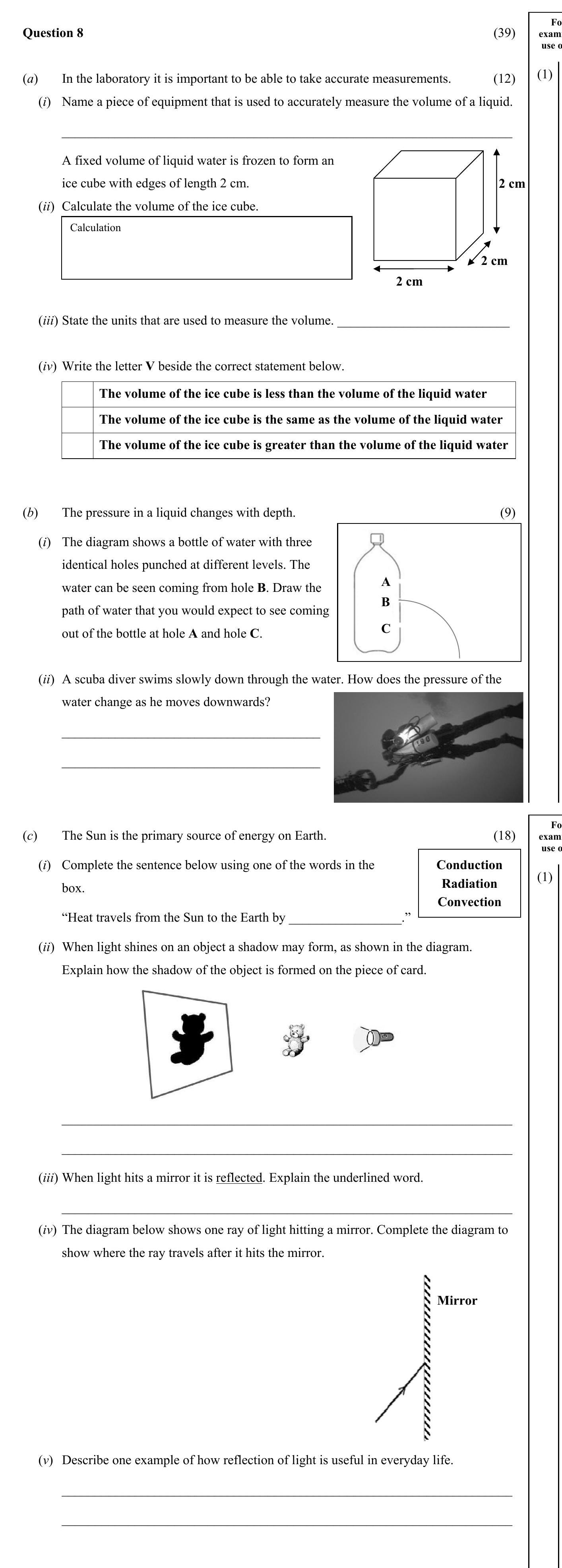
Question 8(a)(i)
Answer
A measuring cylinder (or burette/pipette/graduated flask)
Note
[1/1 Marks] The answer correctly identifies a common laboratory instrument used to accurately measure the volume of liquids.
Question 8(a)(ii)
Working
To calculate the volume of the ice cube, I need to use the formula for the volume of a cube:
- Volume of a cube = length × width × height
- Substitute the dimensions: Volume = 2 cm × 2 cm × 2 cm
- Calculate: Volume = 8 cm³
Final Answer: 8 cm³
Note
[1/1 Marks] The calculation correctly applies the formula for volume of a cube with all dimensions being 2 cm.
Question 8(a)(iii)
Answer
Cubic centimetres (cm³) or cubic metres (m³)
Note
[1/1 Marks] The answer correctly states the standard units used for measuring volume.
Question 8(a)(iv)
Answer
V should be placed beside "The volume of the ice cube is greater than the volume of the liquid water"
Note
[1/1 Marks] Water expands when it freezes, so ice takes up more space than the same amount of liquid water.
Question 8(b)(i)
Answer
For hole A (top): The water would come out with a short horizontal path that curves downward quickly. For hole C (bottom): The water would come out with a longer horizontal path before curving downward, travelling further horizontally than from holes A or B. For hole B (middle): The water would follow a path between those of A and C.
Note
[2/2 Marks] The answer correctly describes how water exits differently from each hole due to different water pressure at different depths. The trajectory from hole C would extend furthest horizontally due to higher pressure.
Question 8(b)(ii)
Answer
As the scuba diver swims downward through the water, the pressure increases. The water pressure increases with depth because of the increasing weight of water above the diver.
Note
[1/1 Marks] The answer correctly identifies that pressure increases with depth in a liquid.
Question 8(c)(i)
Answer
"Heat travels from the Sun to the Earth by radiation."
Note
[1/1 Marks] Radiation is the correct mode of heat transfer through space (vacuum) from the Sun to Earth.
Question 8(c)(ii)
Answer
A shadow is formed when light travels in straight lines and the object blocks the light from reaching the card. The light cannot pass through the opaque object, creating a dark area (shadow) on the card behind it. The shape of the shadow depends on the shape of the object blocking the light.
Note
[2/2 Marks] The answer correctly explains shadow formation by mentioning light travelling in straight lines and being blocked by the opaque object.
Question 8(c)(iii)
Answer
When light is reflected, it bounces off the mirror's surface. Reflexion means the light rays hit the mirror's surface and change direction according to the law of reflexion, where the angle of incidence equals the angle of reflexion.
Note
[2/2 Marks] The answer correctly explains what happens when light is reflected from a mirror surface.
Question 8(c)(iv)
Answer
The completed diagram would show the incident ray hitting the mirror and the reflected ray leaving the mirror at the same angle to the normal but on the opposite side. The angle of incidence equals the angle of reflexion, following the law of reflexion.
Note
[2/2 Marks] The answer correctly describes how to complete the diagram following the law of reflexion.
Question 8(c)(v)
Answer
Mirrors are useful for seeing ourselves when getting ready (bathroom/makeup mirrors). Other examples include: rearview mirrors in vehicles allowing drivers to see behind them; periscopes using mirrors to see around corners; reflective road signs increasing visibility at night; or solar cookers using mirrors to concentrate sunlight.
Note
[2/2 Marks] The answer provides a practical example of how reflexion of light is useful in everyday life.
Marking Scheme