The Water Cycle, Carbon Cycle, and Climate Change (Junior Cert Science): Revision Notes
📚Revision Notes
The Water Cycle, Carbon Cycle, and Climate Change
The water cycle
Water is essential for all life on Earth. About of our bodies are made up of water, and approximately of the Earth's surface is covered in water. Water is constantly moving between the Earth's surface, the clouds, and back again as rain and snow. This continuous movement affects our climate and the habitats where many plants and animals depend.
Processes that add water to the atmosphere
Water enters the atmosphere through three main processes:
Evaporation occurs when water from seas, lakes, and land changes from liquid to gas (water vapour). This happens when the Sun heats the water, giving it enough energy to escape into the air.
Transpiration is the process by which living plants lose water vapour from their leaves. Plants release water to keep themselves cool, similar to how we sweat.
Combustion happens when fossil fuels are burned for transport, energy, and industry. This burning process releases water vapour into the atmosphere.
What happens to water vapour in the atmosphere
As water vapour rises into the atmosphere, it cools down. This cooling causes condensation, which is the process where water vapour changes back into liquid water. The vapour is converted to clouds, which consist of tiny water droplets. Some of these droplets may be blown over land by wind, and they may also be blown higher over mountains, where it gets even colder.
What happens when water reaches the land
When clouds are forced upwards by wind over hills and mountains, they continue to cool. The water droplets in the clouds get larger until they become too heavy to stay in the air. The water then falls as rain, sleet, or snow. This process is called precipitation.

When rain falls on land, it can collect in streams and lakes. Water makes its way back to the sea through rivers. However, some water doesn't return to the sea immediately. Instead, it can remain stored underground for many years.
Precipitation that falls as snow can remain frozen for years and can form glaciers. Glaciers are large masses of ice that store fresh water for thousands of years. Eventually, glaciers make their way back to the sea and melt.
Important
There is concern that glaciers are melting at a faster rate than they are formed, which is causing sea levels to rise. This is one of the most visible effects of climate change.
Water returning to the sea
The entire journey that water takes in moving from land to sea and to the atmosphere and back is known as the water cycle. This cycle is summarised in the following diagram:
Note
Key steps in the water cycle:
- Precipitation: Water falls to the earth as rain, hail, or snow
- Run-off: Water collects in streams and lakes and is returned to the sea via rivers
- Infiltration: Water seeps down into the earth and can be stored as springs and wells
- Evaporation: Heat from the sun causes water to evaporate from the oceans
- Rivers flow to the sea: They dissolve substances from the rocks and receive sewage and industrial waste
- Some water is diverted to reservoirs
- Water is purified in the water treatment works
- Water is then used in homes and industry
- After use, water is treated in sewage works
- Transpiration: Plants lose water through leaves
Benefits of the water cycle
Without the water cycle, the land would be a desert, and it would be very difficult to irrigate the land to grow crops. This would make the cost of food much more expensive.
Note
Without a water cycle, there would be no source of fresh, clean water. Your body needs clean water free of salts. This makes it safe to drink and to use for washing ourselves. If the water cycle did not exist, we would have to desalinate (remove salt from) water for drinking, irrigation, and washing.
This happens in some arid (very dry) countries, such as Israel and Saudi Arabia. Removing salt from water is expensive and uses a lot of energy.
The carbon cycle
Carbon dioxide makes up about (or per cent carbon dioxide) of our atmosphere, and it is as important a part in our lives as water. Your body is constantly burning compounds of carbon to keep you alive. Every time you breathe, you exhale carbon dioxide. Plants also depend on carbon to stay alive. They can take in carbon dioxide and make food and oxygen from it by photosynthesis.
The atmosphere
The Earth is surrounded by a layer of gases that reaches up to km above the surface. This is our atmosphere. Carbon is present in the atmosphere as carbon dioxide. Less than per cent of the atmosphere is made up of carbon dioxide. It is a minor but important component of the atmosphere.
The pie chart shows the composition of air. The main gases are:
- Nitrogen:
- Oxygen:
- Argon:
- Carbon dioxide:
- All others:
Carbon sources
Carbon dioxide is added to the atmosphere by carbon sources. The main carbon sources are:
1. Combustion of fossil fuels: The dramatic increase in the use of fossil fuels has caused an increase in concentration over the past years.
2. Respiration: This occurs in animals and plants, which release carbon dioxide as they break down food to produce energy.
3. Natural processes: These include volcanic eruptions and decay of dead organisms.
4. Roasting limestone: This is done to make lime for agriculture and construction.
Carbon sinks
Carbon dioxide is removed from the atmosphere by carbon sinks. A carbon sink is any process that removes more carbon dioxide from the atmosphere than it contributes to it. Some major carbon sinks include:
Dissolving in water: Water in the ocean dissolves from the atmosphere to form carbonic acid.
Photosynthesis: Plants convert to oxygen and starch (food) using energy from the sun.
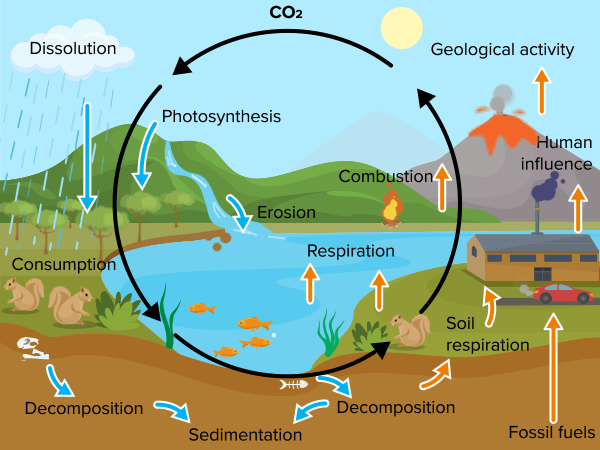
The diagram above shows the complete carbon cycle. It describes the process in which carbon continuously travels from the atmosphere to the Earth and back again into the atmosphere.
How carbon is stored underground
Limestone: Carbon is stored in rock such as limestone. Limestone is made from the compressed shells of ancient sea clams, mussels, and coral.
Oil, coal and gas: These were formed when the bodies of plants and animals (fossils) that settled on the sea bed mixed with mud and were buried. Over millions of years, due to the high pressure and temperature, the remains of these plants and animals were converted into oil and gas. The Sun is the ultimate source of the energy stored in fossil fuels.
Note
The combined processes in which carbon continuously travels from the atmosphere to the Earth and back to the atmosphere again is called the carbon cycle.
What is the problem with the carbon cycle today?
Carbon dioxide naturally insulates the Earth and keeps heat in. A garden greenhouse helps us trap some of the radiated energy from the sun. Thus, the plants growing in the greenhouse are kept warmer than if they were growing outside. Carbon dioxide and other gases such as water vapour act like a blanket around the Earth and keep the temperature approximately warmer than if there was no carbon dioxide in the atmosphere. This is an entirely natural occurrence.
Important
Without the greenhouse effect, the world would be covered in a sheet of ice and life would not have had a chance to begin. This is a natural and essential process.
However, the increasing concentration of carbon dioxide in the atmosphere has increased mainly due to the burning of fossil fuels. This is causing the average temperature of the world to increase.
The amount of carbon dioxide released into the atmosphere as a result of the activities of a particular individual, organisation, or community is known as their carbon footprint.
A carbon footprint is the amount of carbon dioxide released into the atmosphere as a result of the activities of a particular individual, organisation or community.
Greenhouse gases and the enhanced greenhouse effect
A greenhouse gas is any gas that contributes to the greenhouse effect.
The increase in greenhouse gas concentrations is called the enhanced greenhouse effect. This is an entirely unnatural occurrence caused by human activity. The enhanced greenhouse effect is called global warming.
Carbon dioxide is only one of a number of greenhouse gases. Others include methane (natural gas), CFCs (chlorofluorocarbons), and nitrous oxide.
The different greenhouse gases and their sources:
- Carbon dioxide (): from burning fossil fuels and respiration
- Methane (): from cows, sheep, and waste dumps
- CFC gases (): from fridges and aerosols
- Nitrous oxide (): from cars and planes
- Other sources ()
Note
Methane is produced when certain materials decay in dumps, from animal slurry, and in grass-eating animals that generate methane gas in their gut. Releasing one tonne of methane into the atmosphere has the same ability to cause the greenhouse effect as releasing times as much carbon dioxide.
CFCs were used as coolants in older refrigerators and were used in the past in aerosols.
Nitrous oxide is produced by jet aircraft, coal-fired power stations, and the use of chemical fertiliser in agriculture.
What is the main cause of global warming?
The major cause of global warming is the huge increase in the concentration of atmospheric carbon dioxide. This is caused by two main factors:
Important
The huge increase in the burning of carbon stores in the Earth, such as fossil fuels.
Deforestation – the removal of trees from forests. Cutting down trees means that there is less plant material available to take carbon dioxide out of the atmosphere.
Sources of greenhouse gases by sector in Ireland:
- Agriculture:
- Energy:
- Transport:
- Industrial/commercial:
- Residential:
- Waste:
What problems are caused by global warming?
Rise in sea level: As the planet gets warmer, it is predicted that there will be a rise in sea level. This is caused by the expansion of water as it gets warmer. In addition, the faster melting of glaciers and ice sheets will contribute to an increase in sea level.
Climate change: It is predicted that as the temperature of the planet increases, there will be more violent storms and that they will become more frequent and unpredictable. Some ways you can help to tackle the problem of global warming are outlined below.
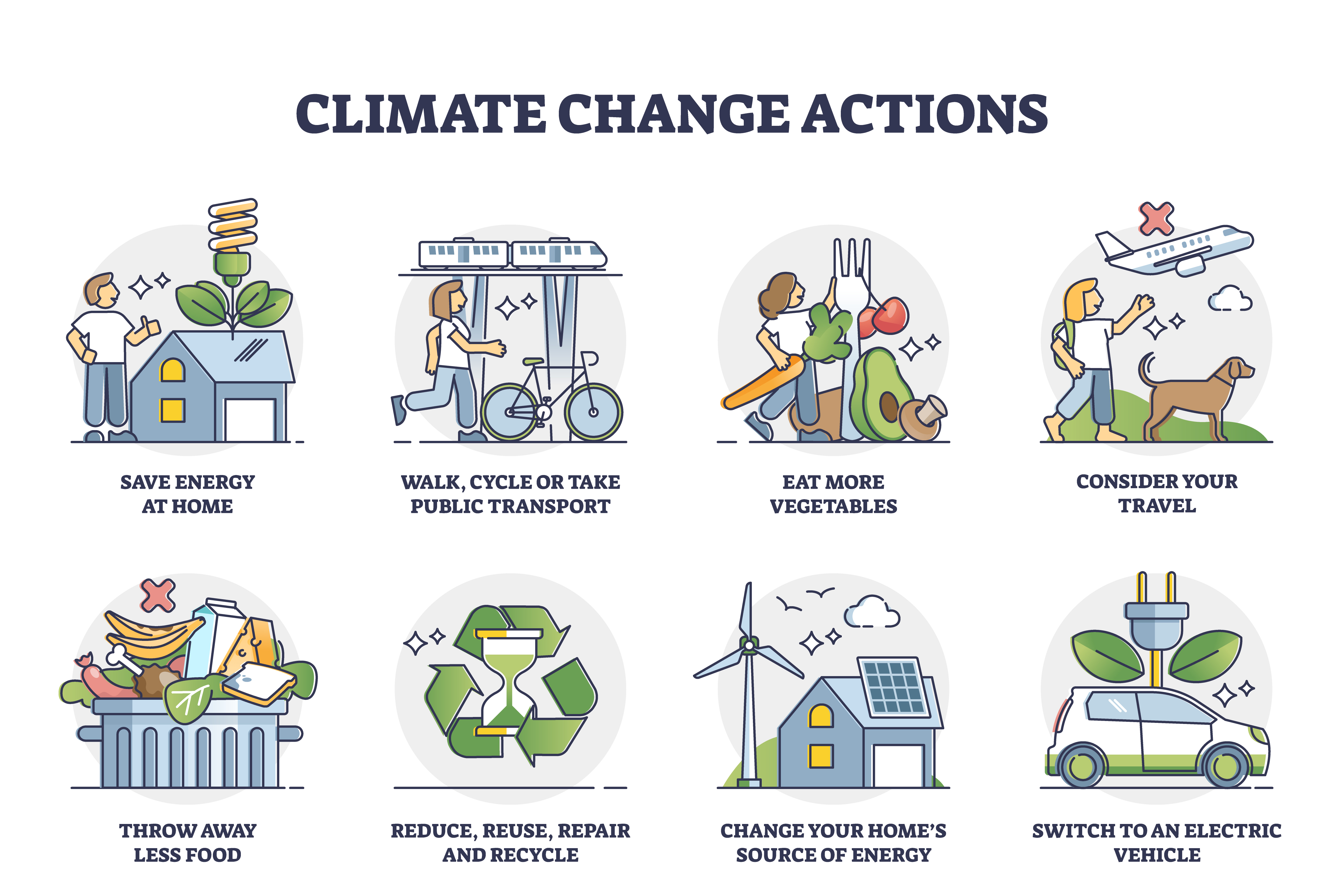
Addressing climate change
What has been done to address the problem of global warming?
Note
The Kyoto Protocol was an agreement by a number of countries, including Ireland. The countries that signed it committed to reducing their carbon dioxide emissions by agreed targets.
The 2015 Paris Agreement will limit the increase in global warming to less than compared with pre-industrial levels.
Has enough been done to address the problem of global warming?
Not yet. Some of the major producers of carbon dioxide in the world, such as the USA, China, and Canada, did not legally commit to reducing their carbon dioxide emissions. To date, Ireland has not met the targets under the protocol. However, this was only possible due to the economic recession in 2009.
Why don't more countries agree to reduce their carbon dioxide emissions?
Fossil fuels are a relatively cheap source of energy. It is expensive to change from fossil fuels to renewable sources of energy. This would make the cost of energy more expensive for citizens and for industry. As countries get richer, they need more energy.
What is our government doing to reduce our carbon dioxide emissions?
Our government is committed to meeting its Kyoto Protocol target. It has put many policies in place to achieve this, including:
- Improving the minimum building standards of new houses so that they use less energy to heat
1. No chimney will be built as fossil fuels will not be burned in a fireplace or boiler
2. Some of the energy needed by the house will have to come from solar panels
3. More of the electricity used will have to come from renewable sources
- Placing a carbon tax on fuels. This is just another tax, but it may encourage people to insulate their homes and drive more efficient cars
- Introducing schemes that encourage private companies to build renewable sources of electricity, such as wind energy, by allowing them to charge higher prices for electricity generated in this way
- Introducing the cycle-to-work scheme, which subsidises workers to buy a bicycle and equipment used to get to work. This reduces the use of fossil fuels by people who would otherwise drive to work
- Giving a subsidy to companies that provide public transport
Note
New building regulations will reduce the carbon footprint of modern houses significantly. These buildings are called nearly zero-energy buildings (NZEB). They will reduce the carbon footprint of a house by per cent.
What can you do to reduce your carbon footprint?
There are many actions you can take as an individual to help reduce carbon dioxide emissions:
- Separate your waste – reduce, reuse, and recycle where possible
- Take short showers instead of baths to save water and energy
- Buy locally produced food in season instead of buying imported food
- Switch off lights and turn off heating in empty rooms
- Use public transport, walk, or cycle instead of driving everywhere
Exam tip: understanding carbon cycle processes
Example
Understanding Carbon Cycle Processes
The carbon cycle involves several key processes that move carbon dioxide between the atmosphere, living things, and fuels:
The main processes are:
| Process | Name |
|---|---|
| W | Combustion |
| X | Respiration |
| Y | Photosynthesis |
| Z | Respiration |
Combustion (burning) of fossil fuels releases carbon dioxide into the atmosphere.
Photosynthesis removes carbon dioxide from the atmosphere as plants use it to make food.
Respiration releases carbon dioxide back into the atmosphere as living things break down food for energy. Both plants and animals respire.
Remember!
Summary
Key Points to Remember:
-
The water cycle describes how water continuously moves between the Earth's surface and the atmosphere through evaporation, condensation, and precipitation.
-
The carbon cycle describes how carbon moves between the atmosphere, living things, and the Earth through photosynthesis, respiration, and combustion.
-
Greenhouse gases like carbon dioxide, methane, and CFCs trap heat in the atmosphere and cause the enhanced greenhouse effect, leading to global warming.
-
The main cause of global warming is the burning of fossil fuels and deforestation, which increase atmospheric carbon dioxide levels.
-
Climate change is causing sea levels to rise and more extreme weather events. We can all help by reducing our carbon footprint through actions like recycling, using renewable energy, and choosing sustainable transport.