Ohm's Law (Junior Cert Wood Technology): Revision Notes
📚Revision Notes
Ohm's Law
This revision note explains Ohm's Law, how it is used in simple circuits, and what it means in practice.
Definitions
- Voltage (V): This is the electric potential difference between two points in a circuit, measured in volts (V). It pushes charges through a conductor.
- Current (I): This is the flow of electric charge through a conductor, measured in amperes (A).
- Resistance (R): This is how much a material resists the flow of current, measured in ohms (Ω).
Definition and Mathematical Expression
- Definition of Ohm's Law: Ohm's Law states that current (I) through a conductor between two points is directly proportional to voltage (V) across the points and inversely proportional to resistance (R).
Important
- Mathematical Expression: Ohm's Law is shown as . You can also write it as or .
- Explanation of Components:
- V = Voltage in volts (V)
- I = Current in amperes (A)
- R = Resistance in ohms (Ω)
Example Calculation of Voltage
- Step-by-Step Calculation of Voltage (V):
- Known Values: Assume the current (I) is 2A and resistance (R) is 3Ω.
- Substitution into Formula: Enter values into , so .
- Solution: V = 6V, verifying Ohm's Law for I = 2A and R = 3Ω.
Illustration of Simple Circuit
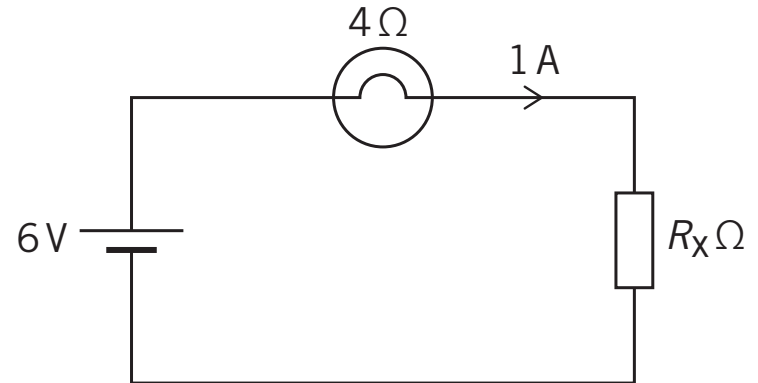
- Description: A 6V battery connects in series with a 4-ohm resistor, making a path for current flow.
- Function of Components:
- The battery provides the voltage that drives the current.
- The resistor limits the current flow, based on its resistance.
Relationship Between Voltage, Current, and Resistance
Note
- Proportional Relationships: If resistance stays the same, more voltage means more current. If voltage stays the same, more resistance means less current.
Example Calculations
- Example Calculation - Solving for Current:
- Given V = 12V and R = 6Ω; use to find 2A.
- Example Calculation - Solving for Resistance:
- Given V = 9V and I = 1.5A; use to find 6Ω.
Practical Implications and Limitations
- Applications: Ohm's Law is essential for designing and analysing circuits.
- Limitations: Real circuits may change because temperature affects resistance, complicating the simple use of Ohm's Law.
Note
Summary
- Ohm's Law:
- Knowing how voltage, current, and resistance relate is key in electronics.
- Ohm's Law helps design circuits, but real conditions like temperature can cause changes.