Written Exam Guide (Leaving Cert Agricultural Science): Revision Notes
📚Revision Notes
Written Exam Guide
Course overview
The Leaving Certificate Agricultural Science course was introduced into classrooms in September 2019 and first examined in June 2021. Your final grade comes from two main components that work together to assess your agricultural knowledge and scientific skills.
The written examination accounts for 75% of your total grade and takes place in June during your Leaving Certificate year. This comprehensive exam tests your understanding of agricultural concepts, scientific practices, and practical applications across all areas of the syllabus.
The Individual Investigative Study (IIS) contributes 25% to your final grade. This independent research project allows you to explore a specific agricultural topic in depth, developing your scientific investigation skills while building knowledge that will also support your written exam performance.
Note
The course structure ensures that both theoretical knowledge and practical research skills are assessed, providing a comprehensive evaluation of your agricultural science understanding.
Study strategies for success
Achieving excellence in Agricultural Science requires consistent effort and strategic study approaches. Begin by establishing a routine where you review material covered in class each day, then create your own summary notes or mind maps. These personal study aids work particularly well when made on flashcards or A3 pages at the completion of each topic.
Expanding your agricultural knowledge
To broaden your understanding beyond the classroom, engage with current agricultural media and resources:
Example
Recommended Weekly Study Resources:
Television programmes: Ear to the Ground and Countryfile provide real-world context for agricultural concepts, while video clips from Agri Aware offer focused educational content.
Agricultural publications: Teagasc resources, the Irish Farmers Journal, Agriland, and farming sections in the Irish Independent (Tuesday) and Irish Examiner (Thursday) keep you current with industry developments.
Online resources: www.scoilnet.ie offers comprehensive support materials including video clips, worksheets, and revision resources, with particularly valuable content on specified practical activities.
Reading one agricultural article weekly helps you stay informed about farming sector developments and agricultural science advances both in Ireland and internationally. Focus on diverse topics like farm diseases, dairy and beef production, or fertiliser use to build comprehensive knowledge that supports both your exam answers and IIS research.
Important
Your examination preparation should centre on the official Agricultural Science Curriculum Specification, particularly pages 16-24, which forms the foundation for all exam questions.
Exam format and structure
Paper layout and timing
The written examination lasts 2.5 hours and consists of approximately 40 pages. Don't feel overwhelmed by the paper size - you must answer all questions in the spaces provided, so no additional answer sheets are needed.
Section A contains ten short questions worth 10 marks each, totalling 100 marks. You must complete all ten questions, with some offering internal choices between different options.
Section B presents five long questions worth 50 marks each, totalling 200 marks. You select and answer four of these five questions based on your strengths and preparation.
Important
Modified 2023 Format: The 2023 exam featured a modified format due to State Examinations Commission adjustments. That paper offered choices of 10 out of 12 short questions in Section A and 4 out of 6 long questions in Section B.
Time management strategy
Allocate approximately 45 minutes to Section A, allowing enough time to read through Section B and select your strongest four questions. Plan for a minimum of 22 minutes per long question, which provides time at the exam's start for paper review and question selection, plus time at the end for answer revision.
Example
Time Management Calculation:
Total exam time: 2.5 hours (150 minutes)
- Section A: 45 minutes
- Section B: 105 minutes ÷ 4 questions = 26.25 minutes per question
- This leaves time for paper review and final checking
Course content framework
The Agricultural Science curriculum follows a structured approach with scientific practices forming the central foundation. This framework helps you understand how different topics connect and support each other.
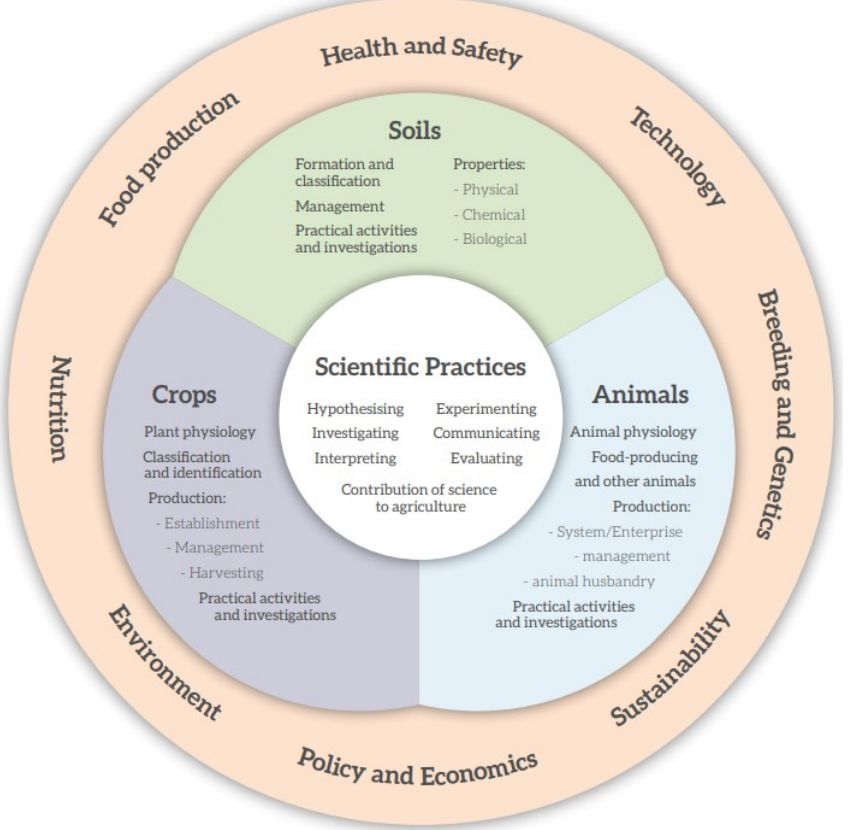
Scientific practices sit at the curriculum's heart and include core skills like hypothesising, experimenting, investigating, communicating, interpreting, and evaluating. These practices demonstrate science's contribution to agriculture and appear throughout all course areas.
Three main subject strands surround this scientific core:
- Soils: Covers formation, classification, management, and physical, chemical, and biological properties
- Crops: Includes plant physiology, classification, and production processes
- Animals: Encompasses animal physiology, food-producing animals, and production systems
Note
Eight cross-cutting themes form the outer framework: Health and Safety, Technology, Breeding and Genetics, Sustainability, Policy and Economics, Environment, Nutrition, and Food Production. These themes connect and enhance your understanding across all subject areas.
Specified practical activities
The course includes 20 Specified Practical Activities (SPAs) that your teacher covers throughout fifth and sixth year. These laboratory experiments develop your hands-on scientific skills while reinforcing theoretical concepts.
Keep detailed records of each SPA, ensuring you understand the reasoning behind every step. Always include large, clearly labelled diagrams showing experimental setups, and familiarise yourself with key concepts like dependent variables (what you measure), independent variables (what you change), and control variables (what you keep constant).
Important
SPA Record-Keeping Essential: Understanding variables and methodology in all practical activities is crucial, as these concepts frequently appear in exam questions and form the foundation of scientific investigation skills.
SPA exam integration
Written exam questions frequently test SPA knowledge. For example, recent higher-level papers have included questions asking students to:
Example
Common SPA-Based Exam Questions:
- Explain methods for determining organic matter percentage in soil samples
- Describe earthworm activity in soil using labelled diagrams
- Outline plant breeding hybridisation processes
- Detail procedures for isolating and growing bacteria from clover root nodules
- Compare characteristics between certified and uncertified seed batches
- Design investigations into soil temperature effects on crop germination
The investigative skills you develop during your IIS complement SPA learning perfectly. Both components enhance your ability to gather and process data, evaluate evidence, and develop scientific arguments - skills directly assessed in your written examination.
Success strategies for achieving H1 grades
Daily study habits
Developing consistent study routines forms the foundation of exam success. Review each day's class material before the next lesson and complete all homework assignments to your highest standard, then seek teacher feedback to improve your responses further.
Ensure you understand the purpose behind each step in practical work, particularly during SPAs. Create comprehensive summary notes with clearly labelled diagrams after completing each topic.
Broader learning approaches
Expand your agricultural knowledge by reading at least one farming-related article weekly to enhance your agricultural knowledge base. Begin your IIS as early as possible, completing it well before mock examinations to allow time for revisions and reference updates.
Note
Practice extensively with past examination papers and mock exams, as questions draw from various course areas and this preparation significantly benefits June performance.
Examination technique
During the actual exam, apply strategic approaches that maximise your performance. Never leave questions blank during the exam - draw on your agricultural knowledge to provide reasoned responses even for unfamiliar topics.
Read each question carefully, as some may cover topics not explicitly taught but which you can address using your broader agricultural understanding. During the exam, read the entire paper first and identify questions where you feel most confident before beginning your responses.
Exam day preparation
On examination day, invest time in thoroughly reading the complete paper, paying particular attention to Section B. Mark or tick the questions you can answer most effectively, allowing you to select the four long questions where you feel most confident.
You may encounter questions on topics that seem unfamiliar, but don't panic. These questions typically guide you towards the actual requirements, and your agricultural knowledge base will enable you to develop appropriate responses.
Important
Critical Exam Day Rule: Never leave any question completely blank. Even partial answers demonstrate knowledge and can earn valuable marks.
Summary
Key Success Strategies:
- Daily routine: Review class material consistently and complete all homework to the highest standard
- Broader learning: Read agricultural articles weekly and complete IIS early
- Practice: Use past papers extensively to familiarise yourself with question styles and requirements
- Exam technique: Read the full paper first, select strongest questions, and never leave blanks