Applied Genetics (Leaving Cert Agricultural Science): Revision Notes
📚Revision Notes
Applied Genetics
Applied genetics involves using scientific understanding of heredity to improve agricultural productivity and efficiency. This field combines traditional breeding methods with modern biotechnology to develop better crops and livestock that meet the needs of farmers and consumers.

Selective breeding
Selective breeding represents the foundation of applied genetics in agriculture. This systematic approach involves choosing animals or plants that possess desirable characteristics and encouraging them to reproduce, thereby concentrating these beneficial traits in future generations. Farmers have used this method for centuries to create more productive and profitable farming operations.
Note
This process is also referred to as artificial selection because humans deliberately choose which organisms will breed, rather than leaving reproduction to chance. The primary goal is to enhance favourable traits while simultaneously working to eliminate any unwanted characteristics that might reduce farm profitability or animal welfare.
Selective breeding programmes typically follow one of two main strategies: inbreeding or crossbreeding, each offering distinct advantages and challenges for agricultural applications.
Inbreeding
Inbreeding involves mating closely related animals within the same family line or breed. This strategy increases the likelihood that offspring will inherit specific traits from both parents, as these animals share similar genetic backgrounds.
The technique proves particularly valuable when farmers want to establish consistent characteristics within their herds or flocks. For example, dairy farmers might use inbreeding to maintain high milk production levels in Holstein cattle, ensuring that calves inherit the superior milk-producing capabilities of their parents. This approach creates pedigree animals whose ancestry and genetic background are well-documented and predictable.
Inbreeding also promotes uniformity among offspring, making management easier and more efficient. When animals share similar growth rates, feeding requirements, and behavioural patterns, farmers can standardise their care routines and predict production outcomes more accurately.
Important
Risks of Inbreeding
However, inbreeding carries significant risks that farmers must carefully consider. The same genetic concentration that fixes desirable traits can also concentrate harmful recessive characteristics. These undesirable traits, termed deleterious traits, can cause serious health problems or reduce productivity. A notable example is mule foot in cattle, a recessive condition that causes the two toes on each hoof to fuse together, resulting in lameness and mobility issues.
More seriously, some inbreeding can prove lethal, causing death in affected offspring. Additionally, inbreeding depression commonly occurs, characterising the overall reduction in fertility, productivity, and general health that develops when animals become too closely related.
Crossbreeding
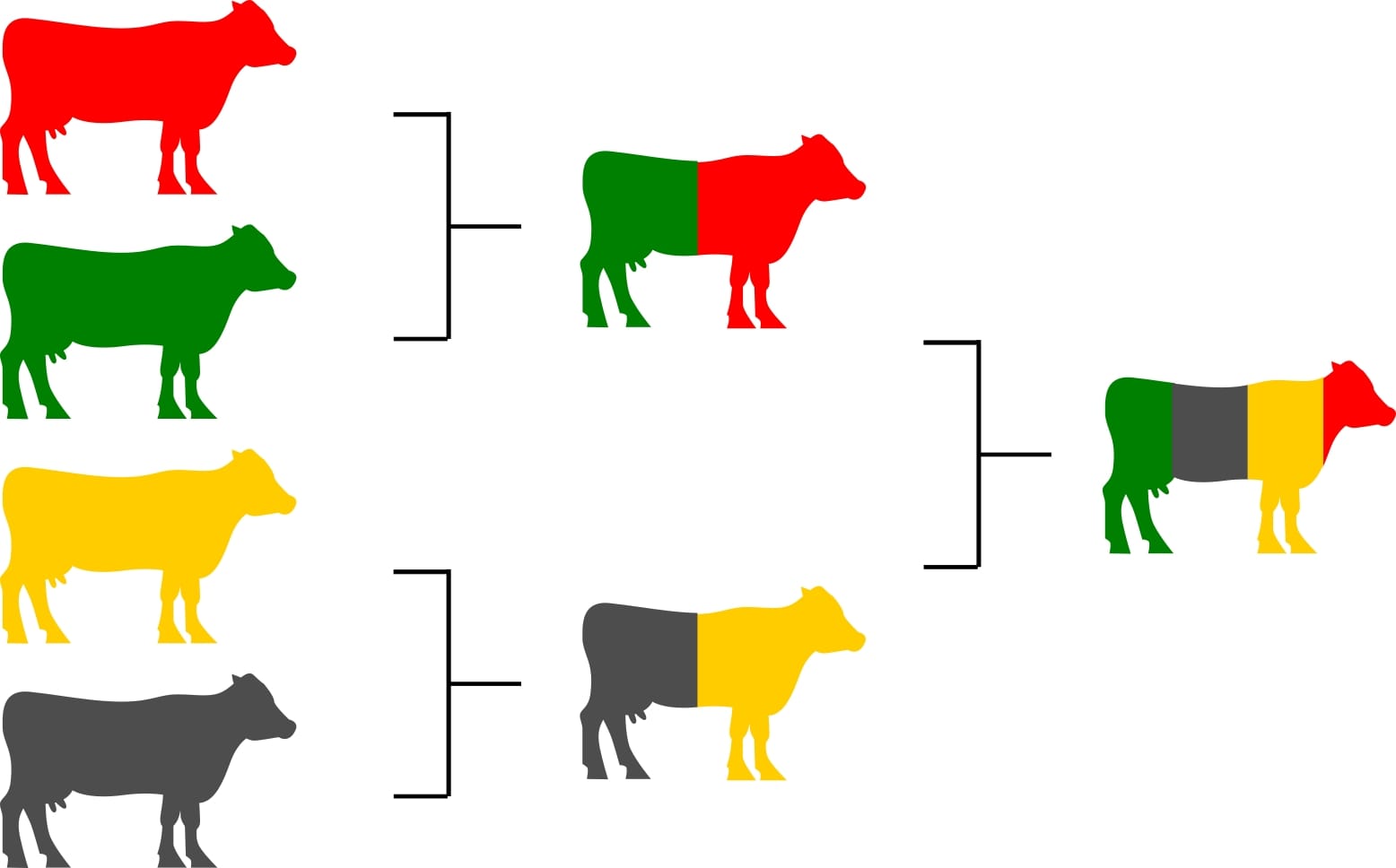
Crossbreeding takes the opposite approach by mating animals or plants from different breeds, varieties, or even species. This strategy introduces genetic diversity, allowing offspring to inherit beneficial characteristics from both parent lines while reducing the concentration of harmful recessive genes.
Note
Hybrid Vigour (Heterosis)
The most significant advantage of crossbreeding is hybrid vigour, also known as heterosis. This phenomenon describes the increased productivity and improved performance that offspring often display when their parents come from genetically different backgrounds. Crossbred animals frequently show better growth rates, improved disease resistance, and enhanced reproductive success compared to their purebred parents.
While crossbreeding effectively reduces the risk of inheriting harmful recessive traits, farmers should note that hybrid vigour typically decreases in subsequent generations. When crossbred animals mate with each other, their offspring often show reduced performance compared to the original cross, making it necessary to maintain separate purebred lines for continued crossbreeding programmes.
Crossbreeding programmes require higher maintenance and more complex management systems because farmers must maintain two or more distinct breeding populations simultaneously. This increased complexity can add significant costs and labour requirements to farming operations.
F1 hybrid seed varieties
Commercial seed production extensively utilises crossbreeding to create F1 hybrid seeds, which demonstrate superior performance characteristics compared to traditional varieties. These hybrid seeds result from crossing two carefully selected parent cultivars (plant varieties developed through selective breeding) to produce offspring with enhanced traits.
F1 hybrid seeds typically exhibit greater strength and resilience, improved disease resistance, and significantly higher yields compared to conventional seeds. The parent varieties, known as breeding stock, must be crossed annually to maintain these superior characteristics, as the advantages diminish in subsequent generations.
A cultivar represents a plant variety that has been developed through deliberate selective breeding programmes to emphasise specific desirable traits. To produce F1 hybrid seeds successfully, plant breeders must cross these parent cultivars every year, as crossing F1 hybrid seeds with each other would result in decreased hybrid vigour and reduced performance in the resulting plants.
Reproductive technologies
Modern reproductive technologies have revolutionised animal breeding by allowing farmers to precisely control and accelerate genetic improvement programmes. These sophisticated techniques enable targeted improvements in specific areas while making efficient use of genetic material from superior animals.
Artificial insemination (AI)
Artificial insemination allows farmers to target particular characteristics in their herds without maintaining expensive breeding bulls on their properties. This technology enables widespread distribution of genetic material from exceptional males, significantly accelerating improvement programmes across entire industries.
Farmers commonly use AI to enhance several important production traits:
- Milk yield: Increasing the quantity of milk produced per cow
- Milk composition: Improving protein and fat content for better processing quality
- Fertility: Enhancing reproductive success rates
- Conformation: Developing better body structure and physical characteristics
Preparation of an AI straw
The AI process begins with collecting semen from selected bulls and preparing it for storage and distribution. After collection, technicians dilute the bull's semen with a specialised extender solution that serves multiple protective functions during storage.
Note
Extender Components
The extender contains several essential components:
- Milk or egg yolk: Provides protection against cold shock during the freezing process
- Glucose: Supplies energy to maintain sperm viability during storage
- Glycerol: Prevents cellular damage when the semen is frozen
Once properly mixed with the extender, the semen is packaged in plastic straws and stored in liquid nitrogen at extremely low temperatures (-196°C), where it remains viable for extended periods.
AI procedure in cows
When farmers decide to inseminate a cow, they begin by thawing the frozen straw in warm water to restore the sperm to functional condition. The thawed semen is then loaded into a catheter, which serves as the insemination device.
A trained AI technician carefully inserts their hand into the cow's rectum to guide the catheter through the cervix and into the uterus. This procedure requires skill and experience to ensure proper placement and minimise stress to the animal. Once correctly positioned, the technician deposits the semen into the cow's uterus, where fertilisation can occur.
Laparoscopic AI
For sheep breeding, farmers often employ laparoscopic AI, which uses different techniques suited to the smaller anatomy of ewes. This method utilises a laparoscope, an optical instrument that allows visualisation of internal structures.
The procedure involves making a small incision in the ewe's abdomen and inserting the laparoscope to locate the reproductive organs. The technician then deposits semen directly into both the left and right horns of the uterus, maximising the chances of successful fertilisation.
Advantages of sexed semen
Recent developments in reproductive technology have introduced sexed semen, which contains sperm that will produce offspring of a predetermined sex. This innovation offers numerous advantages for dairy farming operations:
- Increased heifer calves: Produces more female calves for herd replacement
- Herd expansion: Facilitates faster growth of milking herds
- Improved genetics: Allows greater selection pressure on female offspring from top-producing cows
- Reduced calving difficulties: Female calves typically cause fewer birthing complications
- Fewer unwanted bull calves: Reduces the number of male calves that have limited value in dairy operations
- High success rates: Achieves approximately 90% accuracy in sex determination
- Premium breeding: Enables production of top-quality replacement bulls when male calves are desired
Embryo transplantation
Embryo transplantation represents an advanced reproductive technology that maximises the genetic contribution of exceptional female animals. This technique allows superior pedigree females to produce many more offspring than would be possible through natural reproduction alone.
The process begins by identifying high-quality donor females that possess outstanding genetic characteristics. These animals serve as the source of embryos that carry their superior genetic traits. The donor's embryos are then transferred to surrogate mothers that may have lower genetic quality but possess good health and strong maternal abilities.
Note
The surrogate mother carries the pregnancy to term and gives birth to a pedigree animal that is genetically identical to the donor's offspring, despite not being genetically related to the surrogate. This arrangement allows valuable females to produce multiple offspring annually while requiring surrogate mothers to maintain only good health and mothering capabilities.
Embryo transplantation procedure
Important
Complex Procedure Requirements
The embryo transplantation process requires careful coordination between donor and surrogate animals to ensure successful outcomes. Initially, farmers give the donor female hormone injections designed to cause super ovulation, which stimulates the production of multiple mature eggs simultaneously rather than the single egg typically released during normal reproductive cycles.
Following super ovulation, technicians mate the donor with a top-class bull through artificial insemination, allowing the superior sperm to fertilise the multiple eggs. Both the donor and surrogate females must have their reproductive cycles synchronised through hormone treatments to ensure optimal timing for embryo transfer.
After fertilisation occurs, technicians flush out the developing embryos from the donor's reproductive tract and immediately implant them into the prepared surrogate mothers. The surrogate then carries the pregnancy to completion, ultimately giving birth to a top-class pedigree calf that carries the genetic characteristics of both donor parents.
Super ovulation specifically refers to the artificial stimulation that causes a female to produce significantly more mature eggs than would occur naturally, dramatically increasing the potential number of offspring from a single breeding cycle.
Advanced genetic techniques
Modern biotechnology has introduced sophisticated genetic manipulation techniques that allow precise control over hereditary characteristics. These advanced methods enable scientists and farmers to make genetic changes that would be impossible through traditional breeding approaches.
Cloning
Cloning technology enables the production of genetically identical individuals, creating perfect genetic copies of animals with exceptional characteristics. This technique offers the potential to rapidly multiply valuable genetics without the time constraints of traditional breeding programmes.
Cloning procedure
Example
Cloning Process Step-by-Step
The cloning process involves several complex laboratory steps that combine genetic material from different sources:
Step 1: Remove a somatic cell (body cell) from the animal to be cloned, typically from tissue such as skin or muscle.
Step 2: Collect an egg cell from a different animal and carefully remove its nucleus, which contains the genetic material.
Step 3: Fuse these cells together using electrical current, which stimulates the egg to begin division and embryonic development.
Step 4: Implant the resulting blastocyst (embryo 5-6 days after fertilisation) into a surrogate mother who carries the pregnancy to term.
The primary advantage of cloning lies in its ability to produce identical copies of genetically superior animals, allowing farmers to rapidly multiply exceptional genetics without waiting for multiple generations of breeding.
Important
Significant Disadvantages of Cloning
However, the disadvantages of cloning appear to outweigh its benefits in most practical applications:
- High failure rate: Many cloning attempts fail to produce viable offspring
- Reduced biodiversity: Genetic uniformity increases vulnerability to diseases and environmental changes
- Premature ageing and early death: Cloned animals often experience accelerated ageing and shorter lifespans
- Ethical concerns: Many people question the moral implications of creating identical genetic copies
Micropropagation
Micropropagation, also known as tissue culturing, represents a plant multiplication technique that produces numerous genetically identical plants from small tissue samples. This method proves particularly valuable for rapid multiplication of valuable plant varieties while maintaining their exact genetic characteristics.
The process produces many plants asexually from small pieces of plant tissue that are genetically identical to the parent plant. Micropropagation finds extensive use in producing potato seeds and other valuable crop varieties.
Example
Micropropagation Procedure
Step 1: Cut small pieces of plant tissue (sometimes single cells) from the parent plant.
Step 2: Place tissue samples on a sterile growth medium similar to agar, providing necessary nutrients for growth.
Step 3: Under controlled laboratory conditions, tissue pieces form a callus - undifferentiated plant cells capable of developing into complete plants.
Step 4: Transfer the callus to a new growth medium containing different nutrients and hormones.
Step 5: Plant hormones stimulate the callus to differentiate into roots, stems, and leaves, developing into complete plants identical to the original parent.
Advantages and disadvantages of micropropagation
Micropropagation offers several significant advantages for plant production:
- High multiplication rates: A single plant can produce thousands of identical clones rapidly
- Genetic uniformity: All plants produced are genetically identical to the parent, ensuring consistent characteristics
- Speed and efficiency: Plants are produced very quickly and relatively inexpensively compared to traditional propagation methods
Important
However, micropropagation also presents important limitations:
- Disease susceptibility: The original plant must be completely disease-free, as any pathogens will be replicated in all clones, potentially causing widespread crop failures
Genetic modification (engineering)
Genetic modification represents the most advanced form of applied genetics, involving the direct manipulation of an organism's DNA to achieve specific improvements or corrections. This technology enables scientists to make precise genetic changes that would be impossible through conventional breeding methods.
Genetic modification describes any process that alters an organism's DNA for the purpose of improvement or to correct genetic defects. Plants and animals produced through genetic engineering are called GMOs (Genetically Modified Organisms), reflecting their artificially altered genetic composition.
Note
In some applications, scientists can transfer genes from one organism, such as bacteria, into a completely unrelated organism, such as a plant. These genetically modified organisms are termed transgenic species, indicating that they contain genetic material from different species.
Transgenic species specifically refers to any organism that has received DNA from another species through genetic engineering techniques, creating combinations that do not occur naturally.
Example
Example: Genetically Modified Maize
A practical example involves genetically modified maize plants that contain bacterial genes. Scientists have inserted a gene from a specific type of bacteria that enables the maize plant to produce a poison effective against corn borer caterpillars - major agricultural pests that typically cause significant crop damage.
This genetic modification makes the crop naturally resistant to these destructive pests, reducing the need for chemical pesticides and improving crop yields. The modified maize produces its own insecticide, providing continuous protection throughout the growing season.
Cisgenic species refers to genetic modification using genes from organisms of the same species, representing a more conservative approach to genetic engineering that maintains natural species boundaries.
Advantages of genetic modification
Genetic modification offers several potential benefits for agricultural production:
- Accelerated breeding: Can speed up the plant-breeding process significantly compared to traditional methods
- Crop protection: Has the potential to preserve crop yields during disease outbreaks or drought conditions by introducing resistance genes
- Medical applications: In medicine, genetic modification is used to produce important substances like insulin for treating diabetes
Disadvantages of genetic modification
Important
Significant Concerns About Genetic Modification
Despite its potential benefits, genetic modification faces several significant concerns:
- Limited understanding: Public and scientific understanding of the technology remains incomplete, making long-term effects difficult to predict
- Health concerns: GM crops may cause allergic reactions in some people who consume them, though this remains a subject of ongoing research and debate
Polyploidy
Polyploidy describes a genetic condition where cells contain more than the normal two sets of chromosomes found in most organisms. While most organisms are diploid (containing two sets of chromosomes, abbreviated as ), polyploid organisms possess three, four, or even more chromosome sets.
This condition occurs most commonly in plants due to abnormal cell division during reproduction, though it can also be artificially induced for agricultural purposes. Polyploid plants often display unique characteristics that can be advantageous for crop production.
Farmers and plant breeders can deliberately induce polyploidy by exposing plants to chemicals such as colchicine, which disrupts normal cell division and causes chromosome numbers to multiply. Some polyploid crops are sterile or infertile, particularly those with odd numbers of chromosome sets (such as triploids with three sets), which prevents them from producing viable seeds.
Note
This sterility can actually be advantageous in certain crops, leading to seedless fruits such as seedless grapes, which consumers often prefer. Additionally, polyploid plants are often larger in size because they contain more DNA and cellular material than their diploid relatives.
Examples of polyploidy
Note
Polyploidy in Agricultural Crops
Polyploidy occurs naturally in many important agricultural crops, with different species showing various chromosome numbers:
- Triploid (): Three sets of chromosomes, found in apples and bananas
- Tetraploid (): Four sets of chromosomes, occurring in durum wheat and potatoes
- Pentaploid (): Five sets of chromosomes, present in orchids
- Hexaploid (): Six sets of chromosomes, found in oats and bread wheat
- Octoploid (): Eight sets of chromosomes, occurring in sugar cane
- Decaploid (): Ten sets of chromosomes, present in some varieties of strawberries
These examples demonstrate how polyploidy contributes to the diversity and characteristics of many crops that form essential components of human agriculture and nutrition.
Remember!
Summary
Key Points to Remember:
-
Selective breeding combines inbreeding (for consistency) and crossbreeding (for hybrid vigour) to improve agricultural productivity while managing the risks of each approach
-
Artificial insemination enables widespread distribution of superior genetics and allows farmers to target specific improvements in milk yield, composition, fertility, and conformation
-
Embryo transplantation maximises the genetic contribution of exceptional females by using surrogate mothers to carry multiple offspring from valuable breeding stock
-
Advanced genetic techniques including cloning, micropropagation, and genetic modification offer precise control over hereditary traits but require careful consideration of ethical and practical limitations
-
Polyploidy creates opportunities for developing improved crops with enhanced size and unique characteristics, including valuable seedless varieties for consumer markets