Conservation (Leaving Cert Agricultural Science): Revision Notes
📚Revision Notes
Conservation
Introduction to grass conservation
Grass conservation is the process of storing and saving grass for future use, particularly as winter feed for livestock. This is essential because grass grows most actively during summer months, but animals need feeding throughout the year. By conserving excess summer grass growth, farmers can maintain their herds during winter with minimal reliance on expensive external feed sources.
Note
The timing of grass conservation is crucial - farmers must capture grass at its peak nutritional value during the growing season to ensure high-quality winter feed for their livestock.
There are two main methods of grass conservation: either as silage through fermentation, or as hay through dehydration. Each method has its own requirements, advantages, and considerations that farmers must understand.
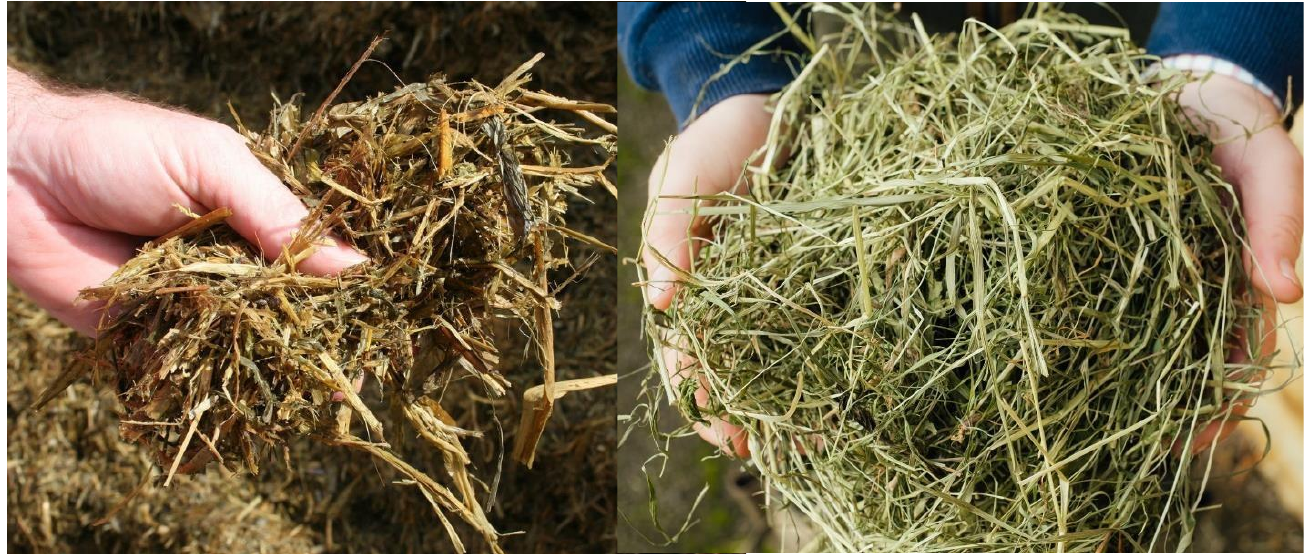
The image above shows the contrast between these two conservation methods - the dark, decomposed material on the left represents silage, whilst the lighter, fibrous material on the right shows hay.
Conservation as silage (ensiling)
Ensiling is the process of preserving grass through fermentation in the absence of oxygen. This method is widely used because it's relatively inexpensive and produces high-quality feed when done correctly. Most farmers in Ireland use silage as their primary conservation method.
Timing and cutting factors for silage production
Several critical factors determine when grass should be cut for silage production:
Weather conditions: Good, dry weather is essential - avoid cutting when it's windy or wet, as this can affect the fermentation process.
Grass maturity: Early cutting (May) produces different results than late cutting (June). The timing affects the peak productivity and digestibility of the grass.
Peak digestibility: Aim to cut when the grass reaches peak DMD (Digestible Dry Matter), which is typically around 75% at the heading stage, then declines afterwards.
Carbohydrate levels: High carbohydrate content is crucial for successful fermentation, so timing the cut to maximise these levels is important.
Important
Critical Timing Rule: Cut grass when DMD is at its peak (typically 75%) and carbohydrate levels are maximum. Missing this window significantly reduces silage quality and nutritional value.
Maximising carbohydrate content
Since carbohydrates are essential for the fermentation process that preserves the grass, farmers must take specific steps to ensure maximum carbohydrate levels:
- Cut at peak vegetative growth - This occurs when photosynthesis is at its highest, producing maximum carbohydrates
- Avoid cutting soon after rain - Water dilutes the carbohydrate concentration in the grass
- Allow wilting after cutting - This reduces water content and concentrates the carbohydrates
- Cut in the afternoon - This gives time for photosynthesis to occur throughout the day
- Consider additives - Substances like molasses can be added to boost fermentation
Additives for silage production
Various chemicals can be added to silage before storage to improve quality:
- Acids: Help preservation by lowering pH and preventing unwanted bacterial activity
- Sugars: Increase carbohydrate concentration for fermentation (such as molasses)
- Enzymes: Break down grass fibres to release more carbohydrates for the fermentation process
- Bacterial inoculants: Add beneficial bacteria to speed up fermentation
Biochemistry of silage production
The preservation of silage depends on acid production during carbohydrate fermentation. Bacteria consume the carbohydrates through respiration and produce acid as a by-product. The low pH of this acid prevents the grass from rotting and decaying.
Note
The fermentation process is essentially controlled decomposition - the right bacteria convert carbohydrates into preservative acids, while the wrong bacteria cause spoilage.
The process requires anaerobic conditions (no oxygen present). All oxygen must be removed from the grass before fermentation can begin properly. This is why careful rolling and sealing in plastic is essential - if oxygen enters, the silage will rot rather than preserve, making the entire batch useless.
Silage quality assessment
The quality of silage can be determined by examining several key factors:
High-quality silage characteristics:
- High sugar (carbohydrate) content
- Dominated by Lactobacillus bacteria
- Produces lactic acid
- Results in palatable and digestible feed
Low-quality silage characteristics:
- Low sugar content
- Dominated by Clostridium bacteria
- Produces butyric acid
- Results in unpalatable feed with low nutritional value, unpleasant smell, and rapid spoilage
Quality can be tested by:
- Calculating sugar content to assess carbohydrate levels
- Testing pH to check acid production
- Examining smell and colour to identify bacterial types
- Looking for signs of Clostridium (overly wet or slimy silage indicates poor fermentation)
Important
Quality Indicator Memory Aid: Lactobacillus = Lactic = Lovely silage produces sweet-smelling, high-quality feed, while Clostridium bacteria create foul-smelling, poor-quality silage that animals will refuse to eat.
Production methods: pit silage vs bale silage
There are two main approaches to storing silage, each with distinct advantages and disadvantages.
Example
Comparison: Pit Silage vs Bale Silage
Pit Silage Method:
- Grass collected with forage harvester
- Stored in concrete pit
- Rolled to remove oxygen
- Covered with plastic sheeting and tyres
Bale Silage Method:
- Grass cut and wilted in field
- Formed into round bales
- Individual bales wrapped in plastic
- Fermentation occurs within each bale
Pit silage:
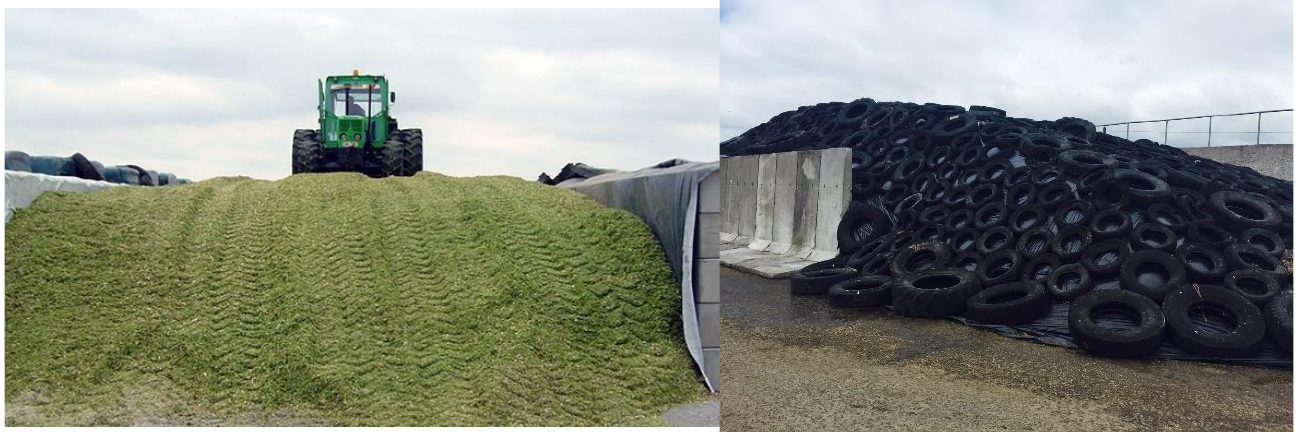
This method involves collecting cut grass with a forage harvester and storing it in a specially constructed concrete pit. The grass is piled up and machinery rolls over it to remove oxygen. Heavy-duty plastic sheeting seals the surface, often held down with old tyres.
Advantages of pit silage:
- Uses less plastic overall
- Can store large amounts in one location
- More economical for large-scale operations
Disadvantages of pit silage:
- If covering fails, the entire pile can spoil
- Once opened, must be used quickly as it cannot be re-covered
- Not suitable for small farms requiring small amounts of silage
Bale silage:
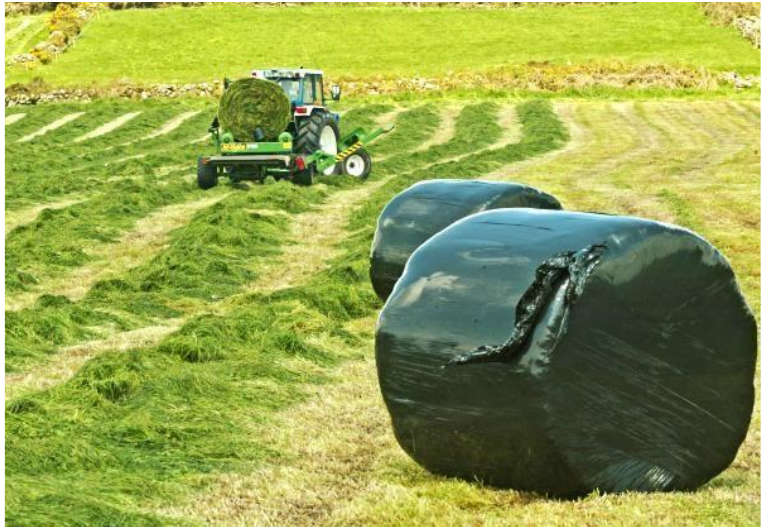
With this method, grass is cut and left to wilt in the field, then gathered by a baler and formed into round bales. These bales are immediately wrapped in multiple layers of plastic to exclude oxygen and allow fermentation.
Advantages of bale silage:
- Excess bales can be sold for additional income
- Lower spoilage compared to pit silage - bales can be opened as needed
- Lower dry matter losses during storage than pit silage
- Less expensive than constructing a silage pit
- Reduces effluent production when wrapped correctly
Disadvantages of bale silage:
- Higher cost per unit of silage (though pit construction costs are avoided)
- Individual wrapping produces more plastic waste
- More labour-intensive for feeding operations
Environmental impacts of silage production
Silage production creates more environmental concerns than hay production, particularly regarding waste products.
Important
Environmental Warning: Silage effluent is highly polluting and can cause serious environmental damage if it reaches watercourses. Proper containment and management are legally required.
Effluent management:
The liquid waste produced during early stages of ensiling is called effluent. This liquid contains high nutrient levels and nitric acid, giving it a high BOD (Biological Oxygen Demand) level. If this effluent reaches watercourses, it causes serious pollution.
Prevention measures include:
- Building silage pits with secure, leak-proof effluent storage
- Recognising that round bales pose less effluent leakage risk than pits
- Using effluent as a nutrient-rich fertiliser rather than allowing it to become waste
Plastic waste:
Silage production generates significant plastic waste. Efforts should focus on recycling silage wrapping where possible, selecting more easily recycled wrap materials, and developing biodegradable silage wrapping alternatives.
Conservation as hay
Hay production involves much less complexity than silage production, but requires specific weather conditions for success.
Note
In Ireland, only about 20% of grass is conserved as hay, with the remainder conserved as silage. This is primarily due to Ireland's unpredictable weather patterns that make hay production challenging.
In Ireland, only about 20% of grass is conserved as hay, with the remainder conserved as silage. Hay production relies heavily on good weather conditions to dry the grass properly.
Timing and cutting for hay
- Optimal cutting time: When DMD is highest (May or June)
- Weather requirements: Extended period of good weather needed, as grass must dry to only 20% moisture content
- Pre-cutting management: Grass should not be grazed for 6 weeks prior to hay cutting
How hay is preserved
Hay preservation works through dehydration. The grass is dried until it cannot rot or decay. If hay becomes wet after drying, it will develop mould and spoil quickly.
One significant advantage of hay conservation is that it produces no effluent and requires no plastic materials.
Haylage as an intermediate option
Haylage falls between hay and silage in terms of moisture content. It contains less moisture than silage but more than hay. The grass is left to dry for several days but collected when moisture is still around 60%.
Like silage production, haylage relies on fermentation and acid production for preservation. Lactic acid from Lactobacillus bacteria preserves the grass. The bales are wrapped in plastic to maintain the anaerobic conditions needed for fermentation.
Machinery used in grass conservation
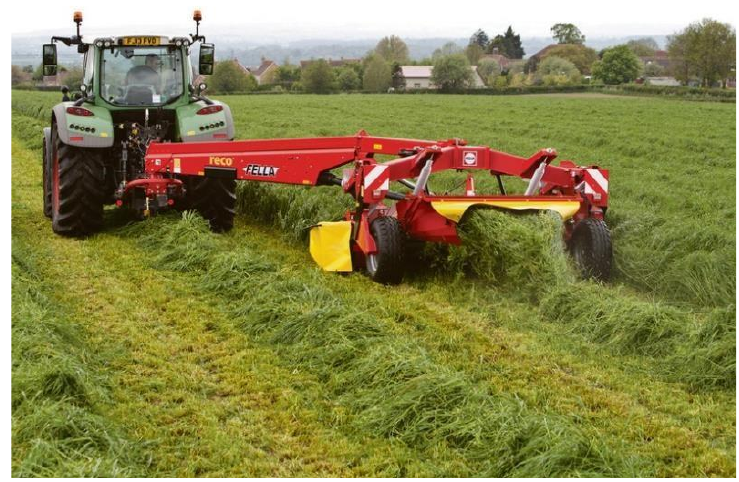
Students should be able to identify and name the key machines used in grass conservation from images. Here are the essential machines and their functions:
Mower conditioner:
- Cuts the grass for both hay and silage production
- Pushes grass through rollers to create larger surface area for faster drying
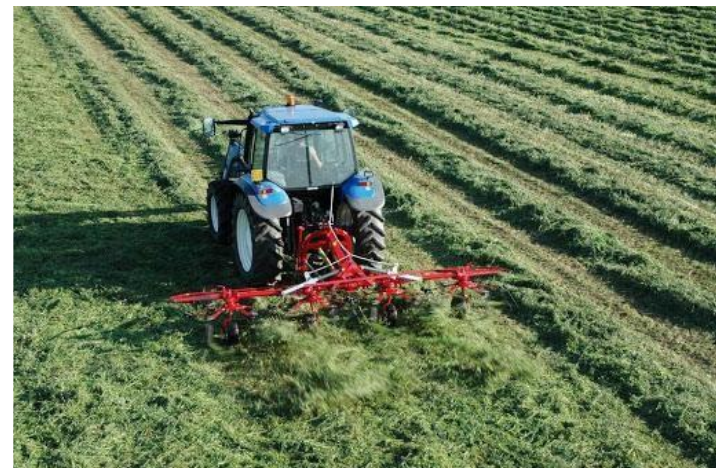
Rotary tedder:
- Shakes up swathes of grass to allow air circulation and faster drying
- Used only in hay production
- Can be used with rotary rake to re-make swathes when needed
Note
Identification Tip: The rotary tedder has distinctive spinning wheels with curved tines that lift and shake the grass to promote drying - it's only used in hay production, never for silage.
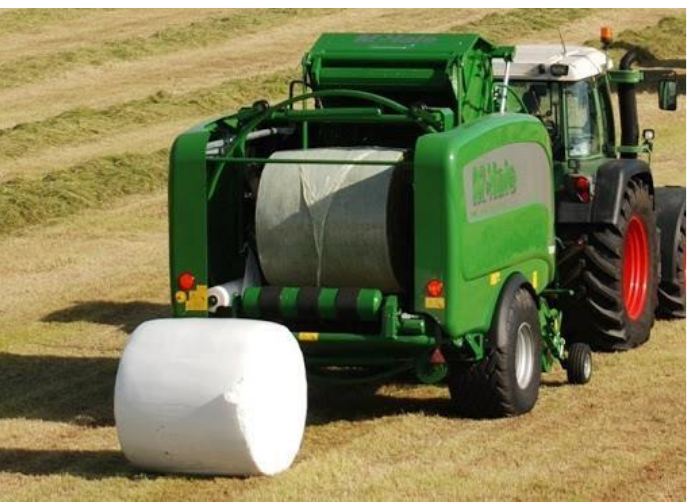
The baler:
- Creates square bales for hay or round bales for silage
- Wraps silage bales in plastic
- Leaves bales in field for collection and storage
Forage harvester:
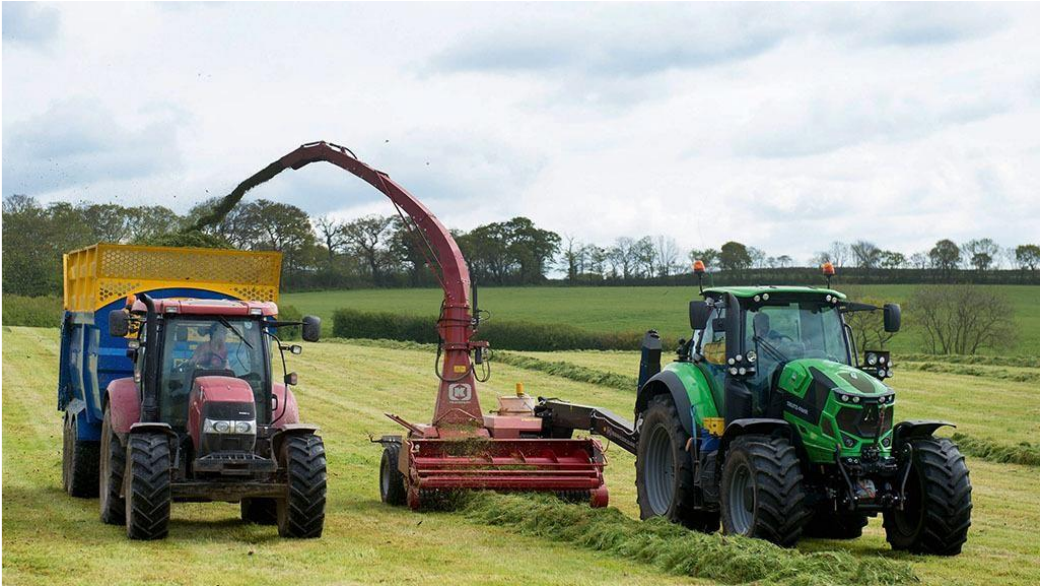
- Collects swathes without baling them and loads grass into trailers
- Used specifically for producing pit silage
- Works in coordination with tractors and trailers for efficient collection
Storage of conserved grass
Proper storage is crucial for maintaining quality and ensuring safety around conserved grass.
Silage pit safety:
The silage pit presents several hazards including steep sloping surfaces and vertical concrete walls. Safety risks include machinery overturning and suffocation from fermentation gases under plastic covers.
Important
Critical Safety Warning: Never work under silage covers once in place - fermentation produces dangerous gases that can cause suffocation. Mark pit edges clearly and ensure slopes are no steeper than 45 degrees.
Safety precautions:
- Never overfill the pit to reduce overturning risk
- Slope sides and ends at safe angles (45 degrees or less)
- Mark edges and sides clearly
- Never go underneath silage covers once in place
Bale stacking guidelines:
Round bales:
- Ideally store on flat ends, one bale high
- If stacking is necessary, use curved sides in pyramid formation
- Maximum height of 3 bales (or 2 if bales are very dense)
- Use chocks or supports on bottom row to prevent rolling
Square bales:
- Stack using interlocking pattern to tie bales together
- Height should not exceed 1.5 times the width of the base
- Take appropriate precautions when working at height
Surface preparation for all bale storage should be level, smooth, and well-draining. Position stacks away from overhead power lines.
Health and safety considerations
Working on silage pits
Hazards: Steep sloping surfaces, vertical concrete walls, and suffocation risk from fermentation gases under covers.
Safety measures:
- Avoid overfilling pits
- Ensure slopes are 45 degrees or less
- Mark pit edges clearly
- Never work under silage covers
Harvesting safety
Important
Peak Accident Period: Harvest time sees the highest number of farm accidents due to time pressures, long working hours, and increased machinery use. Extra caution is essential during this period.
Harvest time sees peak farm accidents due to time pressures and long working hours. Tractors, harvesters, and farm vehicles pose significant risks, as do accidents during bale storage, handling, and transport.
Precautions:
- Take adequate breaks for food and rest
- Follow safety guidelines for machinery operation carefully
- Ensure vehicles are legal and roadworthy when using public roads
- Use proper bale handling equipment operated by competent persons
Working with bales
Hazards: Being crushed by falling bales, falling from height, being rolled over by bales on slopes, and being crushed by bale handling equipment.
Safety precautions:
- Never climb or play on bale stacks
- Build stacks to prevent collapse
- Use level, smooth, hard, and well-drained surfaces
- Remove bales from top down, never from middle or bottom layers
- Stack round bales on rounded sides with maximum 3 bale height
- Monitor remaining bales for settlement after removal
Summary
Key Points to Remember:
-
Grass conservation means storing grass for future use - either as silage (through fermentation) or hay (through dehydration)
-
Successful silage requires high carbohydrates, good bacteria (Lactobacillus), and no oxygen - this produces lactic acid which preserves the grass
-
Timing is crucial - cut when DMD is highest and carbohydrate levels are maximum, typically in good weather conditions
-
Bale silage is popular on smaller farms whilst pit silage suits larger operations, each with distinct advantages and environmental considerations
-
Safety is paramount - working around silage pits, during harvest, and with bale stacks requires strict adherence to safety protocols to prevent serious accidents