Management (Leaving Cert Agricultural Science): Revision Notes
📚Revision Notes
Management
Introduction and uses of grass
Grassland serves two essential purposes in Irish agriculture. First, it provides direct grazing and immediate nutrition for livestock during the summer months. Second, it can be harvested and stored to supply winter fodder throughout the winter period when grass growth is minimal.
Understanding grass management is crucial because all livestock enterprises that raise cattle or sheep depend entirely on grass for productivity. Like any crop such as barley or potatoes, grass requires careful attention and management to achieve maximum production potential.
Note
Farmers who provide both summer grazing and winter fodder must carefully plan their pasture management to balance these dual requirements. Through regular assessment of grass growth, farmers can budget their grass resources by calculating how much their livestock will need and comparing this to expected pasture output.
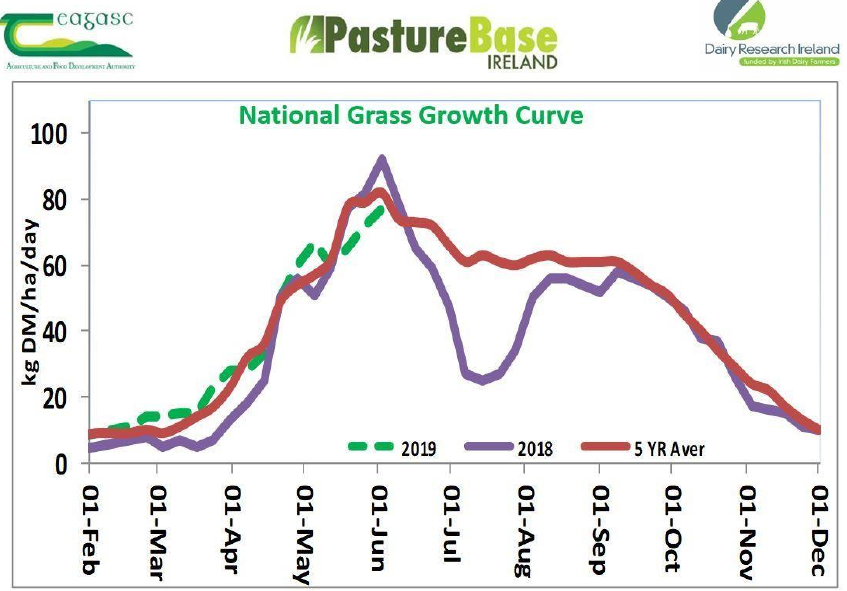
The National Grass Growth Curve shows how grass production varies dramatically throughout the year in Ireland. Peak growth occurs in late spring and early summer, with significantly reduced growth during winter months. Weather patterns like the 2018 drought can severely impact grass production, creating challenges for farmers in providing adequate feed.
Livestock units
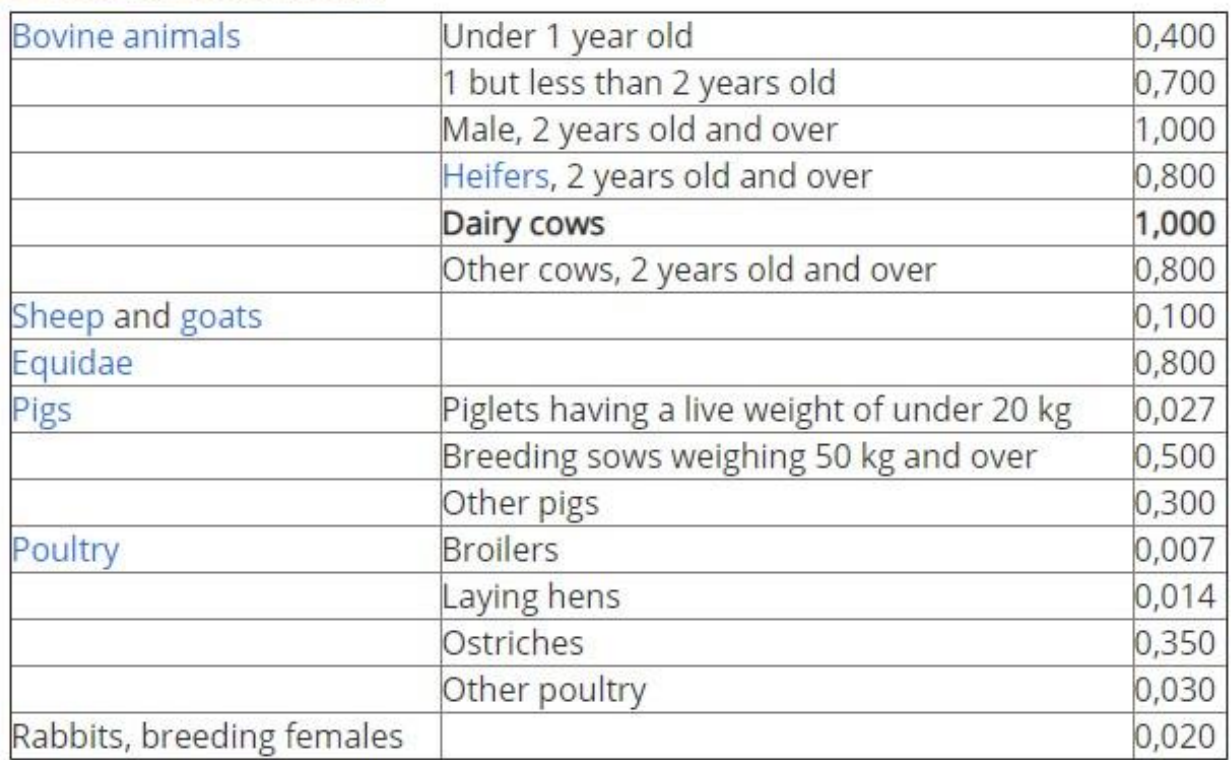
To properly budget grass resources, farmers need to understand two key elements: expected pasture production and livestock consumption requirements. The amount each animal consumes varies greatly depending on the animal type, gender, and age. To simplify calculations, we use Livestock Units (LU) - a standardised system where each animal receives a unit value based on its characteristics.
Livestock units allow farmers to measure the total grazing pressure in a pasture and calculate both the annual green herbage (grass) needed for the herd and the winter fodder requirements.
Important
Key livestock unit values to remember:
- One LU requires 12 tonnes of herbage per year (one tonne per month)
- One dairy/suckler cow = 1.0 LU
- Cattle 1-2 years = 0.6 LU
- Cattle under 1 year = 0.4 LU
- Sheep = 0.15 LU
Example
Worked Example: Livestock Unit Calculation
For a farm with:
- 75 dairy cows
- 22 sheep
- 12 cattle under 1 year
Step 1: Calculate total LU Total LU = (75 × 1.0) + (22 × 0.15) + (12 × 0.4) = 83.1 LU
Step 2: Calculate annual herbage requirement Annual herbage requirement = 83.1 LU × 12 = 997.2 tonnes per year
Grazing systems
The grazing system determines how farmers move livestock to maximise grass utilisation while allowing grazed areas to recover. Most systems are rotational, based on moving animals between different areas so livestock get access to fresh grazing while pastures rest and recover between grazing periods.
Important
After grazing, grass typically needs three weeks to regrow sufficiently for re-grazing. All systems must ensure no pasture gets grazed again within this recovery timeframe.
Note
Important considerations:
- Water access is critical when dividing land for grazing, regardless of the system used
- Rotational grazing helps break the lifecycle of endoparasites in livestock
Rotational grazing
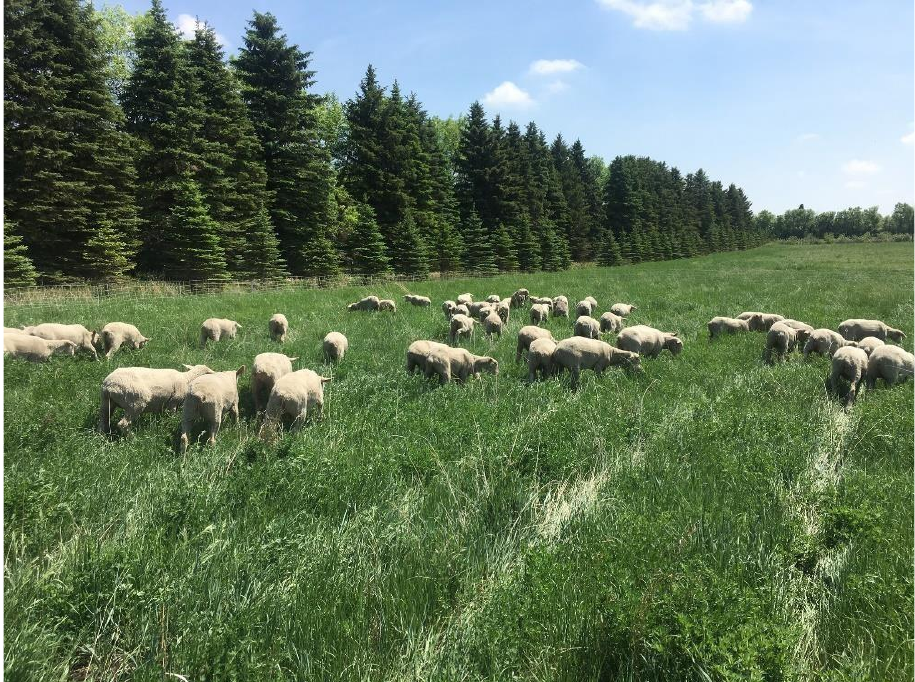
In rotational systems, animals move around throughout the grazing season. After each area is grazed, it's allowed to recover before being grazed again in the next rotation. The rotation might involve entire fields or divided sections within larger fields.
Block grazing
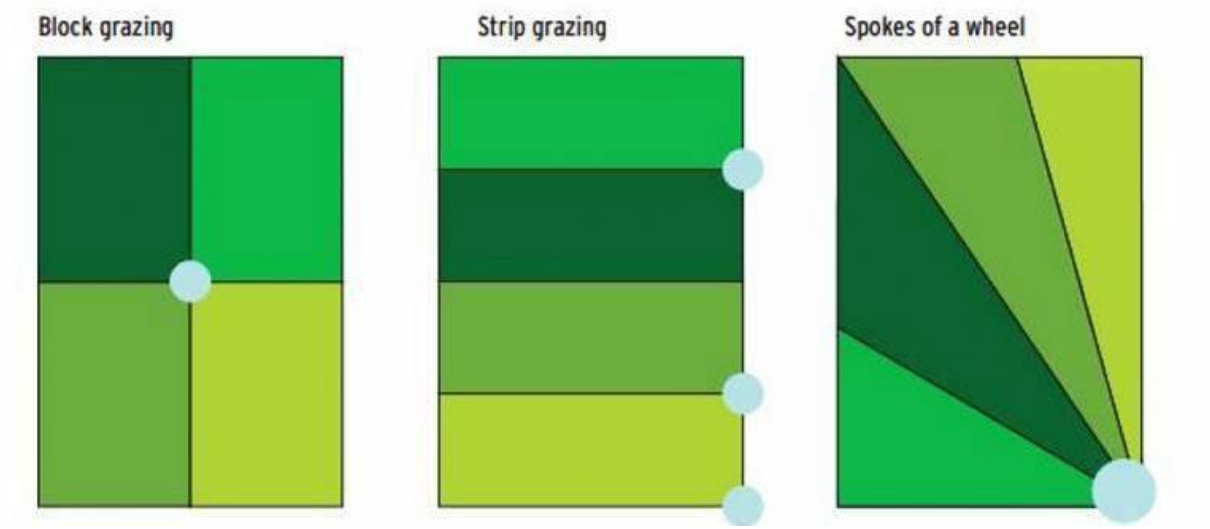
Block grazing divides large fields into smaller, independently grazed blocks. It's similar to strip and paddock grazing, but animals remain on each block for longer periods (one week or more), whereas strip and paddock systems involve daily animal movement.
Advantages of block grazing:
- More economical due to reduced fencing and labour costs
- Less labour intensive than strip or paddock grazing
- Suitable for part-time farmers or when daily labour is limited
Disadvantages of block grazing:
- Less efficient than paddock or strip grazing
- Results in more wastage of quality grass
Strip grazing
Strip grazing divides fields into long, narrow strips, with each strip containing approximately 24 hours worth of grass. Electric fences define each strip and move daily to provide fresh grazing areas.
The system requires both back fencing to prevent animals returning to previously grazed strips, and front fencing to control access to fresh grass. Water sources must be mobile (moved daily) or accessible via a permanent pathway back to troughs.
Advantages of strip grazing:
- Fresh grass always available with no wastage
- Animals cannot return to previously grazed pasture, allowing proper recovery
Disadvantages of strip grazing:
- Requires significant daily management and attention from farmers
- Moving fences and water sources daily is extremely labour intensive
- Fixed water sources can be problematic
Paddock grazing

Paddock grazing divides available space into equal-sized paddocks, each containing one day's worth of grazing. The system requires at least 21 paddocks to allow grass 21 days recovery time before re-grazing.
Note
When drawing diagrams, remember that while you might only show 6-8 paddocks, the system actually requires 21 paddocks total. Fencing can be electric or fixed, though fixed fencing is extremely expensive. Multiple paddocks can share water sources.
Advantages of paddock grazing:
- Fresh grass always available with no wastage
- Potential for silage production from excess grass
- Paddocks can recover properly between rotations
Disadvantages of paddock grazing:
- Requires extensive fencing, multiple water sources, and access to each paddock - expensive to establish
- Demands significant management and attention
- Very small paddocks are difficult to cut for silage
Set stocking
Set stocking involves no pasture division - farmers know the field size and release animals at a set rate per unit area. This system works best on very large areas, rough grazing, or areas with difficult daily access.
Advantages of set stocking:
- Inexpensive - no mobile fencing or water sources required
- Low labour and maintenance requirements
- Minimises poaching and density issues as stock spreads out
Disadvantages of set stocking:
- Not very effective for grass utilisation - animals may be selective in grazing
- Quality grass may get trampled and damaged
- Ungrazed grass becomes stemmy and unpalatable
- Constant exposure to pests and diseases
Zero grazing
Zero grazing means exactly what it sounds like - animals never enter pastures. Instead, grass is cut by machine and brought to livestock housing, where animals consume fresh grass but remain housed year-round.
Zero grazing is also called ex-situ grazing and works well when animals are permanently housed. Catch crops can supplement zero grazing systems.
Advantages of zero grazing:
- No poaching or land compaction
- Energy not wasted on animal movement, resulting in higher live weight gain and milk yields
- Distance from farmyard not an issue
- No water sources or fencing needed in fields
Disadvantages of zero grazing:
- Extremely labour intensive for farmers
- Costly in terms of labour and diesel expenses
Complementary grazing systems
These animal management systems work alongside rotational systems rather than replacing them. For instance, creep grazing might be used within a paddock rotational system.
Important
These systems work in combination with other grazing systems, not instead of them.
Creep grazing
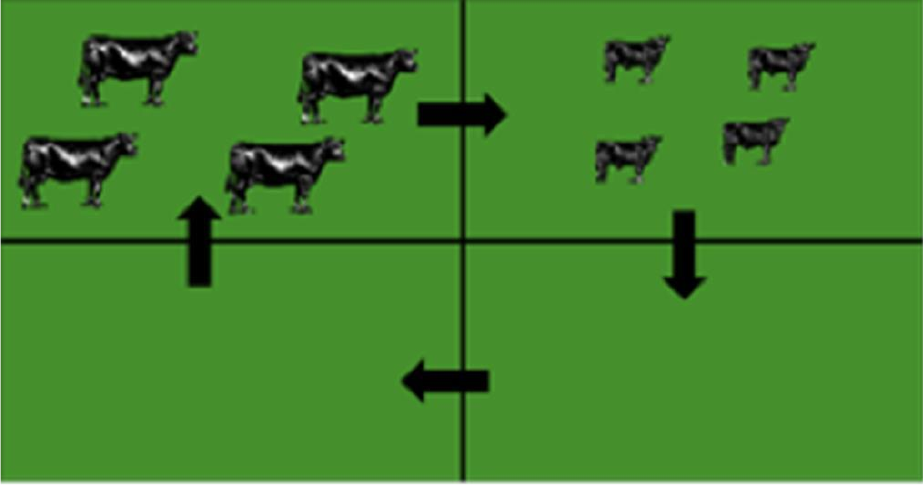
Creep grazing allows young animals (ewes and lambs, or suckler calves and dams) to graze together. The paddock is subdivided so young animals access fresh grass areas that adults cannot reach. This is typically achieved by installing gates too small for adults to pass through, while young animals move freely between adult and creep areas.
Advantages of creep grazing:
- Young animals can suckle for extended periods
- Young animals access fresh grass for improved weight gain
- Farmers can provide additional concentrate rations in creep areas that adults cannot access
- Reduces disease and parasite buildup in young animals
Disadvantages of creep grazing:
- Similar to block grazing, mobile fencing and water source costs can be high
- Can be labour intensive if combined with strip grazing requiring daily fence movement
Leader follower grazing
Leader-follower grazing extends rotational systems and works with any rotational approach. Unlike creep grazing, young and older animals occupy separate paddocks throughout the rotation. Young animals graze each pasture first, then older animals follow to the pasture just vacated by the younger group.
Advantages of leader-follower grazing:
- Freshest grass goes to youngest animals to support growth
- Farmers avoid disease and parasites in young animals since they graze ungrazed pasture without parasite eggs
- Following with older animals maximises grass usage, as they consume grass left by young animals
Disadvantages of leader-follower grazing:
- Same disadvantages as other rotational systems
- Costly with extensive mobile fencing and water sources
- Labour intensive if animals and fencing move daily
Mixed grazing
Mixed grazing combines cattle and sheep grazing the same pasture simultaneously. Note that sheep and goats cannot graze together as they share similar endoparasites. This system exploits the differences between sheep and cattle grazing patterns and parasite types.
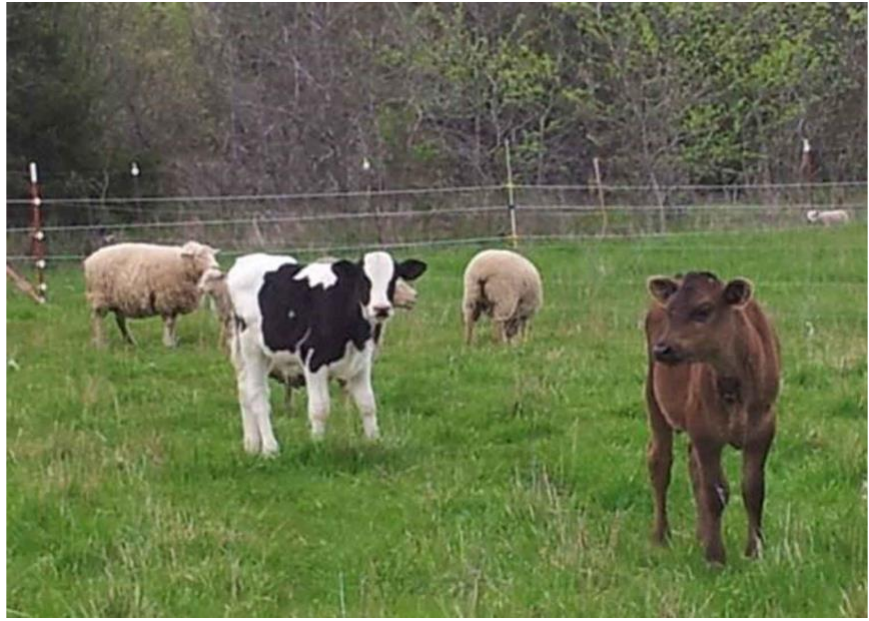
Advantages of mixed grazing:
- No grass wastage since sheep are less selective than cattle, increasing pasture productivity and meat output
- Mixed grazing reduces internal parasite numbers in each species due to lower host animal density and different parasite types between cattle and sheep
- Production of each animal type increases by 10-15%
- Closer cropping by sheep increases tillering for improved next rotation production
Disadvantages of mixed grazing:
- Lower density of each animal type means fewer cattle per hectare than cattle-only grazing
- Same disadvantages as the underlying rotational system regarding cost and labour
Extended grazing
Extended grazing keeps animals grazing outdoors longer into the period when they would normally enter winter housing (December to March). This can significantly reduce the enterprise's carbon footprint.
Note
Grazing land must be closed from July to allow sufficient grass buildup, as grass grazed in late August onwards will not regrow fully.
Advantages of extended grazing:
- Reduces winter housing and feeding requirements, greatly increasing profit margins since winter housing and feeding is expensive
- Reduces silage and concentrate needs, meaning more grass available for grazing and less reliance on market prices for concentrate feeds
- Makes enterprises more sustainable and reduces carbon footprint
Disadvantages of extended grazing:
- Autumn and winter grass quality is poorer, potentially affecting livestock live weight gain
- Weather conditions can make land unusable due to flooding or poaching
- Winter grazing means closing pastures early, reducing available pasture for normal late-year grazing
- Can decrease ryegrass proportion in pastures, with more annual meadow grass and other lower-nutrient grasses
Fertilising grassland
Grass grown for livestock requires careful maintenance and management like any crop. This sometimes means fertilising grassland similar to tillage fields to maintain maximum output. Grass needs relatively high nitrogen levels, especially under intensive grazing.
Important
Nitrogen must be applied following nitrates directives. For grazed land, farmers must account for manure deposited during grazing as part of their nitrogen budget before applying supplemental nitrogen.
Nitrogen application
One dairy cow (one livestock unit) produces 85kg nitrogen per year. Using LU calculations similarly to herbage needs, a herd with 10.2 LU total would produce 867kg nitrogen annually spread across multiple land hectares.
The grazing sward composition should be considered when calculating nitrogen needs - clover presence reduces nitrogen requirements.
Fertiliser application always follows soil testing and responds to soil index results. When soil index is sufficiently high, no additional fertiliser is needed.
Note
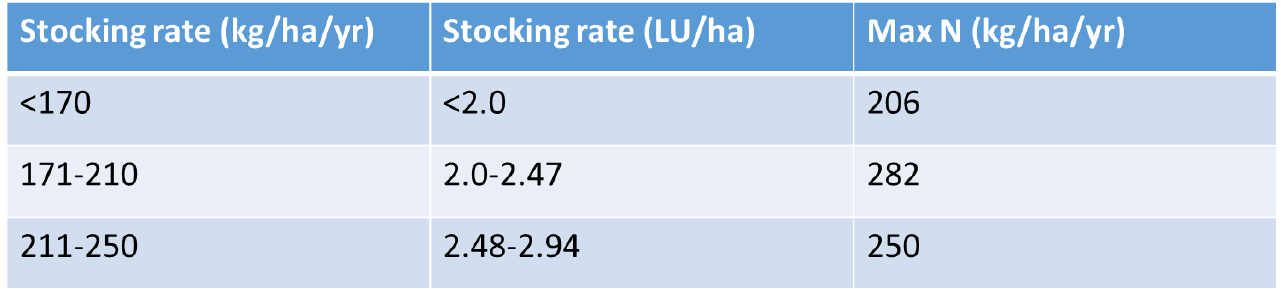
The table shows maximum nitrogen amounts contributed by livestock at different stocking rates. Generally, maximum rates are 170kg per hectare annually (equivalent to 2 LU per hectare), though most farms operate at lower stocking rates. Higher figures may apply to intensively stocked enterprises like dairy farms.
Maximum supplemental nitrogen equals the difference between livestock nitrogen and maximum allowable nitrogen. At 2LU/ha stocking rate, maximum additional nitrogen would be approximately 36kg.
Phosphorus application
Additional fertilisers are only applied after soil testing, and only when soil index shows soil deficiency in particular nutrients. This prevents fertiliser overuse.
Phosphorus application depends on soil index - at index 4, no additional phosphorus is needed. Like nitrogen, phosphorus requirements depend on stocking rate.
At the highest stocking rate (211-250 kg/ha/yr) with the lowest soil index (1), maximum phosphorus application would be 39kg/ha.
For grass cut for silage with no grazing, at the poorest index (1), maximum phosphorus is 40kg/ha before first cut and 10kg/ha before second cut.
Indirect impacts of grassland management
The primary goal of grassland management is optimising grass production amount and quality. Grass is needed for year-round livestock feeding, either as grazed grass or winter fodder.
Each management action in different grazing systems aims to maximise grass production amount, grass quality, and efficiency of grass utilisation by livestock. However, grassland management can have additional effects on animals and environmental outcomes.
Note
Students should understand how grassland management indirectly affects livestock and farm wildlife beyond the primary production goals.
Impacts on livestock
Grassland management serves as a tool to reduce disease and decrease endoparasites:
- Parasites such as nematodes and liver fluke don't reach high levels when stock avoid grazing the same land area permanently
- Rotational grazing breaks endoparasite life cycles when sufficient time exists between rotations
- Disease is minimised when animals don't graze around their own dung
- Mixed grazing results in higher growth rates for both sheep and cattle when grazed together
- Mixed grazing helps decrease parasite loads in cattle since sheep don't share identical parasites
- Creep grazing (dedicated areas for lambs or calves) allows calves continued access to mothers for suckling while providing access to fresh grass
Impacts on wildlife
Pesticide and herbicide use:
- How farmers apply agrochemicals significantly affects wildlife, particularly pollinators
- Generally not a major problem with grazing grassland management, as using these chemicals would harm livestock
Fertiliser use:
- Excessive nitrogen fertiliser application reduces soil invertebrate diversity - there may be higher invertebrate abundance in over-fertilised soil, but limited to one or two species
- Run-off from poorly applied fertiliser can enter waterways causing eutrophication
- Diversifying grazing swards (adding clover) to minimise additional nitrogen requirements directly benefits pollinators and other insects
Ploughing and reseeding grassland:
- Decreases biodiversity when old permanent pasture is replaced with new leys
- Less impact when pastures are reseeded with diverse grass and clover mixtures
- Ploughing negatively impacts soil structure and soil invertebrates
Intensive grazing effects:
- High stocking rates can result in high nitrogen amounts on pastures
- High stocking rates often cause soil compaction
- Both factors are detrimental to biodiversity
Sward height effects:
- Semi-natural and rough grazing support the highest bird and butterfly diversity
- Closely cropped grass dramatically decreases invertebrate numbers, creating knock-on effects up the food chain
- Spiders are usually extremely abundant in grassland but require taller stem length
- Farmers are encouraged to plant diverse meadow plants to increase sward height and biodiversity
Health and safety
Agricultural Science focuses significantly on working safely, requiring health and safety considerations in every enterprise. Most points apply to both grassland management and general livestock enterprises.
Important
Safety assessment always considers the Hazard (what can harm you), the Risk (what can happen to you), and the Precautions (what you can do to stay safe).
Working with livestock
Livestock hazards are relevant to grassland management since farmers must handle livestock to move them between pastures.
Hazard: The livestock (cattle or sheep) that farmers move between paddocks in grazing systems
Risk: Being kicked, trampled, crushed, bitten, and injuries from horns
Important
Safety precautions:
- Always ensure escape route plans from fields or pens
- All handlers should be capable and experienced, understanding cattle behaviour:
- Cows in heat are unpredictable
- Mothers with young are protective
- Don't place bulls in fields with public access
- Don't isolate or corner animals away from the herd
- Prevent escapes from pastures:
- Inspect and maintain fencing
- Gate locks and latches should be operational and checked frequently
- External fencing should be stock-proof
- When moving livestock:
- Handlers should be experienced and capable
- Plan animal movement beforehand, ensuring paths and roads are clear and gateways are correctly positioned
- Stay calm and avoid panicking animals with loud noises or sudden movements
- Only one option for cattle movement to minimise confusion and stress
Working with fertilisers
Hazard: The fertiliser itself - fertilisers are harmful agrochemicals that tend to be strongly oxidising and can cause serious physical harm
Risk: Fertilisers can cause skin and eye irritation and burning, plus respiratory system inflammation. High nitrate fertilisers represent fire hazards when combined with other materials. Fertiliser decomposition can release dangerous chemicals such as ammonia.
Important
Safety precautions:
General chemical safety:
- Agrochemicals should always be fully labelled with chemical name, associated risks, and safety precautions
- Chemical storage should be correct and specific to each chemical
- Anyone handling chemicals should wear suitable PPE
- Use automated chemical sprayers when possible
- Ensure all sprayer parts are clean and well-maintained before use - all valves, lines, and connections should be secure
Specific fertiliser safety:
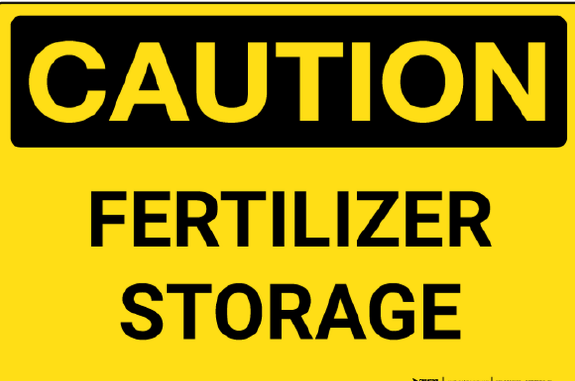
- Store fertiliser bags at least 10m from drains and waterways
- Don't mix fertiliser types in the same storage space
- Don't store fertilisers with combustible materials or near heat sources/ignition sources
Working with machinery
Hazard: Vehicles and machinery used to fertilise, plough, and reseed grassland
Risk: Being crushed or struck by machines, being pinned or thrown from tractors, falling from tractors or machines, entanglement in PTO, injury from moving parts/blades
Important
Safety precautions:
- Check all machinery is in good working order and roadworthy if travelling on public roads
- Ensure all operators and drivers are trained
- Park on flat, solid ground and lower machinery to ground when parked
- Exercise caution working around PTO shafts
Electric fencing
Electric fencing establishes rotational grazing systems and can be moved daily.
Risks:
- Danger of shocks to persons or machines - serious injury risk is highest with prolonged shocks or shocks applied to head or neck
- Danger of entanglement in fencing
Important
Precautions:
- NEVER use barbed wire for electric fencing
- Never work near live fencing in enclosed spaces
- Never crawl under live fencing
Summary
Key Points to Remember:
- One Livestock Unit requires 12 tonnes of herbage per year - this is the fundamental calculation for grass budgeting
- Rotational grazing systems allow grass recovery time while providing fresh grazing, with most systems requiring 3+ weeks between grazings
- Complementary systems work alongside rotational systems to optimise production for different animal groups or extend grazing seasons
- Fertiliser application must follow soil testing and consider existing manure from livestock to avoid over-application
- Proper grassland management reduces parasite burdens in livestock while supporting farm biodiversity when done sustainably